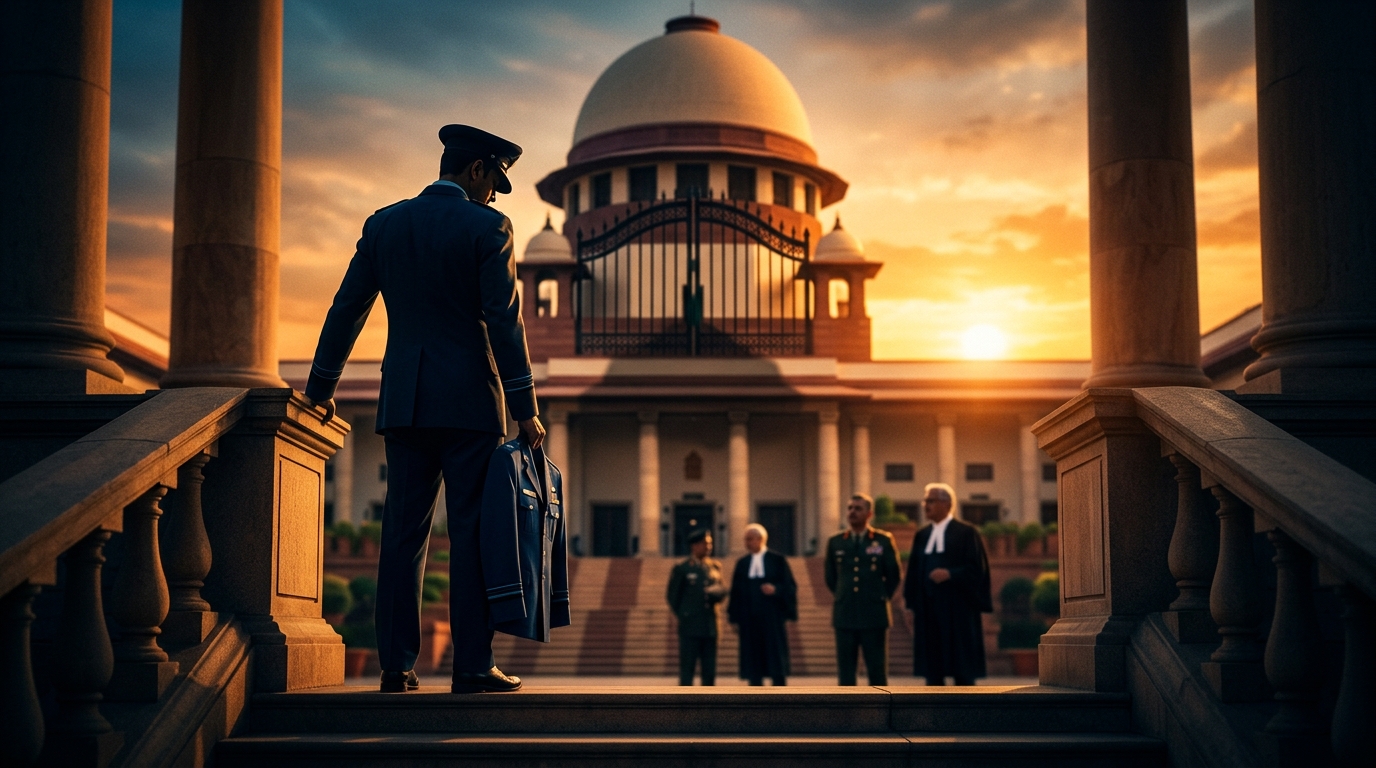
Supreme Court Judgment on Disciplinary Proceedings
The Supreme Court on 15 April 2026 ruled that once the defence forces opt for a criminal trial under the Air Force Act, an acquittal or discharge in that criminal proceeding bars any subsequent disciplinary action.
Key Developments
- The bench of Justice Dipankar Datta and Justice K.V. Viswanathan set aside the Delhi High Court’s dismissal and ordered service benefits for the ex‑officer.
- The Court held that a discharge by a criminal court ends the matter and precludes any administrative or disciplinary action.
- It clarified that the defence force cannot revert to a court‑martial once the criminal route is chosen.
- The punishment order of dismissal was deemed arbitrary and disproportionate, especially as the officer was compelled to obey a superior’s instruction.
- Since the officer has passed the age of superannuation, reinstatement is impossible; however, the Court directed payment of service benefits and a formal farewell to restore his honour.
Important Facts
The incident dates back to 29 March 1987 in a remote Air Force unit in the Thar desert. The officer, then a Senior Operations Officer, moved an intoxicated driver, later found dead, following orders from a Wing Commander. The Air Force elected to try the case under Section 124 of the AF Act. The Sessions Court discharged all accused in January 1990, citing lack of prima facie evidence and absence of sanction under Section 197 of the Criminal Procedure Code. Despite the discharge, the Air Force initiated disciplinary proceedings and dismissed the officer in 1993.
Exam Relevance
This judgment illustrates the interplay between military law and constitutional principles, a frequent topic in GS2: Polity. It underscores the doctrine of *pari materia*—similar provisions across the Army and Air Force Acts are interpreted uniformly. Aspirants should note the significance of *Section 121* (time‑bar for court‑martial) and the protection afforded to defence personnel when a criminal court discharges them. The case also highlights the importance of procedural safeguards, the hierarchy of legal remedies, and the role of the Supreme Court in safeguarding service members’ rights.
Way Forward
Future cases will likely rely on this precedent to challenge disciplinary actions initiated after a criminal discharge. Legal practitioners and defence establishments must ensure that once a criminal jurisdiction is chosen, the decision is final, and any subsequent administrative action must respect the discharge. For UPSC candidates, the judgment serves as a reference point for questions on military justice, the separation of powers, and the protection of individual rights within the armed forces.