Overview
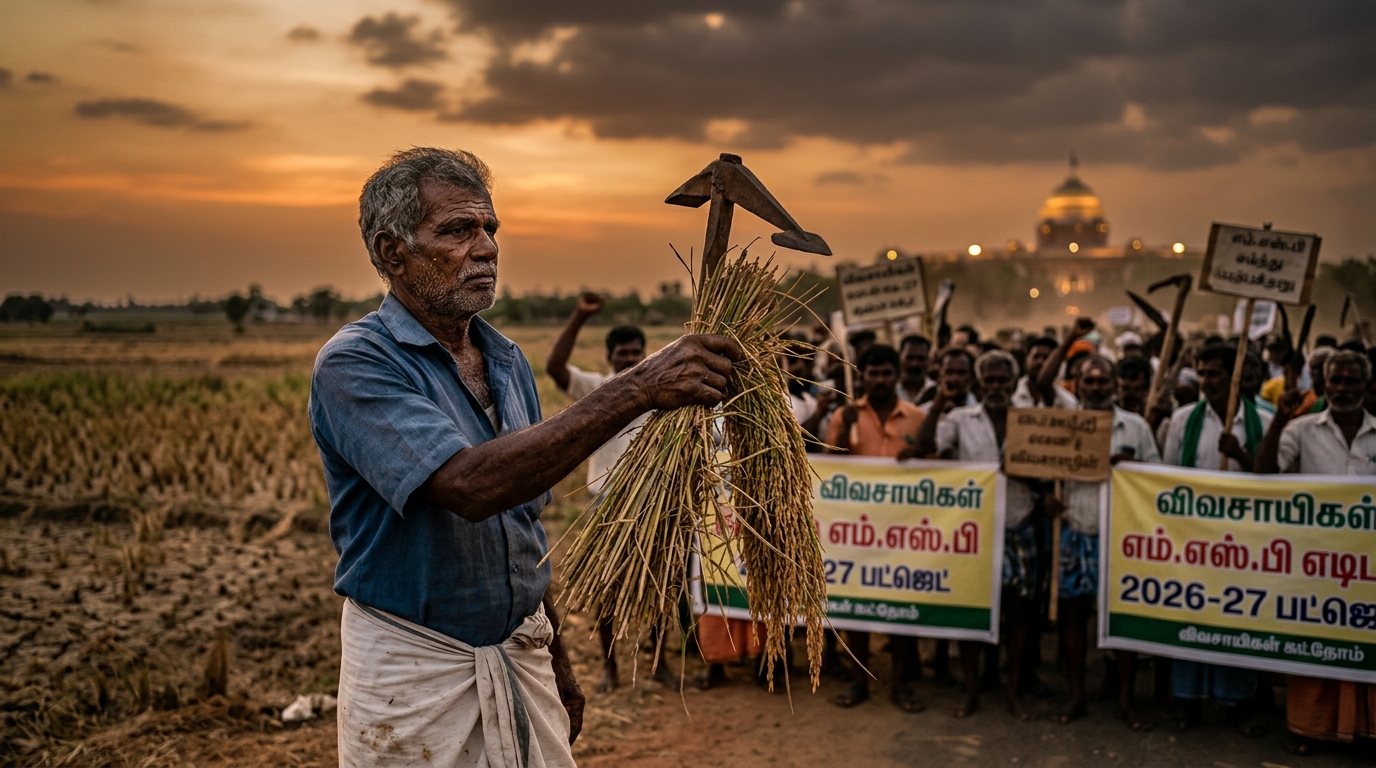
On 1 February 2026, several farmer organisations in Tamil Nadu protested that the Union Budget 2026‑27 failed to address the mounting agrarian distress, soaring input costs and climate‑related challenges. Prominent bodies such as the Tamil Nadu Farmers’ Association (CPI(M)), the All Farmers’ Associations Coordination Committee and the Indian Farmers’ Association highlighted the absence of new schemes, inadequate allocations and the lack of statutory safeguards for the farming sector.
Key Developments
- Development 1: The budget did not increase the ₹6,000 per‑acrean assistance under the PM‑Kisan Samman Nidhi scheme, despite repeated farmer demands.
- Development 2: No statutory provision for a Minimum Support Price (MSP) based on the C2+50% formula was announced, nor a permanent disaster relief fund for climate‑induced crop losses.
- Development 3: While the budget announced initiatives for sandalwood, coconut and cashew, it omitted financial support for staple crops like paddy, wheat and sugarcane, and ignored key infrastructure measures such as river interlinking, rainwater harvesting and groundwater recharge.
Important Facts
- Fact 1: The Union plans to borrow ₹11.70 lakh crore in FY 2026‑27, yet no allocation was earmarked for river interlinking or zero‑interest crop loans.
- Fact 2: Tamil Nadu’s farmer bodies noted that India now surpasses China in paddy production, yet the budget omitted a statutory MSP and a strengthened National Disaster Response Fund.
Exam Relevance
This episode touches upon multiple sections of the UPSC syllabus. In GS Paper II (Governance, Constitution, Polity, Social Justice), it relates to agricultural policy, welfare schemes and the role of central‑state coordination. GS Paper III (Economics) covers fiscal allocation, borrowing, and the impact of budgetary decisions on the agrarian economy. Environment‑related aspects such as climate‑resilient agriculture, water resources management and sustainable mining link to GS Paper II (Environment) and optional subjects like Geography and Public Administration. Potential questions may ask to evaluate the effectiveness of the Union Budget in addressing farmer distress, compare MSP mechanisms, or discuss the fiscal prudence of large‑scale borrowing without sector‑specific allocations.
Way Forward
For a resilient agricultural sector, future budgets must integrate a statutory MSP linked to the C2+50% formula, expand the National Disaster Response Fund, and allocate dedicated resources for river interlinking, groundwater recharge and climate‑smart farming. Strengthening input subsidies, ensuring zero‑interest crop loans and revisiting the PM‑Kisan assistance are essential to meet the “doubling farmers’ income” promise. Continuous dialogue with farmer organisations, especially ahead of state elections, can bridge policy gaps and foster inclusive growth.