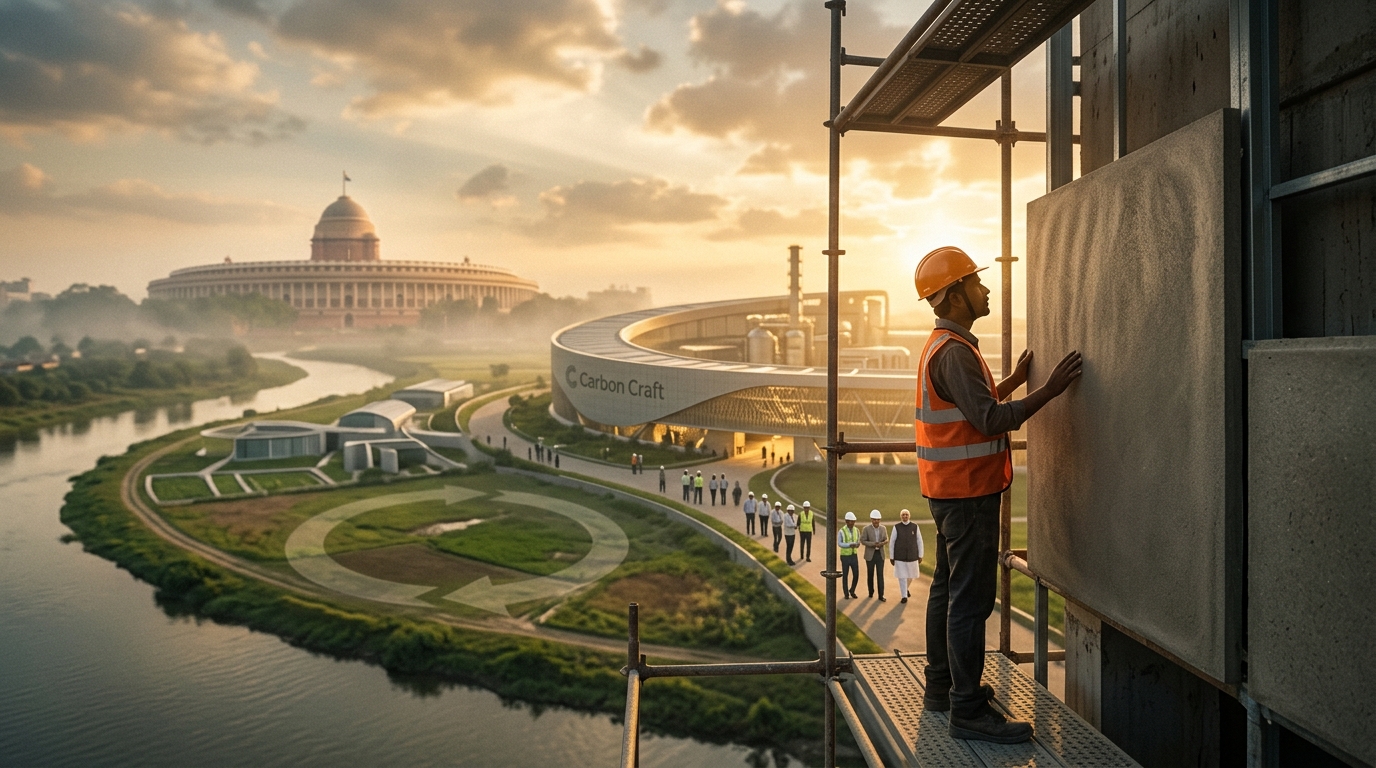
The Technology Development Board (TDB) of the Department of Science & Technology (DST) has signed an agreement with Carbon Craft Design Pvt. Ltd. to fund the commercialisation of eco‑friendly, ultra‑low‑carbon‑footprint wall claddings.
Key Developments
- Financial assistance approved for setting up a state‑of‑the‑art manufacturing unit for geopolymer‑based tiles using indigenous technology.
- Project titled “Commercialisation of the Eco‑friendly Ultra Low Carbon Footprint Wall Claddings”.
- Focus on waste‑valorisation by converting construction‑demolition waste, recycled quartz waste and multi‑grade quartz sand into high‑performance tiles without kiln firing.
- Support aligns with India’s climate‑change mitigation goals and the push for net‑zero ambitions.
Important Facts
Carbon Craft, a design‑and‑material‑innovation startup, employs a proprietary process that permanently sequesters industrial by‑products into value‑added construction materials such as tiles, aggregates and bricks. The proposed wall claddings are manufactured through specialised blending techniques that eliminate the energy‑intensive kiln process, thereby drastically cutting CO₂ emissions.
Secretary Shri Rajesh Kumar Pathak, TDB, highlighted that the transition to sustainable construction materials is critical for achieving India’s climate targets and for fostering a circular economy. The initiative also supports Aatmanirbhar Bharat by reducing reliance on imported architectural cladding.
Exam Relevance
Understanding this scheme helps aspirants grasp the interplay between technology policy, environmental sustainability and industrial strategy—core topics in GS Paper III (Science & Technology, Environment, Economy). The case illustrates how government bodies like TDB catalyse private‑sector innovation, a recurring theme in questions on public‑private partnerships and start‑up ecosystems.
Moreover, the emphasis on import substitution aligns with broader economic policies and can be linked to discussions on trade, manufacturing, and sustainable development.
Way Forward
- Scale‑up production capacity to meet domestic demand for green building materials.
- Encourage replication of the geopolymer technology across other states through additional TDB grants.
- Integrate such low‑carbon materials into government construction projects to set a precedent for sustainable public procurement.
- Monitor environmental impact metrics to quantify CO₂ reduction and waste diversion benefits.
Overall, the TDB‑DST support to Carbon Craft exemplifies India’s strategic push towards sustainable, self‑reliant industrial growth, offering a concrete example for UPSC aspirants on policy implementation in the green technology sector.