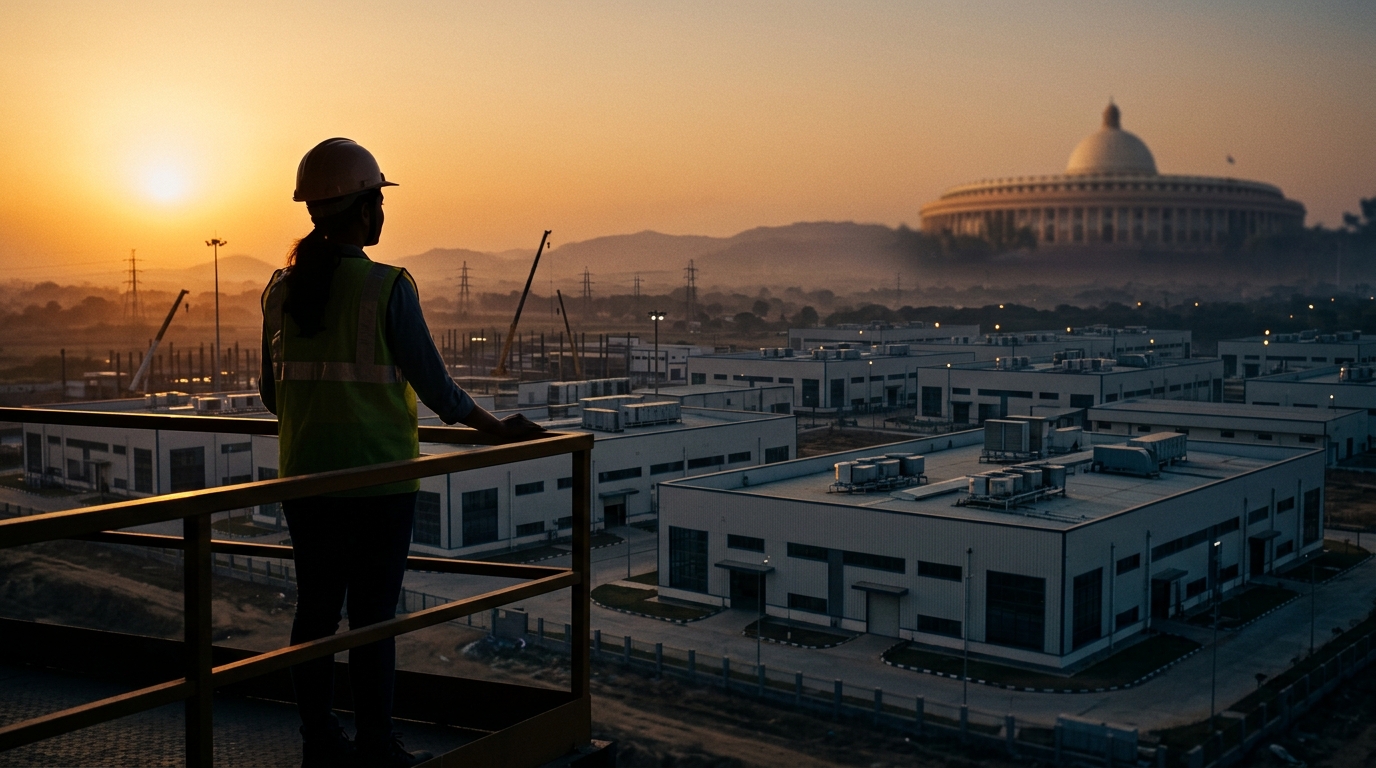
Union Cabinet Approves BHAVYA: Rs 33,660 crore for 100 Plug‑and‑Play Industrial Parks to Boost Atmanirbhar Bharat — UPSC Current Affairs | March 18, 2026
Union Cabinet Approves BHAVYA: Rs 33,660 crore for 100 Plug‑and‑Play Industrial Parks to Boost Atmanirbhar Bharat
The Union Cabinet, chaired by Prime Minister Narendra Modi, has approved the <span class="key-term" data-definition="Bharat Audyogik Vikas Yojna (BHAVYA) – a flagship industrial development scheme allocating Rs 33,660 crore for 100 plug‑and‑play industrial parks, aimed at accelerating manufacturing and Atmanirbhar Bharat (GS3: Economy)">BHAVYA</span> with a budget of Rs 33,660 crore to create world‑class industrial parks across India. The scheme, implemented by the <span class="key-term" data-definition="National Industrial Corridor Development Corporation Limited (NICDC) – a government‑owned entity under DPIIT that executes industrial corridor projects (GS3: Economy)">NICDC</span> in partnership with states and private players, focuses on deregulation, single‑window clearances, and sustainable infrastructure to boost jobs, investment and regional growth.
Union Cabinet Greenlights Bharat Audyogik Vikas Yojna (BHAVYA) Overview The Union Cabinet chaired by Prime Minister Shri Narendra Modi approved the BHAVYA on 18 March 2026. The scheme earmarks Rs 33,660 crore to develop 100 industrial parks ranging from 100 to 1,000 acres, providing pre‑approved land, core and value‑added infrastructure, and a single‑window clearance system. Key Developments Allocation of up to Rs 1 crore per acre for core infrastructure (roads, underground utilities, drainage, ICT, and administrative systems). Additional support of up to 25% of project cost for external connectivity such as roads, rail and ports. Financial assistance for value‑added facilities like ready‑built factory sheds, testing labs, warehousing, and worker housing. Implementation through a challenge mode to ensure quality proposals. Integration with PM GatiShakti principles for multimodal logistics. Important Facts The scheme builds on the success of NICDP and will be executed by the NICDC . The parks will feature: Underground utility corridors for a "no‑dig" environment, reducing maintenance downtime. Green energy solutions and sustainable resource use. Co‑location of manufacturers, suppliers, and service providers to create robust domestic supply chains. Primary beneficiaries include manufacturing units, MSMEs, startups and global investors; secondary beneficiaries are workers, logistics providers, service enterprises and local communities. UPSC Relevance Understanding Atmanirbhar Bharat is crucial for GS‑3 (Economy) as the scheme directly addresses industrial capacity, employment generation, and export potential. The role of the Union Cabinet illustrates the policy‑making process, relevant for GS‑2 (Polity). The public‑private partnership model and single‑window clearances reflect administrative reforms, linking to GS‑4 (Ethics & Governance). Way Forward For aspirants, focus on: How plug‑and‑play industrial parks can reduce the ‘land‑acquisition’ bottleneck. Potential impact on employment: creation of lakhs of direct and indirect jobs across manufacturing, logistics and services. Regional implications: balanced industrial growth across states, strengthening of supply chains, and contribution to export‑led growth. Monitoring mechanisms: role of NICDC, state governments, and private partners in ensuring timely execution. Overall, BHAVYA represents a decisive step toward a resilient, inclusive and globally competitive industrial base.
Login to bookmark articles
Login to mark articles as complete
Overview
BHAVYA’s Rs 33,660 crore plug‑and‑play parks aim to fast‑track Atmanirbhar manufacturing
Key Facts
Union Cabinet approved the Bharat Audyogik Vikas Yojna (BHAVYA) on 18 March 2026.
BHAVYA earmarks Rs 33,660 crore to develop 100 plug‑and‑play industrial parks ranging from 100 to 1,000 acres.
Up to Rs 1 crore per acre is allocated for core infrastructure; an additional 25% of project cost can be funded for external connectivity (roads, rail, ports).
The scheme is implemented by the National Industrial Corridor Development Corporation Ltd (NICDC) under the Department for Promotion of Industry and Internal Trade (DPIIT).
Project proposals are selected through a ‘challenge mode’ competitive process and are linked with PM GatiShakti for multimodal logistics.
Each park will feature underground utility corridors, green energy solutions, and co‑location of manufacturers, suppliers and service providers.
BHAVYA is projected to create lakhs of direct and indirect jobs and enhance India’s export‑led manufacturing growth.
Background & Context
BHAVYA builds on the National Industrial Corridor Development Programme (NICDP) and aligns with the Atmanirbhar Bharat and Make in India initiatives, seeking to overcome land‑acquisition and infrastructure bottlenecks that have hampered industrial growth. By providing ready‑to‑use infrastructure and single‑window clearances, the scheme integrates economic policy with governance reforms and multimodal connectivity under PM GatiShakti.
UPSC Syllabus Connections
Essay•Economy, Development and InequalityGS3•Effects of liberalization on economy, industrial policy and growthGS3•Infrastructure - Energy, Ports, Roads, Airports, RailwaysPrelims_CSAT•Decision MakingPrelims_GS•Sustainable Development and InclusionEssay•Environment and SustainabilityGS3•Indian Economy - Planning, mobilization of resources, growth, development and employmentGS3•Environmental Impact AssessmentGS1•Distribution of Key Natural ResourcesGS2•Executive and Judiciary - structure, organization and functioning
Mains Answer Angle
GS‑3 (Economy) – Evaluate the potential of BHAVYA’s plug‑and‑play industrial parks in accelerating self‑reliant manufacturing, employment generation and export competitiveness.