Loading page, please wait…
HomeCurrent AffairsEditorialsGovt SchemesLearning ResourcesUPSC SyllabusPricingAboutBest UPSC AIUPSC AI ToolAI for UPSCUPSC ChatGPT

© 2026 Vaidra. All rights reserved.

PrivacyTerms
Vaidra Logo
Vaidra

Top 4 items + smart groups

UPSC GPT
New
Current Affairs
Daily Solutions
Daily Puzzle
Mains Evaluator

Version 2.0.0 • Built with ❤️ for UPSC aspirants

Union Cabinet Approves Jal Jeevan Mission 2.0 Extension to 2028 – Focus on Service Delivery and Digital Monitoring

Union Cabinet Approves Jal Jeevan Mission 2.0 Extension to 2028 – Focus on Service Delivery and Digital Monitoring
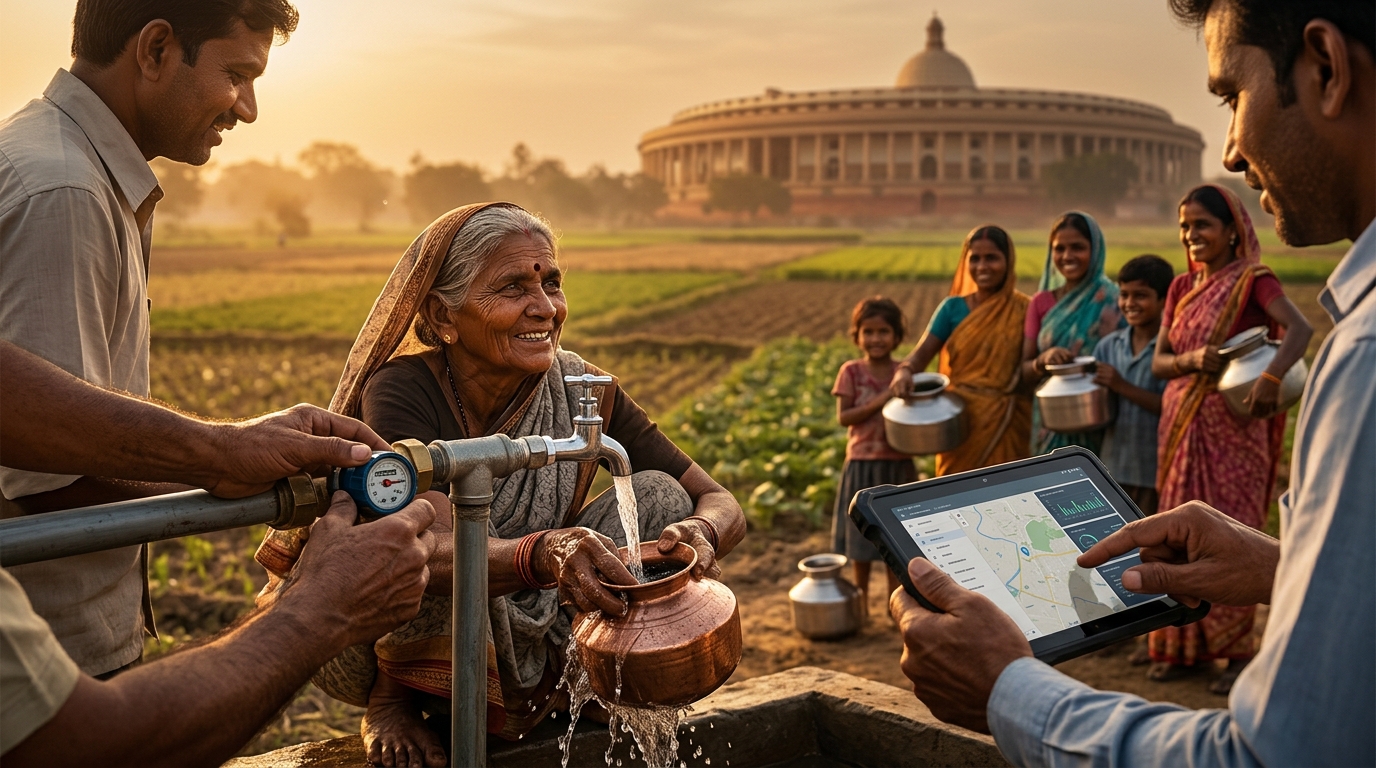
The Union Cabinet, led by Prime Minister Narendra Modi, approved the revamp of the <strong>Jal Jeevan Mission (JJM) 2.0</strong>, extending its target to December 2028 and aiming to provide tap water to all 19.36 crore rural households. The restructuring, backed by an ₹8.69 lakh‑crore outlay, emphasizes service delivery, digital monitoring through <strong>Sujalam Bharat</strong>, and greater Gram Panchayat involvement, underscoring its relevance for UPSC aspirants studying rural development and water governance.
Union Cabinet Approves Revamp of Jal Jeevan Mission (JJM) 2.0 The Union Cabinet, chaired by Prime Minister Narendra Modi , has endorsed a major restructuring of the Jal Jeevan Mission (JJM) 2.0. The new framework extends the mission’s deadline to December 2028 and shifts emphasis from merely constructing infrastructure to ensuring reliable, sustainable service delivery in rural India. Key Developments Cabinet approval of a restructuring proposal by the Ministry of Jal Shakti . Target to provide functional tap connections to all 19.36 crore rural households, up from the current 81.61% coverage. Introduction of the Sujalam Bharat platform for real‑time monitoring. Certification of every gram panchayat as Har Ghar Jal by the 2028 deadline. Enhanced role of Gram Panchayats and Village Water and Sanitation Committees through the ‘Jal Arpan’ initiative. Financial outlay of ₹8.69 lakh crore , including ₹3.59 lakh crore in Central assistance. Important Facts According to the release, out of the identified 19.36 crore rural households across States and Union Territories, about 15.80 crore (81.61%) already have functional tap connections. A State Bank of India Research report cited in the announcement estimates that the mission has liberated nearly nine crore women from the daily chore of water collection, allowing greater participation in economic activities. UPSC Relevance The revamp of JJM 2.0 touches upon several UPSC syllabus areas: water resource management, rural development, digital governance, and the role of local self‑government institutions. Understanding the shift from capital‑intensive infrastructure to service‑oriented delivery helps answer questions on policy effectiveness and sustainability (GS3). The involvement of Union Cabinet and the financial commitment illustrate fiscal federalism and central‑state coordination, pertinent to GS2 and GS3. Moreover, the digital mapping initiative aligns with emerging themes of e‑governance and data‑driven public service delivery. Way Forward Implementation will require robust coordination among the Union Cabinet , the Ministry of Jal Shakti , state governments, and grassroots bodies. Key steps include: Constituting a dedicated action plan at the regional level, as announced by Mysuru MP Yaduveer Krishnadatta Chamaraja Wadiyar . Operationalising the Sujalam Bharat platform for real‑time monitoring and grievance redressal. Ensuring transparent handover of projects through the ‘Jal Arpan’ initiative, with active participation of Gram Panchayats and VWSCs. Periodic audits and performance reviews to achieve the Har Ghar Jal certification by 2028. Successful execution will not only improve rural health and gender equity but also serve as a benchmark for large‑scale, digitally enabled public service delivery in India.
  1. Home
  2. Prepare
  3. Current Affairs
  4. Union Cabinet Approves Jal Jeevan Mission 2.0 Extension to 2028 – Focus on Service Delivery and Digital Monitoring
Must Review
Login to bookmark articles
Login to mark articles as complete

Overview

gs.gs385% UPSC Relevance

Full Article

<h2>Union Cabinet Approves Revamp of Jal Jeevan Mission (JJM) 2.0</h2> <p>The Union Cabinet, chaired by <strong>Prime Minister Narendra Modi</strong>, has endorsed a major restructuring of the <span class="key-term" data-definition="Jal Jeevan Mission (JJM) — a flagship central government scheme launched in 2019 to provide piped drinking water to every rural household by 2024 (GS3: Water resources & rural development).">Jal Jeevan Mission</span> (JJM) 2.0. The new framework extends the mission’s deadline to <strong>December 2028</strong> and shifts emphasis from merely constructing infrastructure to ensuring reliable, sustainable service delivery in rural India.</p> <h3>Key Developments</h3> <ul> <li>Cabinet approval of a restructuring proposal by the <span class="key-term" data-definition="Ministry of Jal Shakti — the central ministry responsible for water resources, water supply, and sanitation (GS3: Water resources).">Ministry of Jal Shakti</span>.</li> <li>Target to provide functional tap connections to all <strong>19.36 crore</strong> rural households, up from the current 81.61% coverage.</li> <li>Introduction of the <span class="key-term" data-definition="Sujalam Bharat — a national digital framework that assigns a unique Service Area ID (Sujal Gaon) to each village, enabling end‑to‑end digital mapping of water sources, treatment, and household taps (GS3: Digital governance).">Sujalam Bharat</span> platform for real‑time monitoring.</li> <li>Certification of every gram panchayat as <span class="key-term" data-definition="Har Ghar Jal — a designation indicating that every rural household in a gram panchayat has access to safe piped drinking water (GS3: Rural development).">Har Ghar Jal</span> by the 2028 deadline.</li> <li>Enhanced role of <span class="key-term" data-definition="Gram Panchayat — the elected local self‑government body at the village level responsible for planning and execution of rural development schemes (GS2: Polity).">Gram Panchayats</span> and <span class="key-term" data-definition="Village Water and Sanitation Committee (VWSC) — a community‑level committee that oversees water supply and sanitation projects, ensuring transparency and accountability (GS2: Polity).">Village Water and Sanitation Committees</span> through the ‘Jal Arpan’ initiative.</li> <li>Financial outlay of <strong>₹8.69 lakh crore</strong>, including <strong>₹3.59 lakh crore</strong> in Central assistance.</li> </ul> <h3>Important Facts</h3> <p>According to the release, out of the identified <strong>19.36 crore</strong> rural households across States and Union Territories, about <strong>15.80 crore</strong> (81.61%) already have functional tap connections. A State Bank of India Research report cited in the announcement estimates that the mission has liberated nearly <strong>nine crore women</strong> from the daily chore of water collection, allowing greater participation in economic activities.</p> <h3>UPSC Relevance</h3> <p>The revamp of JJM 2.0 touches upon several UPSC syllabus areas: water resource management, rural development, digital governance, and the role of local self‑government institutions. Understanding the shift from capital‑intensive infrastructure to service‑oriented delivery helps answer questions on policy effectiveness and sustainability (GS3). The involvement of <span class="key-term" data-definition="Union Cabinet — the supreme decision‑making body of the Government of India, comprising the Prime Minister and senior ministers, responsible for policy approval (GS2: Polity).">Union Cabinet</span> and the financial commitment illustrate fiscal federalism and central‑state coordination, pertinent to GS2 and GS3. Moreover, the digital mapping initiative aligns with emerging themes of e‑governance and data‑driven public service delivery.</p> <h3>Way Forward</h3> <p>Implementation will require robust coordination among the <span class="key-term" data-definition="Union Cabinet — the supreme decision‑making body of the Government of India, comprising the Prime Minister and senior ministers, responsible for policy approval (GS2: Polity).">Union Cabinet</span>, the <span class="key-term" data-definition="Ministry of Jal Shakti — the central ministry responsible for water resources, water supply, and sanitation (GS3: Water resources).">Ministry of Jal Shakti</span>, state governments, and grassroots bodies. Key steps include:</p> <ul> <li>Constituting a dedicated action plan at the regional level, as announced by <strong>Mysuru MP Yaduveer Krishnadatta Chamaraja Wadiyar</strong>.</li> <li>Operationalising the <span class="key-term" data-definition="Sujalam Bharat — a national digital framework that assigns a unique Service Area ID (Sujal Gaon) to each village, enabling end‑to‑end digital mapping of water sources, treatment, and household taps (GS3: Digital governance).">Sujalam Bharat</span> platform for real‑time monitoring and grievance redressal.</li> <li>Ensuring transparent handover of projects through the ‘Jal Arpan’ initiative, with active participation of <span class="key-term" data-definition="Gram Panchayat — the elected local self‑government body at the village level responsible for planning and execution of rural development schemes (GS2: Polity).">Gram Panchayats</span> and VWSCs.</li> <li>Periodic audits and performance reviews to achieve the <span class="key-term" data-definition="Har Ghar Jal — a designation indicating that every rural household in a gram panchayat has access to safe piped drinking water (GS3: Rural development).">Har Ghar Jal</span> certification by 2028.</li> </ul> <p>Successful execution will not only improve rural health and gender equity but also serve as a benchmark for large‑scale, digitally enabled public service delivery in India.</p>
Read Original on hindu

JJM 2.0 extends to 2028, linking digital monitoring with Gram Panchayat‑led water service delivery.

Key Facts

  1. Union Cabinet approved the revamp of Jal Jeevan Mission (JJM) 2.0, extending the deadline to December 2028.
  2. Target: functional tap connections for all 19.36 crore rural households (up from 15.80 crore, 81.61% coverage).
  3. Financial outlay: ₹8.69 lakh crore total, of which ₹3.59 lakh crore is central assistance.
  4. Introduction of the Sujalam Bharat digital platform for end‑to‑end monitoring and grievance redressal.
  5. Every gram panchayat to be certified ‘Har Ghar Jal’ by 2028, with Gram Panchayats and VWSCs driving implementation through the ‘Jal Arpan’ initiative.

Background & Context

The original JJM (launched 2019) aimed at universal rural piped water by 2024 but fell short of service‑delivery goals. JJM 2.0 shifts focus from mere infrastructure creation to sustainable supply, leveraging digital governance (Sujalam Bharat) and decentralised institutions, reflecting the UPSC themes of water resource management, rural development, fiscal federalism and e‑governance.

UPSC Syllabus Connections

Essay•Economy, Development and InequalityPrelims_GS•Sustainable Development and InclusionGS1•Poverty and Developmental IssuesGS2•Devolution of powers and finances to local levelsGS2•Governance, transparency, accountability and e-governancePrelims_GS•Panchayati Raj and Local GovernanceGS4•Lessons from lives and teachings of great leaders, reformers and administratorsGS2•Executive and Judiciary - structure, organization and functioningGS3•Environmental Impact Assessment

Mains Answer Angle

GS‑3 (Water resources, Rural development, Digital governance) – discuss how JJM 2.0 addresses policy‑implementation gaps and the role of local self‑government in achieving sustainable water supply.

Analysis

Practice Questions

GS3
Medium
Prelims MCQ

Water resources & Rural development

1 marks
3 keywords
GS3
Easy
Mains Short Answer

Decentralisation & Rural development

10 marks
4 keywords
GS3
Hard
Mains Essay

E‑governance, Water resources, Rural development

30 marks
5 keywords
Related:Daily•Weekly

Loading related articles...

Loading related articles...

Tip: Click articles above to read more from the same date, or use the back button to see all articles.

Quick Reference

Key Insight

JJM 2.0 extends to 2028, linking digital monitoring with Gram Panchayat‑led water service delivery.

Key Facts

  1. Union Cabinet approved the revamp of Jal Jeevan Mission (JJM) 2.0, extending the deadline to December 2028.
  2. Target: functional tap connections for all 19.36 crore rural households (up from 15.80 crore, 81.61% coverage).
  3. Financial outlay: ₹8.69 lakh crore total, of which ₹3.59 lakh crore is central assistance.
  4. Introduction of the Sujalam Bharat digital platform for end‑to‑end monitoring and grievance redressal.
  5. Every gram panchayat to be certified ‘Har Ghar Jal’ by 2028, with Gram Panchayats and VWSCs driving implementation through the ‘Jal Arpan’ initiative.

Background

The original JJM (launched 2019) aimed at universal rural piped water by 2024 but fell short of service‑delivery goals. JJM 2.0 shifts focus from mere infrastructure creation to sustainable supply, leveraging digital governance (Sujalam Bharat) and decentralised institutions, reflecting the UPSC themes of water resource management, rural development, fiscal federalism and e‑governance.

UPSC Syllabus

  • Essay — Economy, Development and Inequality
  • Prelims_GS — Sustainable Development and Inclusion
  • GS1 — Poverty and Developmental Issues
  • GS2 — Devolution of powers and finances to local levels
  • GS2 — Governance, transparency, accountability and e-governance
  • Prelims_GS — Panchayati Raj and Local Governance
  • GS4 — Lessons from lives and teachings of great leaders, reformers and administrators
  • GS2 — Executive and Judiciary - structure, organization and functioning
  • GS3 — Environmental Impact Assessment

Mains Angle

GS‑3 (Water resources, Rural development, Digital governance) – discuss how JJM 2.0 addresses policy‑implementation gaps and the role of local self‑government in achieving sustainable water supply.

Explore:Current Affairs·Editorial Analysis·Govt Schemes·Study Materials·Previous Year Questions·UPSC GPT
Union Cabinet Approves Jal Jeevan Mission ... | UPSC Current Affairs

Related Topics

  • 📰Current AffairsUnion Cabinet ने Jal Jeevan Mission 2.0 का विस्तार 2028 तक मंजूर किया – सेवा वितरण और डिजिटल मॉनिटरिंग पर केंद्रित
  • 📰Current AffairsCentre Tightens Oversight of Jal Jeevan Mission 2.0 with Rs 1.51 Lakh Crore Allocation and Digital Mapping