Loading page, please wait…
HomeCurrent AffairsEditorialsGovt SchemesLearning ResourcesUPSC SyllabusPricingAboutBest UPSC AIUPSC AI ToolAI for UPSCUPSC ChatGPT

© 2026 Vaidra. All rights reserved.

PrivacyTerms
Vaidra Logo
Vaidra

Top 4 items + smart groups

UPSC GPT
New
Current Affairs
Daily Solutions
Daily Puzzle
Mains Evaluator

Version 2.0.0 • Built with ❤️ for UPSC aspirants

Dr. Jitendra Singh Announces $1 Trillion Bio‑Economy Target for 2047 – Vision 2047, IIT Roorkee

Dr. Jitendra Singh Announces $1 Trillion Bio‑Economy Target for 2047 – Vision 2047, IIT Roorkee
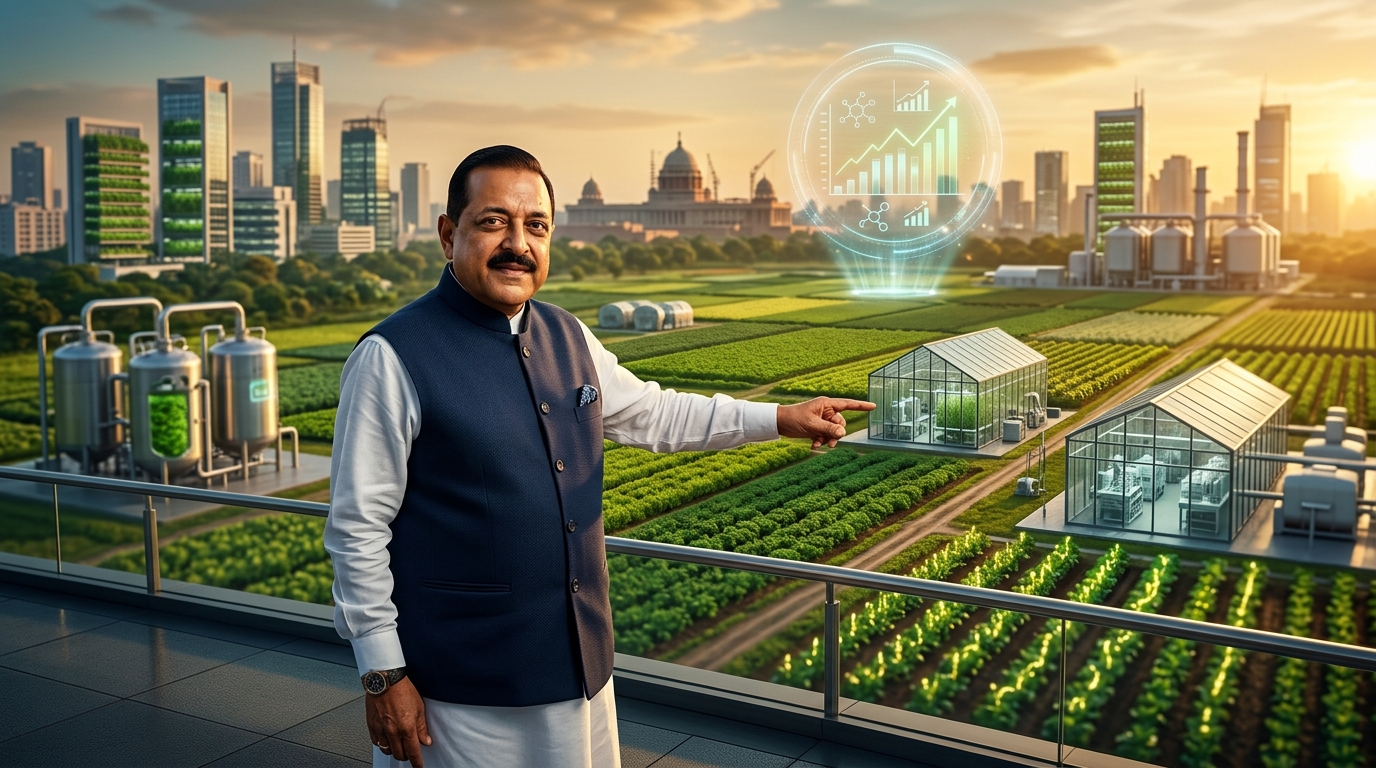
Union Minister Dr. Jitendra Singh, speaking at the Vision 2047 Conference at IIT Roorkee, announced a $1 trillion bio‑economy target for 2047 and outlined the BioE3 Policy, massive biotech startup growth, and key scientific milestones. The initiative underscores India’s drive for full‑stack technological leadership, a priority area for UPSC GS‑3 and GS‑4 preparation.
Union Minister of State (Independent Charge) for Science & Technology, Dr. Jitendra Singh addressed the international Vision 2047 Conference at IIT Roorkee, declaring that the 21st century will be India’s century, driven by a biology‑led economy. He projected the national bio‑economy to reach $1 trillion by 2047. Key Developments Launch of the BioE3 Policy , aiming for a $300 billion bio‑economy by 2030. Growth of biotech startups from ~50 in 2014 to >11,000, supported by the Anusandhan National Research Foundation (ANRF) and a ₹1 lakh crore RDI Fund. Scientific milestones: Genome India progress, indigenous CAR‑T cell therapy, mRNA vaccine platform, first home‑grown antibiotic, and a National Biobank. Space‑biotech collaboration with ISRO and expansion of nuclear‑medicine facilities for affordable cancer care. Advances in emerging tech: the National Quantum Mission achieved key milestones ahead of schedule. India’s ranking in the Global Innovation Index improved to 39, and R&D spending more than doubled in the last decade. Important Facts The bio‑economy has risen from $10 billion in 2014 to over $165 billion today, growing at ~18% per annum. The government targets $300 billion by 2030 and $1 trillion by 2047, positioning India among the top three global bio‑economies. Milestones are set for 2030, 2035, 2040 and 2047, including operationalisation of the Bharatiya Antariksha Station , scaling biotech startups, and advancing marine biotechnology and carbon‑neutral technologies. UPSC Relevance These announcements intersect multiple GS papers: GS3 (Economy, Science & Technology) – understanding the bio‑economy’s contribution to GDP, policy frameworks like BioE3, and innovation rankings; GS4 (Ethics, Integrity and Aptitude) – the civilisational ethos of "Arthasya Moolam Dharmam" linking economic growth with ethical values; and GS2 (Polity) – the role of the Union Minister and institutional mechanisms (ANRF, RDI Fund) in steering national development. Way Forward Minister Singh urged the " Amrit Generation " – students, researchers and startups – to lead the next scientific wave. He called for IIT Roorkee and similar institutions to become hubs of bio‑manufacturing, deep‑tech research and entrepreneurship. The roadmap envisions a coordinated push across biotechnology, quantum computing, space biotechnology and oceanic research to achieve a prosperous, globally competitive India by 2047.
  1. Home
  2. Prepare
  3. Current Affairs
  4. Dr. Jitendra Singh Announces $1 Trillion Bio‑Economy Target for 2047 – Vision 2047, IIT Roorkee
Must Review
Login to bookmark articles
Login to mark articles as complete

Overview

gs.gs382% UPSC Relevance

India targets a $1 trillion bio‑economy by 2047, reshaping growth and innovation.

Key Facts

  1. India's bio‑economy is projected to reach $1 trillion by 2047, up from $165 billion in 2026.
  2. The BioE3 Policy (2024) aims for a $300 billion bio‑economy by 2030.
  3. Biotech startups grew from ~50 in 2014 to over 11,000 in 2026, backed by ANRF (₹50,000 crore) and a ₹1 lakh crore RDI Fund.
  4. Key scientific milestones include Genome India, indigenous CAR‑T therapy, mRNA vaccine platform, first home‑grown antibiotic, and a National Biobank.
  5. India's Global Innovation Index rank improved from 81 (2015) to 39 (2025), with R&D spending more than doubling in the last decade.

Background & Context

The bio‑economy integrates biotechnology, genetics, quantum and space research to generate high‑value products, aligning with GS‑3 themes of science‑technology-driven growth, innovation rankings and sustainable development. The Vision 2047 roadmap links these advances to GDP contribution, employment generation and India's global competitiveness.

UPSC Syllabus Connections

GS3•Developments in science and technology and their applicationsEssay•Economy, Development and InequalityEssay•Science, Technology and SocietyPrelims_GS•National Current AffairsGS2•Government policies and interventions for developmentPrelims_GS•Science and Technology ApplicationsGS2•Functions and responsibilities of Union and StatesPrelims_GS•Biology and HealthGS3•Indian Economy - Planning, mobilization of resources, growth, development and employmentEssay•Environment and Sustainability

Mains Answer Angle

GS‑3: Discuss how the BioE3 Policy and related institutional mechanisms can transform India's economy and position it among the top three global bio‑economies by 2047. Likely question: "Evaluate the role of biotechnology and related policies in achieving inclusive economic growth in India."

Full Article

<p><strong>Union Minister of State (Independent Charge) for Science &amp; Technology, Dr. Jitendra Singh</strong> addressed the international <strong>Vision 2047 Conference</strong> at IIT Roorkee, declaring that the 21st century will be India’s century, driven by a biology‑led economy. He projected the national <span class="key-term" data-definition="Bio‑economy – Economic sector that harnesses biological resources and processes for production, a key focus in GS3: Economy and Science &amp; Technology.">bio‑economy</span> to reach <strong>$1 trillion</strong> by 2047.</p> <h3>Key Developments</h3> <ul> <li>Launch of the <span class="key-term" data-definition="BioE3 Policy – Biotechnology for Economy, Environment and Employment policy (2024) that steers bio‑manufacturing, employment and sustainability, relevant to GS3.">BioE3 Policy</span>, aiming for a $300 billion bio‑economy by 2030.</li> <li>Growth of biotech startups from ~50 in 2014 to >11,000, supported by the <span class="key-term" data-definition="ANRF – Anusandhan National Research Foundation, a ₹50,000 crore fund for deep‑tech research, important for GS3: Innovation.">Anusandhan National Research Foundation (ANRF)</span> and a ₹1 lakh crore RDI Fund.</li> <li>Scientific milestones: <span class="key-term" data-definition="Genome India – Nationwide programme to map genetic diversity of Indian populations, aiding health research; GS3 &amp; GS4 relevance.">Genome India</span> progress, indigenous CAR‑T cell therapy, mRNA vaccine platform, first home‑grown antibiotic, and a National Biobank.</li> <li>Space‑biotech collaboration with ISRO and expansion of nuclear‑medicine facilities for affordable cancer care.</li> <li>Advances in emerging tech: the <span class="key-term" data-definition="National Quantum Mission – Government initiative to develop quantum computing, communication and sensing capabilities, linked to GS3: Technology and security.">National Quantum Mission</span> achieved key milestones ahead of schedule.</li> <li>India’s ranking in the <span class="key-term" data-definition="Global Innovation Index – Annual ranking of countries based on innovation inputs and outputs; India’s rise from 81 to 39 reflects policy impact, GS3 relevance.">Global Innovation Index</span> improved to 39, and R&amp;D spending more than doubled in the last decade.</li> </ul> <h3>Important Facts</h3> <p>The bio‑economy has risen from $10 billion in 2014 to over $165 billion today, growing at ~18% per annum. The government targets $300 billion by 2030 and $1 trillion by 2047, positioning India among the top three global bio‑economies. Milestones are set for 2030, 2035, 2040 and 2047, including operationalisation of the <span class="key-term" data-definition="Bharatiya Antariksha Station – Planned Indian space station that will host micro‑gravity research, part of India’s space programme; GS3 relevance.">Bharatiya Antariksha Station</span>, scaling biotech startups, and advancing marine biotechnology and carbon‑neutral technologies.</p> <h3>UPSC Relevance</h3> <p>These announcements intersect multiple GS papers: <strong>GS3 (Economy, Science &amp; Technology)</strong> – understanding the bio‑economy’s contribution to GDP, policy frameworks like BioE3, and innovation rankings; <strong>GS4 (Ethics, Integrity and Aptitude)</strong> – the civilisational ethos of "Arthasya Moolam Dharmam" linking economic growth with ethical values; and <strong>GS2 (Polity)</strong> – the role of the Union Minister and institutional mechanisms (ANRF, RDI Fund) in steering national development.</p> <h3>Way Forward</h3> <p>Minister Singh urged the "<span class="key-term" data-definition="Amrit Generation – Term used for the youth of India, especially students and innovators, highlighting their role in nation‑building; GS4 relevance.">Amrit Generation</span>" – students, researchers and startups – to lead the next scientific wave. He called for IIT Roorkee and similar institutions to become hubs of bio‑manufacturing, deep‑tech research and entrepreneurship. The roadmap envisions a coordinated push across biotechnology, quantum computing, space biotechnology and oceanic research to achieve a prosperous, globally competitive India by 2047.</p>
Read Original on pib

Analysis

Practice Questions

GS3
Easy
Prelims MCQ

Bio‑economy targets and policy framework

1 marks
5 keywords
GS3
Medium
Mains Short Answer

Policy measures for biotechnology sector

5 marks
5 keywords
GS3
Hard
Mains Essay

Biotechnology as a driver of economic development and sustainability

20 marks
6 keywords
Related:Daily•Weekly

Loading related articles...

Loading related articles...

Tip: Click articles above to read more from the same date, or use the back button to see all articles.

Quick Reference

Key Insight

India targets a $1 trillion bio‑economy by 2047, reshaping growth and innovation.

Key Facts

  1. India's bio‑economy is projected to reach $1 trillion by 2047, up from $165 billion in 2026.
  2. The BioE3 Policy (2024) aims for a $300 billion bio‑economy by 2030.
  3. Biotech startups grew from ~50 in 2014 to over 11,000 in 2026, backed by ANRF (₹50,000 crore) and a ₹1 lakh crore RDI Fund.
  4. Key scientific milestones include Genome India, indigenous CAR‑T therapy, mRNA vaccine platform, first home‑grown antibiotic, and a National Biobank.
  5. India's Global Innovation Index rank improved from 81 (2015) to 39 (2025), with R&D spending more than doubling in the last decade.

Background

The bio‑economy integrates biotechnology, genetics, quantum and space research to generate high‑value products, aligning with GS‑3 themes of science‑technology-driven growth, innovation rankings and sustainable development. The Vision 2047 roadmap links these advances to GDP contribution, employment generation and India's global competitiveness.

UPSC Syllabus

  • GS3 — Developments in science and technology and their applications
  • Essay — Economy, Development and Inequality
  • Essay — Science, Technology and Society
  • Prelims_GS — National Current Affairs
  • GS2 — Government policies and interventions for development
  • Prelims_GS — Science and Technology Applications
  • GS2 — Functions and responsibilities of Union and States
  • Prelims_GS — Biology and Health
  • GS3 — Indian Economy - Planning, mobilization of resources, growth, development and employment
  • Essay — Environment and Sustainability

Mains Angle

GS‑3: Discuss how the BioE3 Policy and related institutional mechanisms can transform India's economy and position it among the top three global bio‑economies by 2047. Likely question: "Evaluate the role of biotechnology and related policies in achieving inclusive economic growth in India."

Explore:Current Affairs·Editorial Analysis·Govt Schemes·Study Materials·Previous Year Questions·UPSC GPT

Related Topics

  • 📖Glossary TermGDP
Dr. Jitendra Singh Announces $1 Trillion B... | UPSC Current Affairs