Written by: Soham Naha11 min readNew DelhiUpdated: Apr 4, 2026 04:17 PM ISTUS troop presence has been building in West Asia amid reports of a potential ground invasion. (File Photo)Make us preferred source on GoogleWhatsapptwitterFacebookRedditPRINTTroops are building up in West Asia, and threats are piling up as Washington and Tehran inch closer to a dangerous escalation. Gulf allies are reportedly pushing the US through backchannels to reshape the region. Meanwhile, in Southeast Asia, Myanmar’s junta chief seeks legitimacy through a controversial election.
I. Potential escalation on the horizon
US President Donald Trump spent the fifth week of the war mounting threats against Iran over its blockade of the Strait of Hormuz. This comes against the backdrop of a US troop buildup in West Asia and reports of a potential ground invasion.
Trump on Friday said Washington could “easily” reopen the Strait of Hormuz with a little more time, days ahead of his deadline (April 6) for Iran to reopen the crucial waterway, which had handled a fifth of the world’s energy supplies before the war.
The US President stated that if Tehran does not reopen the strait, he would target Iran’s power plants, oil wells, desalination plants, and Kharg Island, which handles 90 per cent of Tehran’s oil exports. After reported strikes hit a major bridge linking Tehran and Karaj, Trump on Thursday night issued a warning, urging Iran to agree to a deal “before it’s too late.”
Iran blocked the Hormuz after the US-Israeli assault on February 28, triggering a global energy crunch. WTI crude was recorded at $111 a barrel on Friday evening compared to $65.35 a barrel before the war started. Brent Crude recorded $109, up from $73 a barrel.
During his address to the nation on Thursday, Trump said the US was on track to fulfil its military objectives “very shortly,” adding that the military was going to hit them extremely hard. “Over the next two to three weeks, we are going to bring them back to the Stone Ages where they belong,” he said.
Outlined by US Secretary of State Marco Rubio, Washington’s military objectives involve the destruction of Iran’s air force, navy, and ballistic missiles and their supply chains.Story continues below this ad
Psychological warfare
Iran has not budged to Trump’s threats; instead it has resorted to psychological warfare in view of the reports of a possible US ground assault on Iran. This is amid the mounting global energy crisis and America’s rift with Nato allies.
On Sunday, Iran’s parliament speaker, Mohammad Bagher Qalibaf, issued a warning to Washington that Iranian forces “are waiting for the arrival of American troops on the ground to set them on fire and punish their regional partners forever.”
Earlier, following recurring reports of Trump considering a ground assault and takeover of Iran’s Kharg, the Islamic Republic appeared to signal its awareness, with the front page of The Tehran Times reading: “Welcome to Hell.” It added that “US troops who set foot on Iranian soil will leave only in a coffin.”
The US had passed on a 15-point peace proposal to Tehran via Pakistan last week. Tehran rejected the proposal and put forward a list of demands, including the US’s recognition of Iran’s sovereignty over the Strait of Hormuz.Story continues below this ad
On Monday, a parliamentary commission in Iran approved plans to impose tolls on vessels transiting the Strait of Hormuz.
Also Read | Explained: How the deepening Gulf-Iran divide pushed Arab states towards US and Israel
Meeting in Pakistan
Pakistan hosted high-level delegations from Saudi Arabia, Turkey, and Egypt this week in an effort to de-escalate, but Tehran said it did not participate in the meetings. Iran also said the demands listed in the US peace proposal are “excessive and unreasonable.”
Nato relations faltering
Amid strained relations with North Atlantic Treaty Organisation (Nato), Trump, in an apparent jab at the coalition, urged countries to “take the lead in protecting the oil that they so desperately depend on”.
Key defence partners in the US-led military alliance, including the UK, Germany and France, distanced themselves from the ongoing operation right after the war broke out.Story continues below this ad
This week, Italy and Spain have created logistical hurdles for the American campaign by refusing access to a key airbase and blocking its airspace for military use, respectively.
In a previous article in this series, we covered more on the rift between the US and NATO.
Houthis join the fight
On March 28, the Houthis, another one of Iran’s proxy groups, launched its first attack on Israel in the war, renewing fears of trade disruptions in the Bab el-Mandeb Strait again.
Covered in this series last week, Iran had threatened to disrupt trade in this strategically vital waterway that connects the Indian Ocean to the Red Sea and the Mediterranean Sea.Story continues below this ad
This Strait handles 12 per cent of global oil trade, and another disruption could potentially aggravate the energy crisis. Earlier, the chief International Energy Agency (IEA), Fatih Birol, described the current crunch as worse than the two oil crises of the 1970s combined.
II. Gulf allies pressing the US to continue the war
Amid reports of a potential US ground assault on Iran, reports have revealed that Washington’s Gulf allies have been pushing Trump to continue the war until Tehran has been crippled.
The Associated Press reported that officials from Saudi Arabia, the United Arab Emirates, Bahrain, and Kuwait have privately conveyed that they want the US to continue its campaign until Iran’s influence in West Asia has diminished.
What’s bothering the Gulf?
Amid the war, Gulf countries aligned with the US have come under Iran’s retaliatory attacks since the conflict began.Story continues below this ad
While Tehran has maintained that the American and Israeli establishments in the region are its “legitimate targets,” civilian installations and key energy facilities belonging to the countries have been struck as well.
The strikes threaten to damage their reputation as safe destinations for investments as they diversify their economies. Saudi Arabia’s Vision 2030 and the UAE Centennial Plan 2071 have effectively hit a roadblock.
Oman, which mediated the US-Iran nuclear talks before the war, has favoured diplomacy. Qatar – which hosted leaders of Iran’s Palestinian proxy, Hamas – has also favoured a diplomatic solution.
The Gulf’s relationship with Iran
Saudi Arabia’s and the Gulf states’ troubled relations with Tehran go beyond the ideological Shia-Sunni divide.Story continues below this ad
The Gulf has viewed the growth of Tehran’s conventional armed forces, its nuclear programme, and alleged hegemonic tendencies as threats since the Islamic Revolution in Iran in 1979. After the establishment of the Islamic Republic, Tehran had adopted a policy of “exporting” its revolution.
The Gulf Cooperation Council
The concerns over security threats, ideological subversion, and regional instability posed by Ba’athism (in Iraq) and the revolution in Iran were among the factors that led to the birth of the Gulf Cooperation Council (GCC) in 1981.GCC: An intergovernmental organisation that has largely remained aligned with Washington for its security needs after Iraq invaded Kuwait in 1990. It comprises Saudi Arabia, the United Arab Emirates (UAE), Kuwait, Qatar, Oman and Bahrain.
Ba’athism: A form of Arab nationalism that essentially undermined the monarchical systems in the Gulf. Iraq was under the Ba’athist regime led by Saddam Hussein.‘Oil-for-security’: The US-Saudi strategic partnership had been implicitly following an “oil-for-security arrangement,” where Washington provided security guarantees in exchange for stable global oil supplies from the world’s largest crude exporter. The ambit of this arrangement expanded with the creation of the GCC.
Saudi-US-Iran triangle
In 2019, the Houthis, an Iran-backed Yemeni proxy group, attacked Saudi oil facilities, temporarily knocking out half of the kingdom’s oil output. In 2022, the group attacked the Abu Dhabi International Airport in the UAE. In 2023, a China-brokered deal briefly restored diplomatic ties between Riyadh and Tehran.Story continues below this ad
However, after the US-Israeli assault on February 28, which killed Iran’s Supreme Leader Ayatollah Ali Khamenei, Tehran retaliated with drone and missile attacks on the Gulf states.
Last week, the New York Times reported that Saudi Arabia’s Prime Minister, Crown Prince Mohammed bin Salman, has been urging US President Donald Trump to continue the war against Iran. The report said that Mohammed bin Salman argued the campaign presents a “historic opportunity” to reshape the region.
Riyadh has been among those most alarmed in West Asia regarding Tehran’s nuclear programme. In 2018 and 2023, Prince Salman said that if Tehran built a bomb, Saudi Arabia would soon follow to deter the threat and balance power in the region.
Last month, Reuters reported that the Trump administration waived certain non-proliferation safeguards in the civil nuclear agreement with Riyadh. (The US Congress has a 90-day window to scrutinise the deal under Section 123 of the US Atomic Energy Act of 1954).
Also Read | UPSC Mains Answer Practice GS 1: significance of glaciers and Swadeshi Movement | Week 148
III. Myanmar’s military leader wins elections
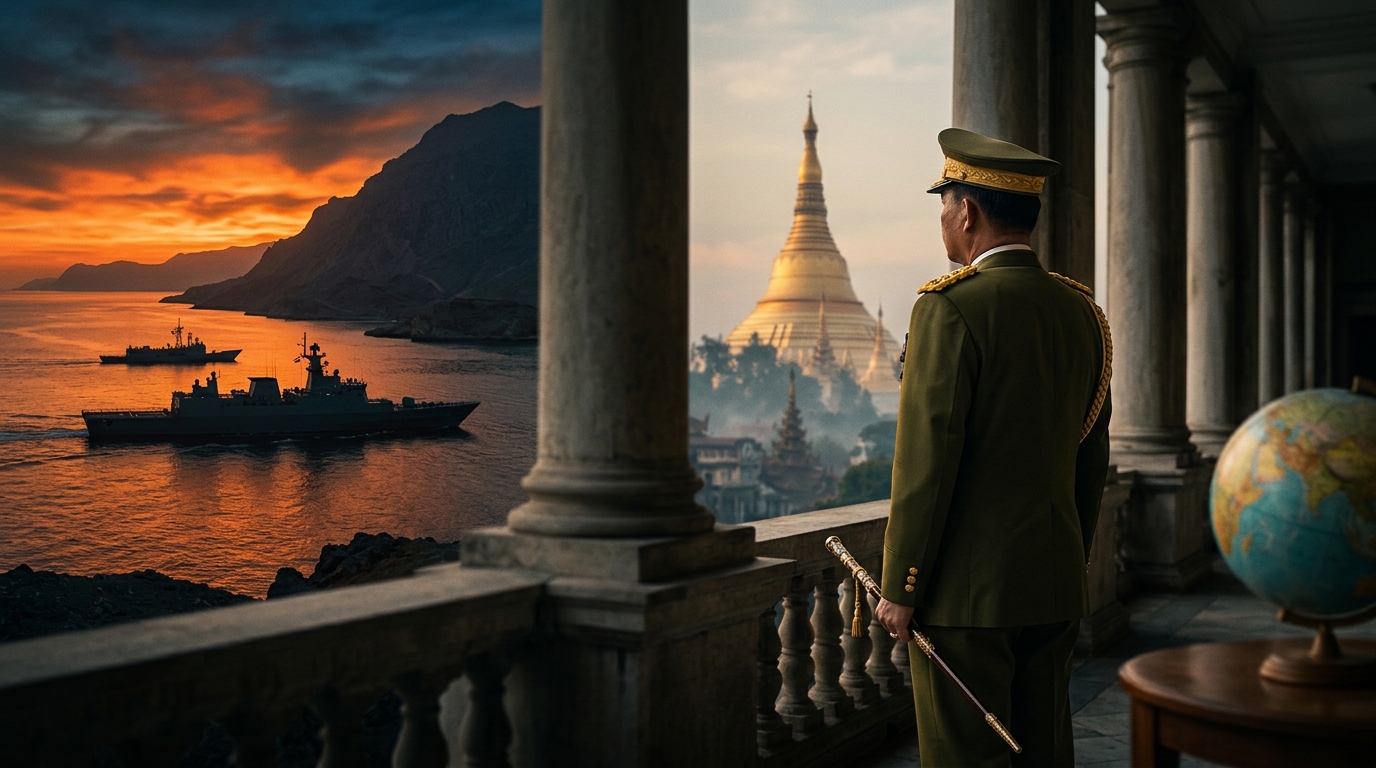
Myanmar’s junta chief, Min Aung Hlaing, was elected the President on Friday after a parliamentary vote, formalising his rule as a civilian leader. He had been the military chief since 2011.
Hlaing toppled the Aung San Suu Kyi government in 2021, which triggered nationwide protests. Following a campaign of repression, the country plunged into ethnic armed resistance.
Critics of Hlaing said that the election was lopsided. On one end was Hlaing himself, and on the other was his junta’s prime minister, Nyo Saw. Hlaing won 429 votes and Nyo Saw, 126, in a parliamentary vote dominated by the junta-backed Union Solidarity and Development Party and legislators appointed by the armed forces.
The Southeast Asian military has ruled the country directly for five of the past six decades, and this election could be seen as an attempt to gain international legitimacy.
In 2024, the International Criminal Court sought an arrest warrant for Min Aung Hlaing over the alleged persecution of the minority Muslim Rohingya. More than a million of this ethnic minority group reportedly fled from Rakhine State to neighbouring Bangladesh and India to escape a military crackdown in 2017.
Similar to Hlaing’s political opposition within the country, his critics abroad are not likely to view his change of attire as anything more than decorative and retain sanctions on his rule in Naypyidaw.
What does it mean for India?
In India’s foreign policy outlook, Myanmar falls under its ‘Act East’ and ‘Neighbourhood First’ policies.India’s foreign policy vis-à-vis MyanmarIndia’s Act East Policy (AEP) of 2014 is a step up from the 1992 Look East Policy, intended to transform engagements in the Asia-Pacific region from economic cooperation to strategic partnerships.
‘Neighbourhood First’ prioritises proactive engagement to build deep and mutually beneficial ties with immediate neighbours.New Delhi has been pragmatic in dealing with dispensations in Myanmar.
During Aung San Suu Kyi’s democratic rule, India and Myanmar conducted joint operations in 2018 and 2019, targeting ethnic armed groups operating around the border areas of the two countries.
In 2025, during Hlaing’s rule, India conducted drone strikes aimed at insurgent camps on the Myanmar side of the border.
Myanmar is also part of the Kaladan Multi-Modal Trade and Transit Project (KMTTP) and the Indo-Myanmar-Thailand (IMT) Trilateral Highway, where work went ahead despite the coup, although facing speed bumps owing to Naypyidaw’s clashes with ethnic armed groups. Hence, the election will maintain the status quo.
Subscribe to our UPSC newsletter. Stay updated with the latest UPSC articles by joining our Telegram channel – IndianExpress UPSC Hub, and follow us on Instagram and X.
🚨 Click Here to read the UPSC Essentials magazine for February 2026. Share your views and suggestions in the comment box or at [email protected]🚨Expand © IE Online Media Services Pvt LtdTags:international relationsUPSC
Loading page, please wait…