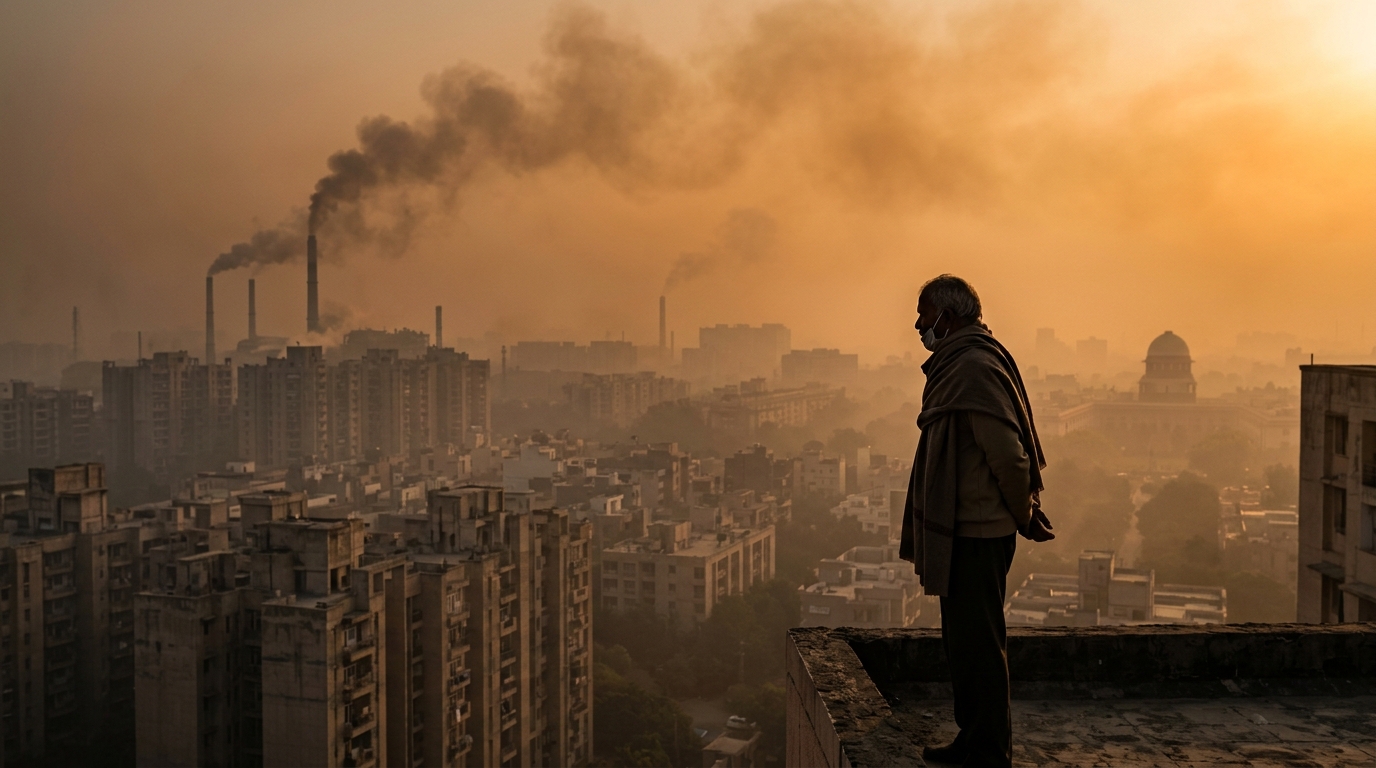
Winter 2025-26 Air Quality Report: Ghaziabad Leads India's Pollution Rankings, NCR Hits Record Non‑Compliance — UPSC Current Affairs | March 6, 2026
Winter 2025-26 Air Quality Report: Ghaziabad Leads India's Pollution Rankings, NCR Hits Record Non‑Compliance
The CREA‑CPCB winter 2025‑26 report shows 204 Indian cities exceeding PM2.5 NAAQS, with Ghaziabad topping the pollution list and Delhi recording only one 'good' day. Persistent non‑compliance across NCR, IGP and NCAP cities highlights the need for nationwide PM2.5 targets and stricter control of gaseous precursors, a key issue for UPSC GS3 (Environment).
Winter 2025-26 Air Quality Situation in India The CREA analysis of data from the CPCB reveals that the winter months (Oct 2025 – Feb 2026) witnessed unprecedented non‑compliance with the NAAQS for PM2.5 . A total of 204 out of 238 monitored cities exceeded the permissible limit, up from 173 the previous winter. Key Developments Ghaziabad recorded the highest average PM2.5 concentration of 172 µg/m³ , making it the most‑polluted city in India. Noida and Delhi followed closely with averages of 166 µg/m³ and 163 µg/m³ respectively. Delhi experienced only 1 ‘good’ day out of 136 winter days, with 18 ‘severe’ and 87 ‘very poor’ days. Eight of the top‑10 polluted cities are in Uttar Pradesh and Haryana , highlighting regional hotspots. At the state level, Haryana had the most cities (24) fully breaching the standard. Conversely, Chamarajanagar, Karnataka emerged as the cleanest city with just 19 µg/m³ . Important Facts Among the 96 cities under the NCAP , 84 exceeded the NAAQS and all 96 surpassed the WHO guideline . Non‑NCAP cities showed a similar trend, with 120 of 142 cities above the national limit and all above the WHO benchmark. In the IGP , 75 of 79 cities breached the national standard. Within the NCR , 28 of 29 monitored cities recorded data, and none complied with the NAAQS . UPSC Relevance The data underscores the persistent challenge of air‑quality management, a recurring topic in GS3 (Environment & Ecology) . Understanding the roles of agencies like CREA , CPCB , and policy frameworks such as NCAP is essential for answering questions on environmental governance, health impacts, and sustainable development. Way Forward Adopt nationwide PM2.5 reduction targets with strict timelines. Strengthen monitoring infrastructure to ensure comprehensive coverage, especially in high‑risk zones like the IGP and NCR . Integrate control of gaseous pollutants ( SO₂ , NO₂ , VOCs ) that act as precursors to secondary PM2.5 and ozone. Promote clean‑energy transitions, stricter vehicular emission norms, and urban greening to mitigate winter inversion effects. Addressing these measures is critical for meeting India’s climate commitments and safeguarding public health, a core concern of the UPSC syllabus.
Login to bookmark articles
Login to mark articles as complete
Overview
Winter 2025‑26 air‑quality crisis underscores urgent need for stronger NCR pollution governance
Key Facts
204 of 238 monitored Indian cities exceeded PM2.5 NAAQS in winter 2025‑26, up from 173 the previous winter.
Ghaziabad recorded the highest average PM2.5 concentration of 172 µg/m³, followed by Noida (166 µg/m³) and Delhi (163 µg/m³).
Delhi logged only 1 ‘good’ day out of 136 winter days, with 18 ‘severe’ and 87 ‘very poor’ days.
All 96 NCAP‑covered cities breached NAAQS; 84 of them also exceeded the WHO PM2.5 guideline of 10 µg/m³.
In the NCR, 28 of 29 monitored cities failed to meet NAAQS – a record level of non‑compliance.
Haryana had the most fully non‑compliant cities (24), while Chamarajanagar, Karnataka, was the cleanest with 19 µg/m³.
CREA (Centre for Research on Energy and Clean Air) analysed CPCB monitoring data to compile the winter report.
Background & Context
Air‑pollution, especially PM2.5, is a core component of GS‑3 (Environment & Ecology) and directly impacts public health, climate commitments and sustainable urban development. The persistent breach of NAAQS across the IGP and NCR highlights gaps in implementation of the National Clean Air Programme and inter‑state coordination mechanisms.
UPSC Syllabus Connections
GS3•Conservation, environmental pollution and degradationPrelims_CSAT•Data InterpretationPrelims_CSAT•Basic Numeracy
Mains Answer Angle
In a GS‑3 answer, candidates can evaluate the effectiveness of NCAP and existing regulatory frameworks, and propose integrated, city‑specific strategies to curb winter smog in the NCR and the broader Indo‑Gangetic Plain.