Loading page, please wait…
What is the International North-South Transport Corridor (INSTC)? - UPSC International Relations
What is What is the International North-South Transport Corridor (INSTC)? in UPSC International Relations?
What is the International North-South Transport Corridor (INSTC)? is a key topic under International Relations for UPSC Civil Services Examination. Key points include: INSTC is a 7,200 km multimodal corridor connecting India, Iran, Russia, Central Asia, and Europe.. It integrates sea, rail, and road routes, significantly reducing transit time and costs compared to traditional routes.. Launched in 2000 by India, Iran, and Russia, its membership has expanded to 13 countries.. Understanding this topic is essential for both UPSC Prelims and Mains preparation.
Why is What is the International North-South Transport Corridor (INSTC)? important for UPSC exam?
What is the International North-South Transport Corridor (INSTC)? is a Medium-level topic in UPSC International Relations. It is tested in both Prelims (factual MCQs) and Mains (analytical answer writing). Previous year UPSC questions have frequently covered aspects of What is the International North-South Transport Corridor (INSTC)?, making it essential for comprehensive IAS preparation.
How to prepare What is the International North-South Transport Corridor (INSTC)? for UPSC?
To prepare What is the International North-South Transport Corridor (INSTC)? for UPSC: (1) Study the comprehensive notes covering all key concepts on Vaidra. (2) Practice previous year questions on this topic. (3) Connect it with current affairs using daily updates. (4) Revise using key takeaways and mind maps available for International Relations. (5) Write practice answers linking What is the International North-South Transport Corridor (INSTC)? to related GS Paper topics.
Key takeaways of What is the International North-South Transport Corridor (INSTC)? for UPSC
- INSTC is a 7,200 km multimodal corridor connecting India, Iran, Russia, Central Asia, and Europe.
- It integrates sea, rail, and road routes, significantly reducing transit time and costs compared to traditional routes.
- Launched in 2000 by India, Iran, and Russia, its membership has expanded to 13 countries.
- Key corridors include Central (Mumbai-Bandar Abbas-Caspian Sea-Russia), Western (Azerbaijan-Iran rail link), and Eastern (Central Asia-Russia-India).
- Strategically important for India to access Eurasian markets, enhance connectivity, and diversify trade routes.
What is the International North-South Transport Corridor (INSTC)?
Medium⏱️ 8 min read
international relations
📖 Introduction
Introduction to INSTC
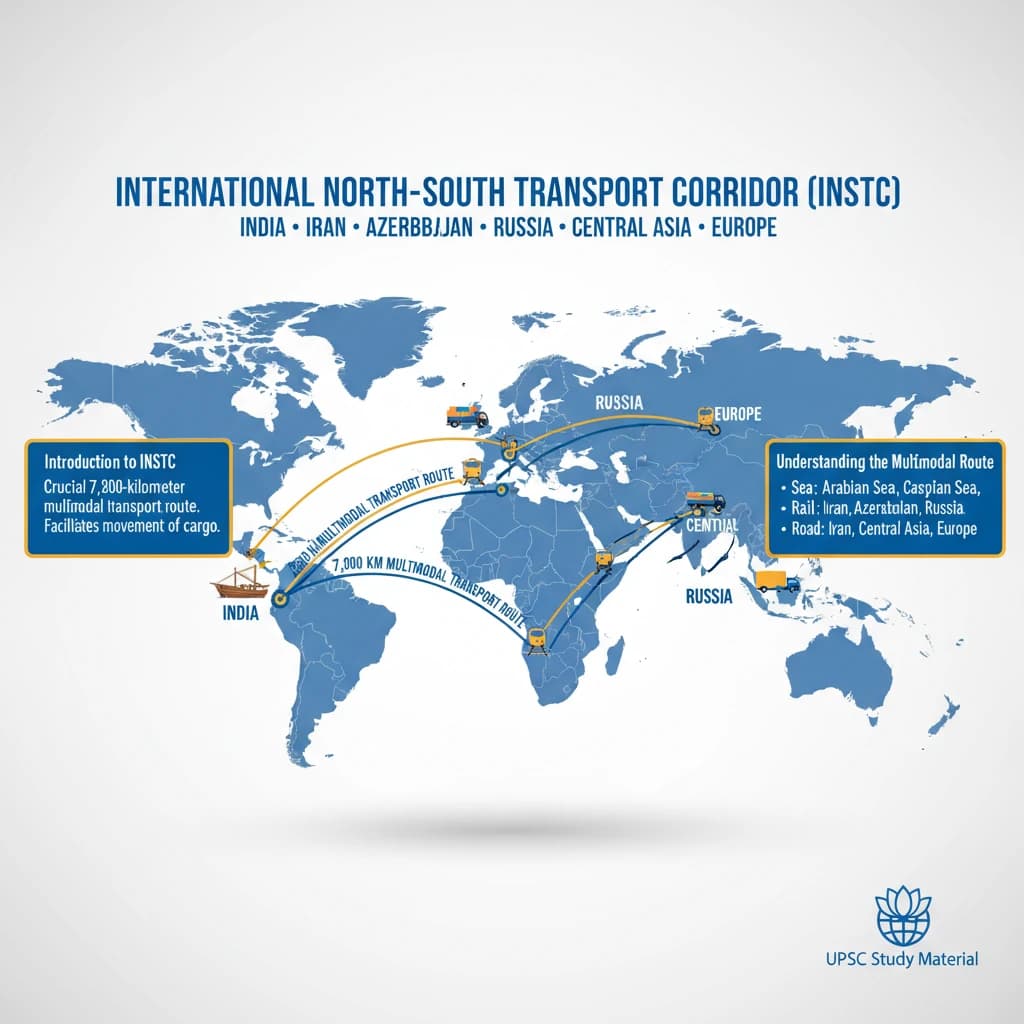
The International North-South Transport Corridor (INSTC) is a crucial 7,200-kilometer multimodal transport route.
It aims to facilitate the movement of cargo between India, Iran, Azerbaijan, Russia, Central Asia, and Europe.
Understanding the Multimodal Route
The INSTC integrates ship, rail, and road routes to ensure efficient and cost-effective transportation of goods.
This comprehensive network links the Indian Ocean and the Persian Gulf to the Caspian Sea via Iran, extending further to northern Europe through St. Petersburg in Russia.
Origin and Establishment
The concept of INSTC was formally launched on September 12, 2000, in St. Petersburg, Russia.
It was established through a trilateral agreement signed by Iran, Russia, and India at the Euro-Asian Conference on Transport.
The primary objective was to foster transportation cooperation among the participating member states.
Expanding Membership and Reach
Initially, the agreement involved Iran, Russia, and India.
Since its inception, the INSTC membership has significantly expanded to include 10 additional countries, bringing the total to 13 member states.
Current members include: Azerbaijan, Armenia, Kazakhstan, Kyrgyzstan, Tajikistan, Turkey, Ukraine, Syria, Belarus, and Oman.
Key Corridors and Operational Routes
The INSTC is structured into several vital corridors, each designed to optimize connectivity across different regions.
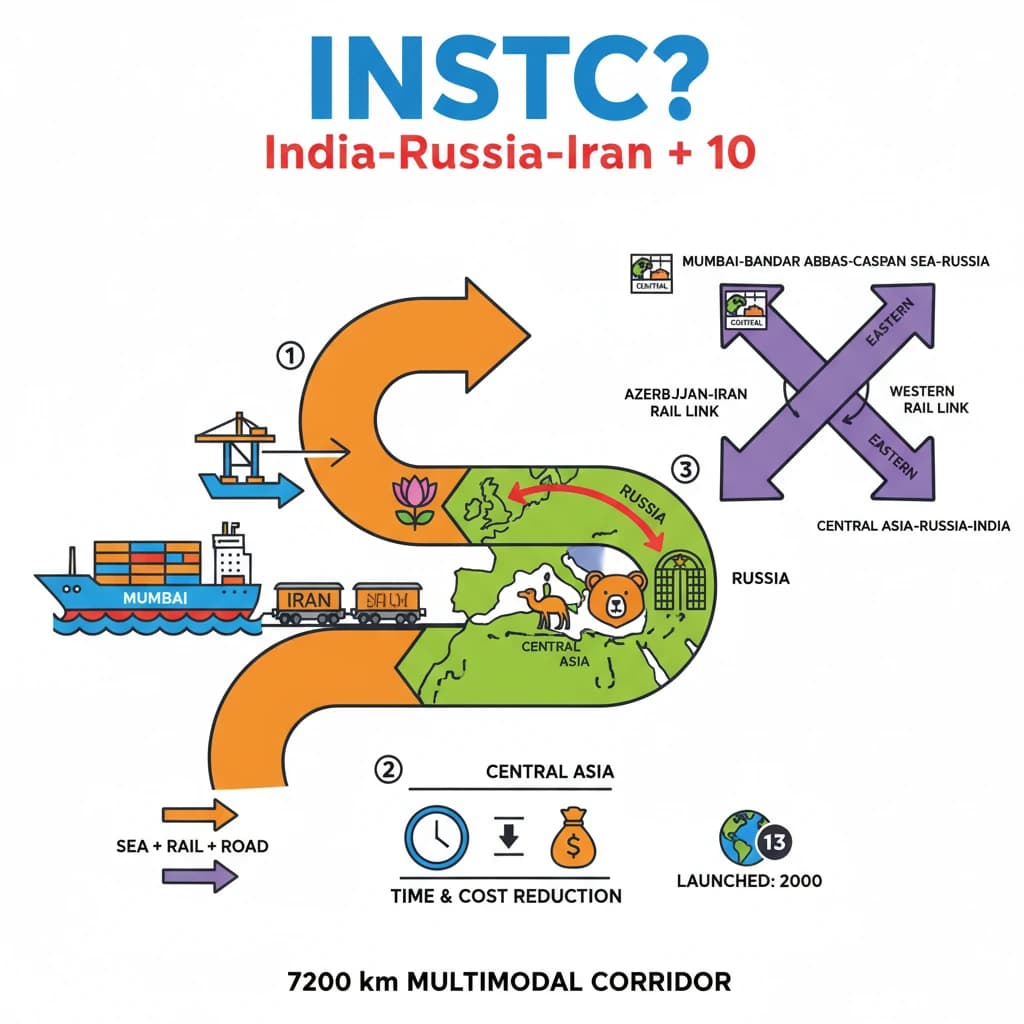
- Central Corridor: This route originates from the Jawaharlal Nehru Port in Mumbai, India. It connects to Bandar Abbas port (Iran) on the Strait of Hormuz. Subsequently, it traverses Iranian territory via Nowshahr, Amirabad, and Bandar-e-Anzali, along the Caspian Sea, reaching Olya and Astrakhan Ports in Russia.
- Western Corridor: This corridor links the railway network of Azerbaijan to that of Iran. The connection occurs through the cross-border nodal points of Astara (Azerbaijan) and Astara (Iran). From there, it extends to the Jawaharlal Nehru Port in India via a sea route.
- Eastern Corridor: This route establishes connectivity between Russia and India. It passes through the Central Asian countries of Kazakhstan, Uzbekistan, and Turkmenistan.
Understanding the specific routes and their geographic significance is crucial for questions on connectivity projects and India's strategic partnerships in UPSC Mains GS-II.
💡 Key Takeaways
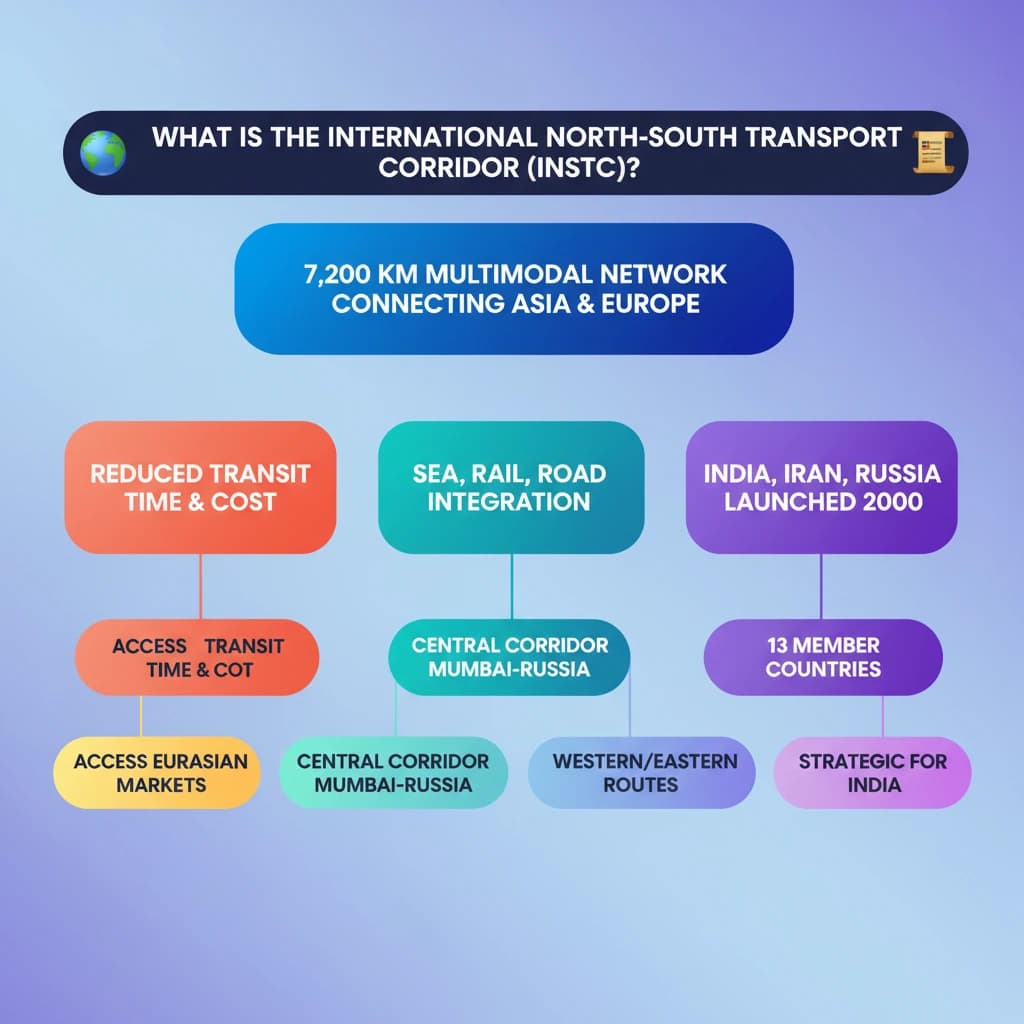
- •INSTC is a 7,200 km multimodal corridor connecting India, Iran, Russia, Central Asia, and Europe.
- •It integrates sea, rail, and road routes, significantly reducing transit time and costs compared to traditional routes.
- •Launched in 2000 by India, Iran, and Russia, its membership has expanded to 13 countries.
- •Key corridors include Central (Mumbai-Bandar Abbas-Caspian Sea-Russia), Western (Azerbaijan-Iran rail link), and Eastern (Central Asia-Russia-India).
- •Strategically important for India to access Eurasian markets, enhance connectivity, and diversify trade routes.
🧠 Memory Techniques
95% Verified Content
📚 Reference Sources
•Ministry of External Affairs (India) reports on INSTC
•Official INSTC website (if available)