Loading page, please wait…
Gene Therapy for Hemophilia A - UPSC Science And Technology
What is Gene Therapy for Hemophilia A in UPSC Science And Technology?
Gene Therapy for Hemophilia A is a key topic under Science And Technology for UPSC Civil Services Examination. Key points include: India conducted its first human gene therapy trial for Hemophilia A at CMC Vellore, a significant medical milestone.. Hemophilia A is an X-linked recessive bleeding disorder caused by a deficiency of Factor VIII, a crucial clotting protein.. Gene therapy for Hemophilia A uses lentiviral vectors to insert a functional Factor VIII gene into stem cells for sustained protein production.. Understanding this topic is essential for both UPSC Prelims and Mains preparation.
Why is Gene Therapy for Hemophilia A important for UPSC exam?
Gene Therapy for Hemophilia A is a Medium-level topic in UPSC Science And Technology. It is tested in both Prelims (factual MCQs) and Mains (analytical answer writing). Previous year UPSC questions have frequently covered aspects of Gene Therapy for Hemophilia A, making it essential for comprehensive IAS preparation.
How to prepare Gene Therapy for Hemophilia A for UPSC?
To prepare Gene Therapy for Hemophilia A for UPSC: (1) Study the comprehensive notes covering all key concepts on Vaidra. (2) Practice previous year questions on this topic. (3) Connect it with current affairs using daily updates. (4) Revise using key takeaways and mind maps available for Science And Technology. (5) Write practice answers linking Gene Therapy for Hemophilia A to related GS Paper topics.
Key takeaways of Gene Therapy for Hemophilia A for UPSC
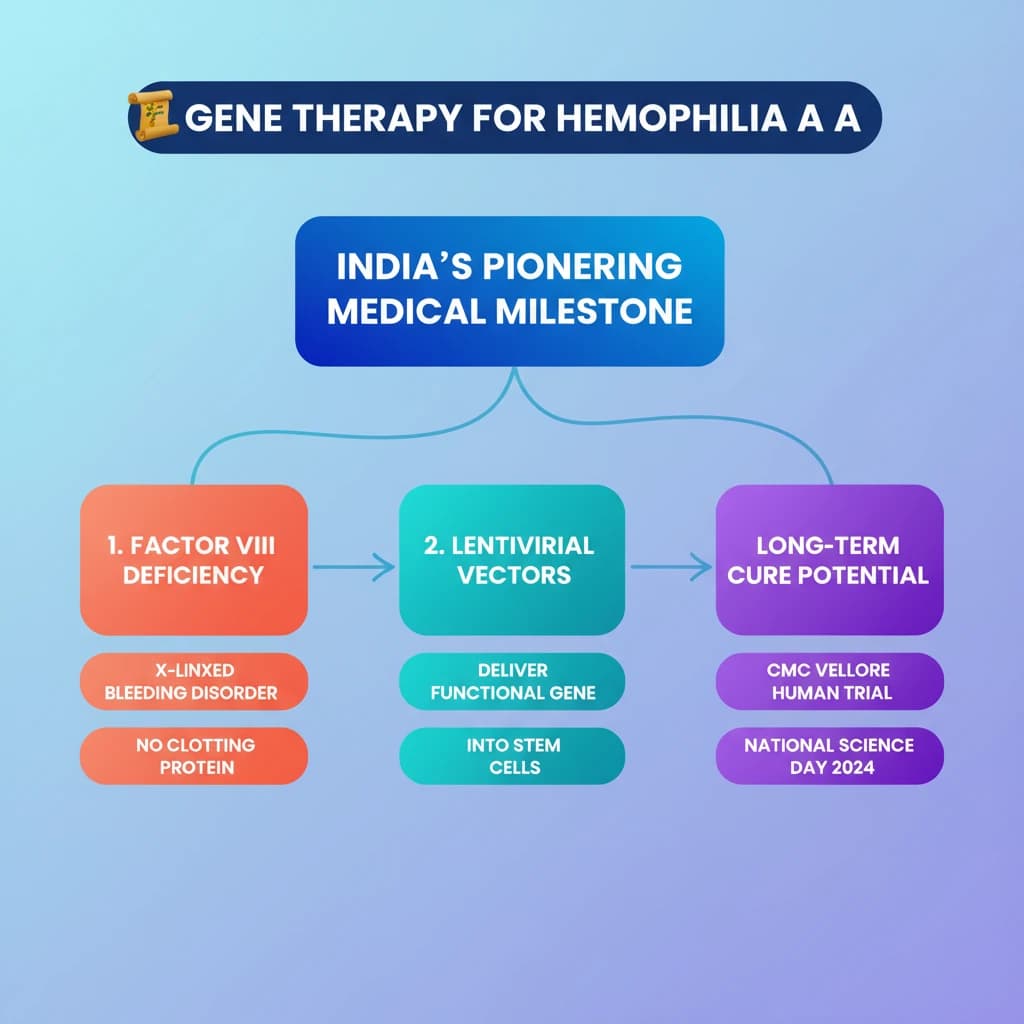
- India conducted its first human gene therapy trial for Hemophilia A at CMC Vellore, a significant medical milestone.
- Hemophilia A is an X-linked recessive bleeding disorder caused by a deficiency of Factor VIII, a crucial clotting protein.
- Gene therapy for Hemophilia A uses lentiviral vectors to insert a functional Factor VIII gene into stem cells for sustained protein production.
- Traditional treatments include plasma-derived and recombinant Factor VIII concentrates, with gene therapy offering a potential long-term cure.
- The trial's announcement on National Science Day 2024 highlights India's progress in S&T and commitment to advanced medical research.

Gene Therapy for Hemophilia A
Medium⏱️ 8 min read
science and technology
📖 Introduction
India's Landmark Gene Therapy Trial for Hemophilia A
Recently, the Union Minister of Science & Technology announced a significant milestone for India. The country successfully conducted its first human clinical trial of gene therapy for Hemophilia A (Factor VIII deficiency).
This pioneering trial took place at Christian Medical College (CMC), Vellore. The announcement was made during the National Science Day 2024 programme, highlighting India's advancements in Science and Technology (S&T).
UPSC Insight: This news is crucial for Science & Technology (GS-III), demonstrating India's capabilities in advanced medical research. Be prepared for questions on gene therapy applications and indigenous S&T initiatives.
Understanding Hemophilia A
Hemophilia is a group of rare bleeding disorders characterized by a congenital deficiency in specific clotting factors. Among these, Hemophilia A is the most prevalent form.
Definition: Hemophilia A results from a deficiency in Factor VIII, a crucial blood clotting protein. This deficiency impairs the blood's ability to clot effectively.
Individuals with Hemophilia A experience prolonged bleeding after injuries because their blood takes longer than usual to form a clot.
Causes of Hemophilia A
Hemophilia A is primarily an inherited (genetic) disorder. It follows an X-linked recessive pattern of inheritance, meaning the gene responsible for Factor VIII production is located on the X chromosome.
X-linked Recessive Inheritance:
- Males (XY): Inherit one X chromosome from their mother. If this X chromosome carries the defective gene, they will develop Hemophilia A.
- Females (XX): Inherit two X chromosomes. Typically, if one X chromosome has the defective gene, the other X chromosome provides enough Factor VIII, making them asymptomatic carriers.
- Rare Cases in Females: Females can develop Hemophilia A if they inherit two defective copies, one from each parent. This is much less common.
Symptoms of Hemophilia A
The severity of Hemophilia A symptoms varies, depending on the level of Factor VIII activity in the blood. Common symptoms include:
- Easy bruising and excessive bleeding from minor injuries (e.g., cuts, scrapes).
- Bleeding into the joints (especially knees, elbows, and ankles), leading to significant pain, swelling, and stiffness.
- Prolonged bleeding after surgical procedures or dental work.
Traditional Treatments for Hemophilia A
Traditional treatment for Hemophilia A focuses on replacing the missing blood clotting factor to enable proper blood clotting. This is typically achieved through injections of clotting factor concentrates into a person's veins.
Types of Clotting Factor Concentrates:
- Plasma-derived Factor Concentrates: These are obtained from human plasma, which contains various proteins, including clotting factors.
- Recombinant Factor Concentrates: Introduced in 1992, these are engineered using DNA Technology. They do not rely on human plasma, eliminating the risk of viral transmission.
Gene Therapy: A Promising New Approach
While traditional treatments manage symptoms, gene therapy is gaining prominence as a potential long-term solution. Recent trials, including India's first, utilize innovative methods to address the root cause.
Mechanism of Gene Therapy for Hemophilia A:
A special type of virus, known as a lentiviral vector, is used to deliver a gene that produces Factor VIII into the patient's own stem cells. These modified stem cells are then re-introduced into the body.
As these modified stem cells develop into specific types of blood cells, they continuously produce the missing Factor VIII, potentially offering a sustained therapeutic effect.
Acquired Hemophilia A
Although Hemophilia A is typically inherited, it can also manifest later in life. This condition, known as acquired hemophilia A, is rare.
Acquired Hemophilia A: This form occurs when the body produces auto-antibodies that target and neutralize Factor VIII. It differs from the congenital form in its onset and progression.
National Science Day and World Haemophilia Day
The announcement of India's gene therapy trial coincided with National Science Day 2024, celebrated annually on February 28th.
National Science Day: Commemorates the discovery of the 'Raman Effect' in 1928 by Sir Chandrasekhara Venkata Raman. This discovery earned him the Nobel Prize in 1930. The Raman Effect is a method for identifying materials based on how they scatter light.
Additionally, World Haemophilia Day is observed annually on April 17th. This day aims to raise awareness about hemophilia and other inherited bleeding disorders.
World Haemophilia Day: Celebrated in honor of Frank Schnabel, the founder of the World Federation of Haemophilia (WHF).
💡 Key Takeaways
- •India conducted its first human gene therapy trial for Hemophilia A at CMC Vellore, a significant medical milestone.
- •Hemophilia A is an X-linked recessive bleeding disorder caused by a deficiency of Factor VIII, a crucial clotting protein.
- •Gene therapy for Hemophilia A uses lentiviral vectors to insert a functional Factor VIII gene into stem cells for sustained protein production.
- •Traditional treatments include plasma-derived and recombinant Factor VIII concentrates, with gene therapy offering a potential long-term cure.
- •The trial's announcement on National Science Day 2024 highlights India's progress in S&T and commitment to advanced medical research.
🧠 Memory Techniques

95% Verified Content
📚 Reference Sources
•World Federation of Hemophilia (WFH) official resources
•National Science Day official information (Govt. of India)
•General knowledge on gene therapy and Hemophilia A