Loading page, please wait…
HomeCurrent AffairsEditorialsGovt SchemesLearning ResourcesUPSC SyllabusPricingAboutBest UPSC AIUPSC AI ToolAI for UPSCUPSC ChatGPT

© 2026 Vaidra. All rights reserved.

PrivacyTerms
Vaidra Logo
Vaidra

Top 4 items + smart groups

UPSC GPT
New
Current Affairs
Daily Solutions
Daily Puzzle
Mains Evaluator

Version 2.0.0 • Built with ❤️ for UPSC aspirants

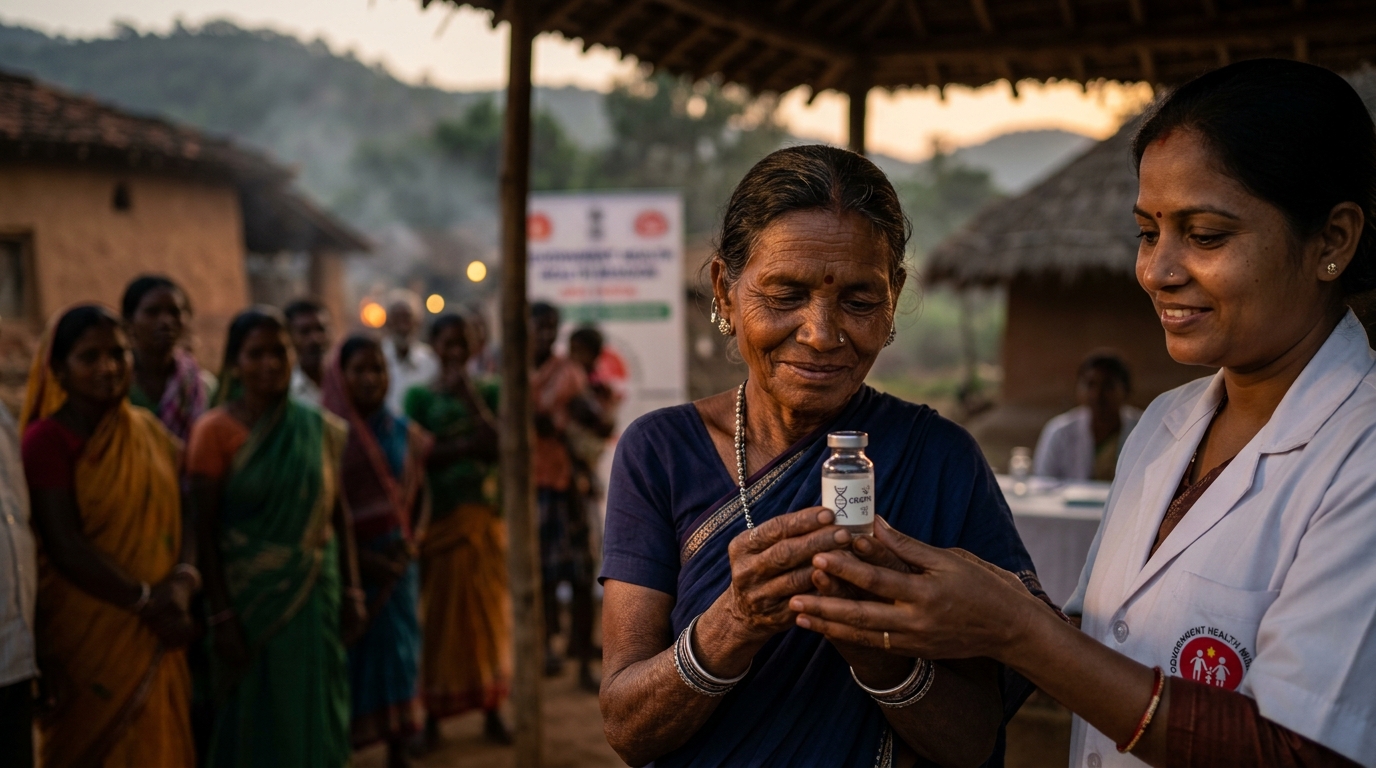
Union Minister Dr. Jitendra Singh launches India's first indigenous "CRISPR" based gene therapy for Sickle Cell Disease, which particularly affects India's tribal population — UPSC Current Affairs | November 19, 2025
Union Minister Dr. Jitendra Singh launches India's first indigenous "CRISPR" based gene therapy for Sickle Cell Disease, which particularly affects India's tribal population
India launched its first indigenous CRISPR-based gene therapy, 'BIRSA 101', for Sickle Cell Disease, developed by CSIR-IGIB and partnered with Serum Institute for affordable access. This initiative aligns with the goal of a Sickle Cell Disease-free India by 2047 and promotes self-reliance in biotechnology.
Overview Union Minister Dr. Jitendra Singh launched India's first indigenous CRISPR based gene therapy for Sickle Cell Disease , named "BIRSA 101" . This therapy is dedicated to Bhagwan Birsa Munda , commemorating his 150th anniversary . The initiative marks a significant step towards achieving a Sickle Cell Disease-free India and promoting Atmanirbhar Bharat in medical technologies. Key Developments Launch Date: November 19, 2025 Therapy Name: BIRSA 101 Developer: CSIR–Institute of Genomics & Integrative Biology (IGIB) Partner: Serum Institute of India (SIIPL) Goal: Sickle Cell Disease-free India by 2047 Significance The development and launch of BIRSA 101 represent a major milestone in India's public health and genomic medicine landscape. This indigenous CRISPR -based gene therapy demonstrates India's capability to produce pathbreaking therapies at a fraction of global costs, potentially replacing treatments priced at ₹20–25 crore overseas. The therapy holds deep national significance, especially for tribal communities in central and eastern India, where the disease burden is highest. Technology Transfer and Collaboration A formal technology transfer and collaboration agreement was exchanged between CSIR-IGIB and the Serum Institute of India Pvt. Ltd. This partnership enables the translation of IGIB’s engineered enFnCas9 CRISPR platform into scalable, affordable therapies for Sickle Cell Disease and other critical genetic disorders. This collaboration mirrors India’s successful public-private model seen during the development of several vaccines and therapeutics over the past decade. UPSC Relevance This development is highly relevant for the UPSC Civil Services Exam , particularly under GS Paper 3 (Science and Technology) and GS Paper 2 (Health) . It highlights India's advancements in biotechnology, healthcare innovation, and public-private partnerships. The focus on tribal communities also connects to social justice and inclusive development themes. Important Facts Sickle Cell Disease particularly affects India's tribal population. BIRSA 101 is dedicated to Bhagwan Birsa Munda . The CRISPR platform was developed at CSIR–Institute of Genomics & Integrative Biology (IGIB) . Serum Institute of India (SIIPL) is partnering for scalable and affordable therapies. The goal is to achieve a Sickle Cell Disease-free India by 2047 .
  1. Home
  2. Prepare
  3. Current Affairs
  4. Union Minister Dr. Jitendra Singh launches India's first indigenous "CRISPR" based gene therapy for Sickle Cell Disease, which particularly affects India's tribal population
Login to bookmark articles
Login to mark articles as complete

Overview

Full Article

Read Original

Analysis

Prelims Facts (Factual Knowledge)

  1. What is the name of India's first indigenous CRISPR-based gene therapy?
  2. Which institute developed the CRISPR platform?
  3. Which organization has partnered with CSIR-IGIB for technology transfer?
  4. What is the target year for a Sickle Cell Disease-free India?
  5. Who is the therapy 'BIRSA 101' dedicated to?

Mains Angles (Analytical Discussion)

  1. Discuss the significance of indigenous gene therapy development for India's healthcare sector.
  2. Analyze the role of public-private partnerships in advancing biotechnology in India.
  3. Evaluate the potential of CRISPR technology in treating genetic disorders, with reference to Sickle Cell Disease.
  4. Assess the impact of affordable gene therapies on underserved populations in India.

Essay Themes (Critical Thinking)

Science and Technology for Inclusive Development

The Role of Public-Private Partnerships in Healthcare Innovation

India's Journey Towards Self-Reliance in Biotechnology

Related:Daily•Weekly

Loading related articles...

Loading related articles...

Tip: Click articles above to read more from the same date, or use the back button to see all articles.

Explore:Current Affairs·Editorial Analysis·Govt Schemes·Study Materials·Previous Year Questions·UPSC GPT