Loading page, please wait…
HomeCurrent AffairsEditorialsGovt SchemesLearning ResourcesUPSC SyllabusPricingAboutBest UPSC AIUPSC AI ToolAI for UPSCUPSC ChatGPT

© 2026 Vaidra. All rights reserved.

PrivacyTerms
Vaidra Logo
Vaidra

Top 4 items + smart groups

UPSC GPT
New
Current Affairs
Daily Solutions
Daily Puzzle
Mains Evaluator

Version 2.0.0 • Built with ❤️ for UPSC aspirants

CDS General Anil Chauhan Inaugurates DRDO’s Two‑Day CBRN Conclave – Building a Resilient India — UPSC Current Affairs | February 26, 2026
CDS General Anil Chauhan Inaugurates DRDO’s Two‑Day CBRN Conclave – Building a Resilient India
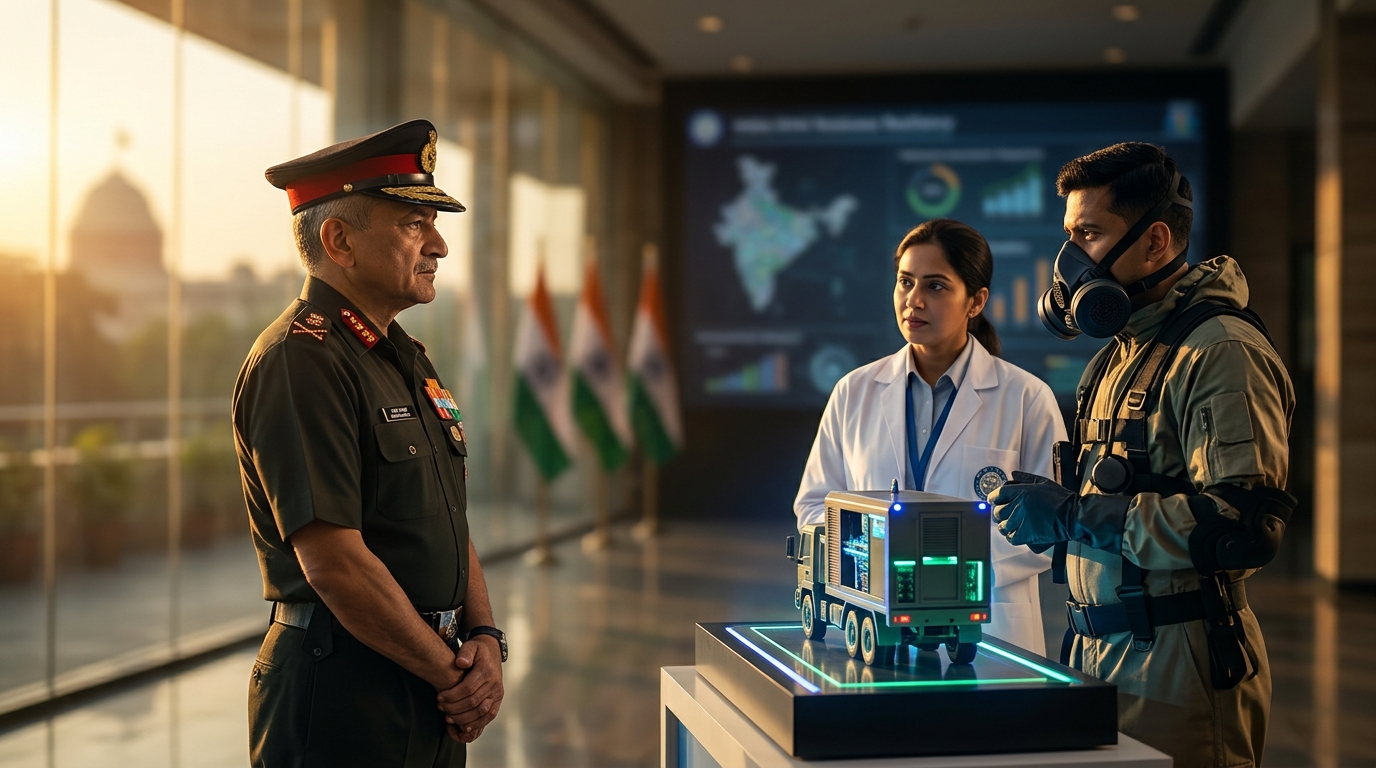
The Chief of Defence Staff General Anil Chauhan inaugurated DRDO’s two‑day CBRN Conclave (26‑27 Feb 2026) to boost India’s resilience against chemical, biological, radiological and nuclear threats. The event emphasized indigenous technology, AI‑driven detection systems, and coordinated training of armed forces, CAPFs and NDRF, underscoring its relevance to UPSC topics on defence policy, science & technology, and disaster management.
The Chief of Defence Staff (CDS) General Anil Chauhan inaugurated a two‑day CBRN Conclave organised by the DRDO at the Manekshaw Centre, New Delhi on 26‑27 February 2026. The event gathered senior officials from the Armed Forces, CAPFs , the NDRF and other stakeholders to strengthen India’s preparedness against CBRN threats. Key Developments CDS praised DRDO’s strides toward self‑reliance in CBRN defence technologies and quoted PM Narendra Modi on India’s resolve against nuclear blackmail. Emphasis on treating CBRN as an environment rather than a mere threat, urging development of indigenous early‑warning systems, lightweight Individual Protective Equipment (IPE) and robust Standard Operating Procedures. DRDO Chairman Dr Samir V Kamat highlighted specialised labs dedicated to CBRN technology and called for peer learning. DG Armed Forces Medical Services (AFMS) Vice Admiral Arti Sarin lauded the Vikiran Prehri programme for building medical capacity. DG (Soldier Support System) Dr U.K. Singh outlined the conclave’s agenda to devise scenario‑based plans guiding rapid technology development. Important Facts The conclave focused on integrating stakeholder perspectives into training modules and technology infusion. It underscored the creation of a national network‑centric command‑and‑control framework leveraging AI/ML ‑driven sensors for real‑time CBRN detection. The event also stressed the need for fast‑track development of indigenous CBRN equipment to reduce dependence on imports. UPSC Relevance Understanding CBRN preparedness touches multiple GS papers: GS 2 (Polity) – role of CDS, DRDO and inter‑agency coordination; GS 3 (Science & Technology, Economy, Disaster Management) – indigenous R&D, AI/ML applications, self‑reliance under ‘Make in India’; GS 4 (Security) – strategic implications of CBRN threats and national resilience. The emphasis on “environmental” framing of CBRN aligns with contemporary security discourse on non‑traditional threats. Way Forward Accelerate indigenous development of early‑warning sensors, IPE and decontamination kits through DRDO‑AFMS collaborations. Institutionalise regular joint drills involving Armed Forces, CAPFs and NDRF to test SOPs in simulated CBRN scenarios. Expand the Vikiran Prehri model to other medical institutions for wider capacity building. Deploy AI/ML‑enabled sensor networks across critical infrastructure to ensure rapid detection and response. Formulate a comprehensive national CBRN policy integrating defence, health, and disaster management ministries, ensuring budgetary allocations and legislative backing.
  1. Home
  2. Prepare
  3. Current Affairs
  4. CDS General Anil Chauhan Inaugurates DRDO’s Two‑Day CBRN Conclave – Building a Resilient India
Login to bookmark articles
Login to mark articles as complete

Overview

CDS‑led CBRN Conclave underscores India’s push for indigenous defence & disaster resilience

Key Facts

  1. 26‑27 February 2026, Manekshaw Centre, New Delhi – two‑day CBRN Conclave.
  2. Inaugurated by Chief of Defence Staff General Anil Chauhan; organised by DRDO.
  3. Attended by senior officials of the Armed Forces, CAPFs, NDRF and DRDO scientists.
  4. Key agenda: indigenous early‑warning sensors, lightweight IPE and AI/ML‑driven detection systems.
  5. DRDO highlighted the Vikiran Prehri programme for radiological emergency medical training.
  6. Plan to create a national network‑centric CBRN command‑and‑control framework.
  7. Goal: fast‑track indigenisation to curb dependence on imports and counter nuclear blackmail.

Background & Context

India’s CBRN preparedness sits at the intersection of GS‑3 (science‑technology, disaster management) and GS‑4 (security). The conclave reflects the ‘Make in India’ thrust in defence R&D and the need for integrated civil‑military response to non‑traditional threats.

UPSC Syllabus Connections

Prelims_GS•Science and Technology ApplicationsGS3•Various security forces and agenciesGS3•Developments in science and technology and their applicationsGS3•Disaster and disaster managementEssay•Science, Technology and SocietyPrelims_GS•National Current Affairs

Mains Answer Angle

In a GS‑3 answer, discuss how DRDO’s CBRN initiatives strengthen national security and disaster resilience, and evaluate the policy‑to‑practice gaps in India’s CBRN framework.

Full Article

Read Original on pib

Analysis

Practice Questions

Prelims
Easy
Prelims MCQ

CBRN preparedness – recent developments

2 marks
4 keywords
GS3
Medium
Mains Short Answer

DRDO’s contribution to CBRN technology

10 marks
5 keywords
GS3
Hard
Mains Essay

National security and disaster management – CBRN threats

250 marks
6 keywords
Related:Daily•Weekly

Loading related articles...

Loading related articles...

Tip: Click articles above to read more from the same date, or use the back button to see all articles.

Explore:Current Affairs·Editorial Analysis·Govt Schemes·Study Materials·Previous Year Questions·UPSC GPT