Overview
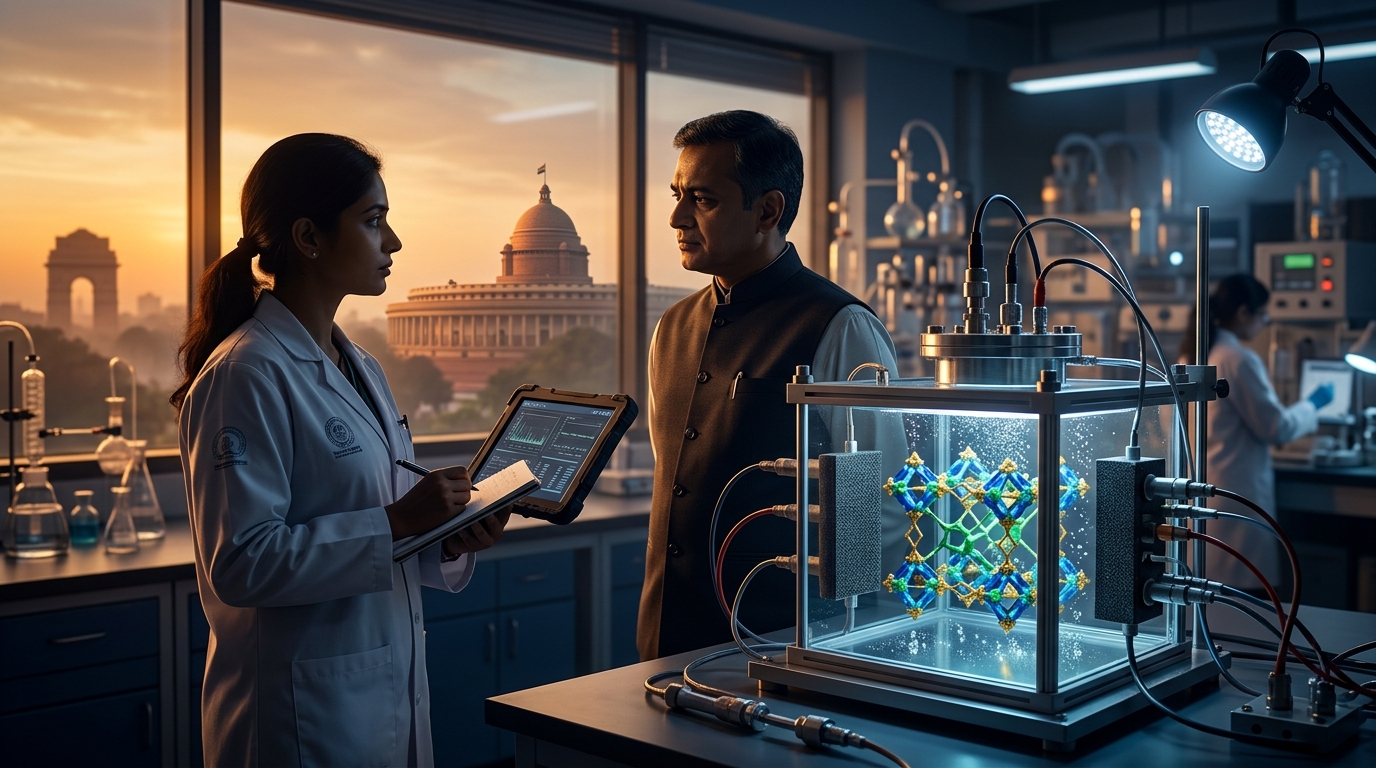
The Ministry of Science & Technology has highlighted a breakthrough in energy materials developed by researchers at the Centre for Nano and Soft Matter Sciences (CeNS), an autonomous arm of the DST, in collaboration with CHRIST (Deemed to be University), Bengaluru. The team synthesized two novel coordination polymers, Zn(DAB) and Cd(DAB), that exhibit exceptional performance both as energy‑storage media and as electrocatalysts for green hydrogen generation.
Key Developments
- Simple, room‑temperature synthesis of Zn(DAB) and Cd(DAB) in bulk without specialised equipment.
- Lab‑scale supercapacitor tests recorded specific capacitances of 2091.4 F g⁻¹ (Zn(DAB)) and 1341.6 F g⁻¹ (Cd(DAB)) in a three‑electrode setup.
- In asymmetric device configuration, the materials retained high capacitance: 785.3 F g⁻¹ (Zn(DAB)) and 428.5 F g⁻¹ (Cd(DAB)).
- Durability demonstrated over 5000 charge‑discharge cycles with negligible loss of capacity.
- Electro‑catalytic water splitting required low overpotential of 263 mV (Zn(DAB)) and 209 mV (Cd(DAB)), rivaling the best known catalysts.
Important Facts
The polymeric frameworks consist of layered structures where Zn²⁺ or Cd²⁺ ions are coordinated with 3,3'-diaminobenzidine (DAB) ligands, creating robust networks that facilitate rapid ion transport and electron conductivity. Their synthesis proceeds at ambient conditions, making them economically viable for scale‑up. The research findings have been peer‑reviewed and published in ACS Omega and Catalysis Science and Technology.
Exam Relevance
Understanding emerging supercapacitor technologies is essential for GS‑3 topics on energy security, renewable integration, and indigenous technology development. The low overpotential values illustrate progress toward cost‑effective green hydrogen, a priority area in India’s National Hydrogen Mission. The role of DST and the Ministry of Science & Technology showcases the policy‑driven push for indigenous R&D, a recurring theme in GS‑2 (Polity) and GS‑3 (Economy) questions.
Way Forward
To translate laboratory success into commercial impact, the following steps are recommended:
- Establish pilot‑scale production units under the DST scheme for advanced materials.
- Integrate Zn(DAB) and Cd(DAB) into grid‑level storage modules and electrolyzer stacks, assessing performance under real‑world load profiles.
- Encourage public‑private partnerships to lower capital costs and accelerate market adoption of high‑capacitance supercapacitors and low‑overpotential hydrogen catalysts.
- Incorporate these materials into India’s National Hydrogen Mission roadmap, aligning with the country’s carbon‑neutral targets for 2070.
Continued interdisciplinary research, supported by robust policy frameworks, can bridge the gap between scientific discovery and sustainable energy solutions for India.