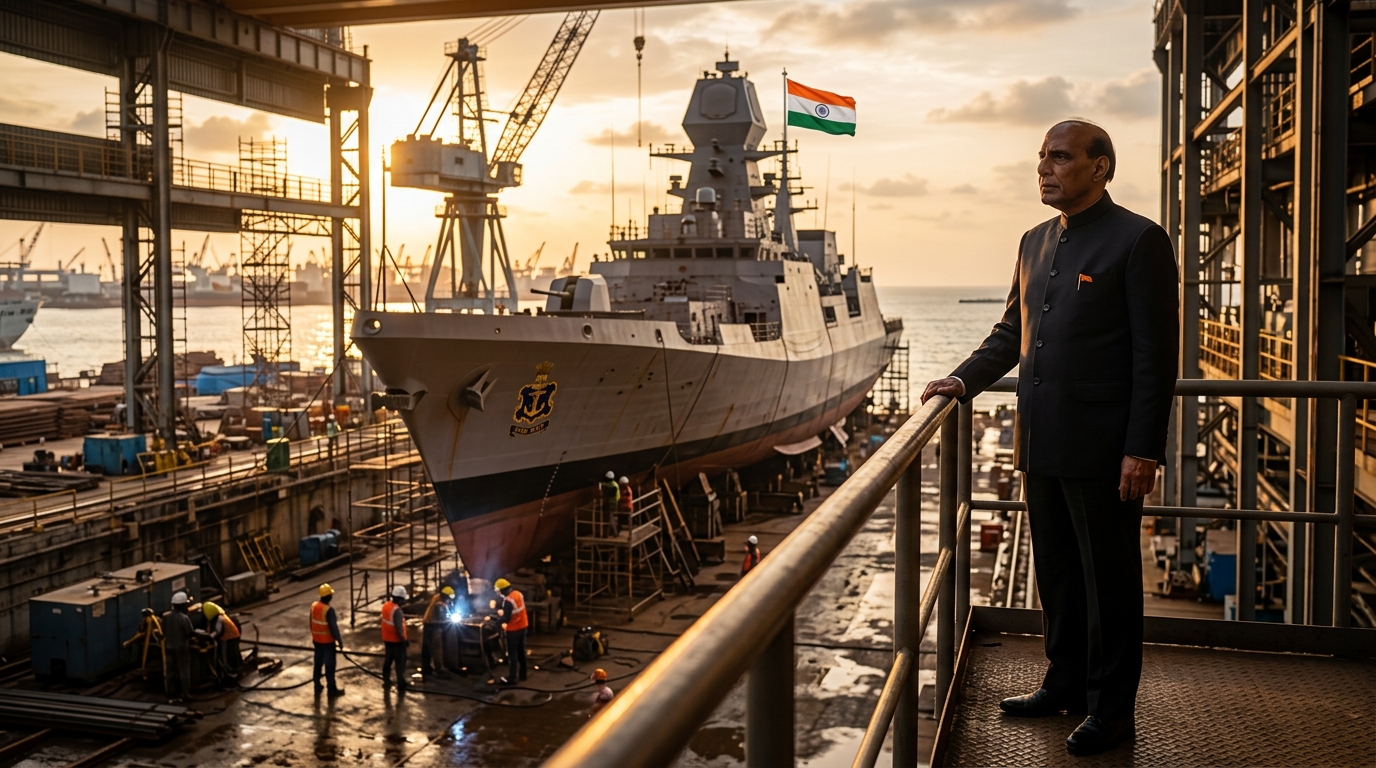
Defence Minister Rajnath Singh Announces Push for Self‑Reliant Shipbuilding – Goal to Reach Top‑10 Global Shipbuilders by 2030 — UPSC Current Affairs | March 6, 2026
Defence Minister Rajnath Singh Announces Push for Self‑Reliant Shipbuilding – Goal to Reach Top‑10 Global Shipbuilders by 2030
Defence Minister Rajnath Singh, at the Sagar Sankalp dialogue on 6 March 2026, announced an ambitious push for self‑reliant shipbuilding, targeting a top‑10 global position by 2030 and top‑5 by 2047, backed by record‑high defence production and export figures. The initiative emphasizes modernising shipyards, expanding private sector participation, and investing Rs 3 lakh crore under Maritime India Vision 2030 and Maritime Amrit Kaal 2047, underscoring its relevance for UPSC topics on defence policy, economic self‑reliance, and maritime strategy.
Overview On 6 March 2026 , Raksha Mantri Shri Rajnath Singh inaugurated Sagar Sankalp in Kolkata. He linked global supply‑chain disruptions and heightened maritime activity to the need for Aatmanirbharta in defence, especially shipbuilding. Key Developments Target to place India among the top‑10 shipbuilding nations by 2030 and top‑5 by 2047. Domestic defence production crossed Rs 1.50 lakh crore in FY 2024‑25; exports reached ≈ Rs 24,000 crore and are projected to hit ≈ Rs 29,000 crore by April 2026 . Private sector’s share in defence platforms is about 25 % and is expected to rise to 50 % of total value. All warships and submarines on order for the Indian Navy are being built in Indian shipyards from design to life‑cycle support. Implementation of defence corridors , green‑channel certification, and opening of DPSU orders to private players. Investment of roughly Rs 3 lakh crore under Maritime India Vision 2030 and Maritime Amrit Kaal 2047 for modern shipbuilding clusters. Important Facts The government has emphasized turning shipyards like GRSE into technology hubs through digital design tools, modular construction, and integrated supply chains. Financial assistance schemes, liberalised FDI norms, and PPP models are being introduced to attract private investment. Operations such as Operation Sindoor showcase the Indian Navy’s readiness, reinforcing the narrative that a “Builder’s Navy” is now a reality rather than a slogan. UPSC Relevance GS 2 (Polity) : Understanding the role of the Defence Ministry, DPSUs, and policy reforms for self‑reliance. GS 3 (Economy) : Impact of defence exports on trade balance, FDI liberalisation, and the economic rationale behind defence corridors . GS 1 (History) : Continuity from the historic transition of the Indian Navy from a “Buyer’s Navy” to a “Builder’s Navy”. GS 4 (Ethics) : Public‑private partnership dynamics and the ethical dimension of self‑reliance versus strategic dependence. Way Forward To achieve the stated targets, the government must sustain: Robust R&D investment in high‑end defence technologies. Streamlined import‑export procedures and faster green‑channel clearances. Enhanced collaboration between DPSUs, MSMEs, start‑ups, and private shipbuilders. Continuous up‑skilling of the workforce to operate advanced digital and modular shipbuilding platforms. Successful implementation will not only secure India’s maritime interests but also position the country as a major global shipbuilding hub, contributing to strategic autonomy and economic growth.
Must Review
Login to bookmark articles
Login to mark articles as complete
Overview
India targets top‑10 shipbuilders by 2030 to boost defence self‑reliance
Key Facts
6 Mar 2026: Defence Minister Rajnath Singh inaugurated Sagar Sankalp in Kolkata, announcing the shipbuilding push.
Goal: India to rank among the top‑10 global shipbuilding nations by 2030 and top‑5 by 2047.
Private sector’s share in defence platforms is ~25% now, targeted to rise to 50% of total defence value.
All warships and submarines on order for the Indian Navy will be built entirely in Indian shipyards, from design to life‑cycle support.
≈ Rs 3 lakh crore earmarked under Maritime India Vision 2030 & Maritime Amrit Kaal 2047 for modern shipbuilding clusters.
Policy levers: defence corridors, green‑channel certification and opening DPSU orders to private players.
Background & Context
The initiative aligns with the Aatmanirbharta drive, linking defence self‑reliance to economic growth, export earnings and strategic autonomy. It reflects a shift from a ‘buyer’s navy’ to a ‘builder’s navy’, integrating industrial policy, PPP models and liberalised FDI within the GS‑3 (Industrial Policy & Infrastructure) framework.
UPSC Syllabus Connections
GS2•Government policies and interventions for developmentEssay•Economy, Development and InequalityGS3•Effects of liberalization on economy, industrial policy and growthEssay•Science, Technology and SocietyPrelims_GS•National Current AffairsGS3•Infrastructure - Energy, Ports, Roads, Airports, RailwaysEssay•Democracy, Governance and Public AdministrationGS3•Developments in science and technology and their applicationsPrelims_GS•Public Policy and Rights IssuesGS2•Governance, transparency, accountability and e-governance
Mains Answer Angle
In GS‑3, candidates can evaluate how public‑private partnerships and defence corridors can propel India to the top‑10 shipbuilding league, assessing implications for trade balance, technology transfer and maritime security.