Loading page, please wait…
HomeCurrent AffairsEditorialsGovt SchemesLearning ResourcesUPSC SyllabusPricingAboutBest UPSC AIUPSC AI ToolAI for UPSCUPSC ChatGPT

© 2026 Vaidra. All rights reserved.

PrivacyTerms
Vaidra Logo
Vaidra

Top 4 items + smart groups

UPSC GPT
New
Current Affairs
Daily Solutions
Daily Puzzle
Mains Evaluator

Version 2.0.0 • Built with ❤️ for UPSC aspirants

Indian Navy’s Decisive Role in Operation Sindoor (May 2025) – Maritime Dominance & Strategic Restraint — UPSC Current Affairs | April 3, 2026
Indian Navy’s Decisive Role in Operation Sindoor (May 2025) – Maritime Dominance & Strategic Restraint
In May 2025, the Indian Navy led a decisive maritime operation—Operation Sindoor—by deploying a Carrier Battle Group centred on INS Vikrant, positioning 36 frontline assets near Karachi and achieving full combat readiness within 96 hours. The show of force, coupled with the commissioning of the nuclear‑powered submarine INS Aridhaman, compelled Pakistan to seek a cease‑fire, illustrating India’s strategic use of naval superiority and measured restraint.
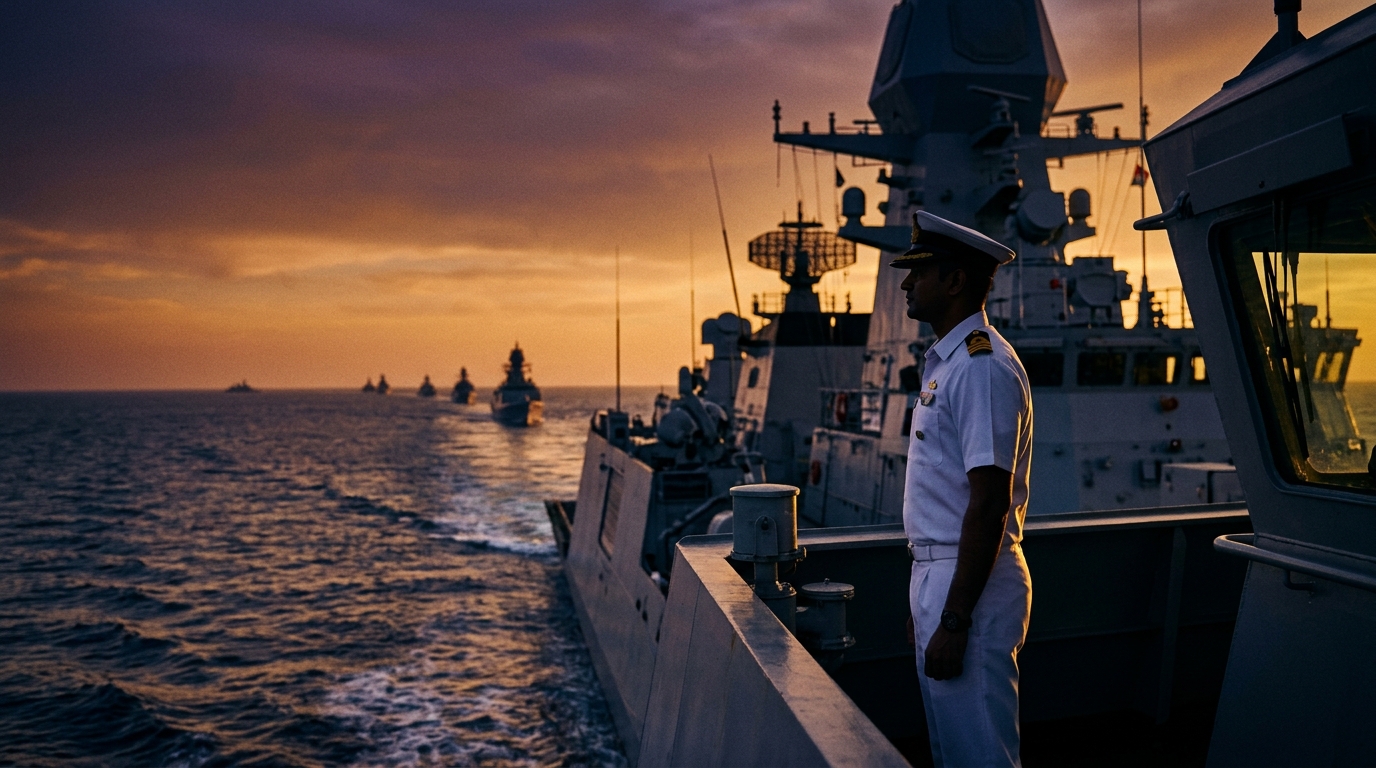
Indian Navy’s Decisive Role in Operation Sindoor The Indian Navy, operating as a networked force, established overwhelming maritime dominance in the Arabian Sea during Operation Sindoor . By deploying a robust Carrier Battle Group led by INS Vikrant , the Navy forced Pakistan into a defensive posture and demonstrated India’s readiness to conduct maritime strikes. Key Developments Deployment of INS Vikrant with MiG‑29K fighters and airborne early‑warning helicopters, ensuring 24‑hour surveillance. Positioning of roughly 36 frontline assets (warships, submarines) near Karachi, a nine‑fold increase over the 1971 war deployment. Readiness to launch maritime strikes within minutes, as stated by Chief of Naval Staff Dinesh K. Tripathi , but restraint exercised after Pakistan sought a cease‑fire. Commissioning of INS Aridhaman on 3 April 2026 , bolstering strategic deterrence. Important Facts • The Navy achieved full combat readiness within 96 hours of the Pahalgam terror attack, as disclosed by Vice Admiral A. N. Pramod , Director General of Naval Operations. • Continuous weapon drills validated strike precision in a complex threat environment. • Pakistani naval and air assets were confined to harbours, limiting their operational freedom along the western seaboard. UPSC Relevance Understanding the Navy’s role in Operation Sindoor is vital for GS 3 (Defence & Security) as it illustrates: Jointness of the three services – Army, Navy, Air Force – in modern Indian warfare. Strategic use of maritime power to achieve political objectives without full‑scale war. India’s evolving naval capabilities, especially the induction of INS Aridhaman , and its impact on the regional security architecture. Way Forward • Maintain high‑readiness posture and regular sea‑based drills to preserve deterrence credibility. • Enhance indigenous ship‑building and submarine programmes to reduce dependence on foreign technology. • Strengthen maritime domain awareness through satellite‑linked sensors and AI‑driven analytics. • Continue diplomatic engagement with Pakistan to translate military pressure into lasting de‑escalation, reflecting the principle of strategic prudence. Overall, the Indian Navy’s calibrated deployment during Operation Sindoor showcases India’s ability to combine hard power with restraint, a critical lesson for future security policymakers.
  1. Home
  2. Prepare
  3. Current Affairs
  4. Indian Navy’s Decisive Role in Operation Sindoor (May 2025) – Maritime Dominance & Strategic Restraint
Must Review
Login to bookmark articles
Login to mark articles as complete

Overview

India’s naval show‑of‑force in Operation Sindoor underscores maritime deterrence and strategic restraint

Key Facts

  1. Operation Sindoor was launched on 7 May 2025 as a limited response to the Pahalgam terror attack.
  2. The Indian Navy deployed a Carrier Battle Group centred on INS Vikrant, equipped with MiG‑29K fighters and airborne early‑warning helicopters.
  3. Approximately 36 frontline naval assets (warships and submarines) were positioned off Karachi – a nine‑fold rise from the 1971 war deployment.
  4. Full combat readiness was achieved within 96 hours of the Pahalgam attack, as confirmed by Director General of Naval Operations Vice Admiral A.N. Pramod.
  5. India commissioned its third nuclear‑powered ballistic missile submarine, INS Aridhaman, on 3 April 2026, completing the nuclear triad.
  6. Despite the capability to launch maritime strikes within minutes, the Navy exercised restraint after Pakistan sought a cease‑fire.
  7. Pakistani naval and air assets were confined to harbours, limiting their operational freedom along the western seaboard.

Background & Context

Operation Sindoor illustrates the growing jointness of India's armed forces and the strategic use of maritime power to achieve political objectives without escalating to full‑scale war, a key theme under GS‑3 (Defence & Security) and internal security. It also reflects the shift in regional security dynamics following the induction of advanced platforms like INS Vikrant and INS Aridhaman.

UPSC Syllabus Connections

GS3•Various security forces and agencies

Mains Answer Angle

GS‑3 (Defence & Security) – Analyse how the Indian Navy’s calibrated deployment in Operation Sindoor demonstrates the balance between hard power projection and strategic restraint, and its implications for India‑Pakistan maritime stability.

Full Article

Read Original on hindu

Analysis

Practice Questions

GS1
Easy
Prelims MCQ

Operation Sindoor and Carrier Battle Group composition

1 marks
3 keywords
GS3
Medium
Mains Short Answer

Maritime dominance and force projection

5 marks
5 keywords
GS3
Hard
Mains Essay

Strategic use of naval power and regional security architecture

20 marks
6 keywords
Related:Daily•Weekly

Loading related articles...

Loading related articles...

Tip: Click articles above to read more from the same date, or use the back button to see all articles.

Explore:Current Affairs·Editorial Analysis·Govt Schemes·Study Materials·Previous Year Questions·UPSC GPT