Loading page, please wait…
HomeCurrent AffairsEditorialsGovt SchemesLearning ResourcesUPSC SyllabusPricingAboutBest UPSC AIUPSC AI ToolAI for UPSCUPSC ChatGPT

© 2026 Vaidra. All rights reserved.

PrivacyTerms
Vaidra Logo
Vaidra

Top 4 items + smart groups

UPSC GPT
New
Current Affairs
Daily Solutions
Daily Puzzle
Mains Evaluator

Version 2.0.0 • Built with ❤️ for UPSC aspirants

Defence Minister Rajnath Singh Calls for Self‑Reliant Drone Manufacturing Ecosystem in India — UPSC Current Affairs | March 19, 2026
Defence Minister Rajnath Singh Calls for Self‑Reliant Drone Manufacturing Ecosystem in India
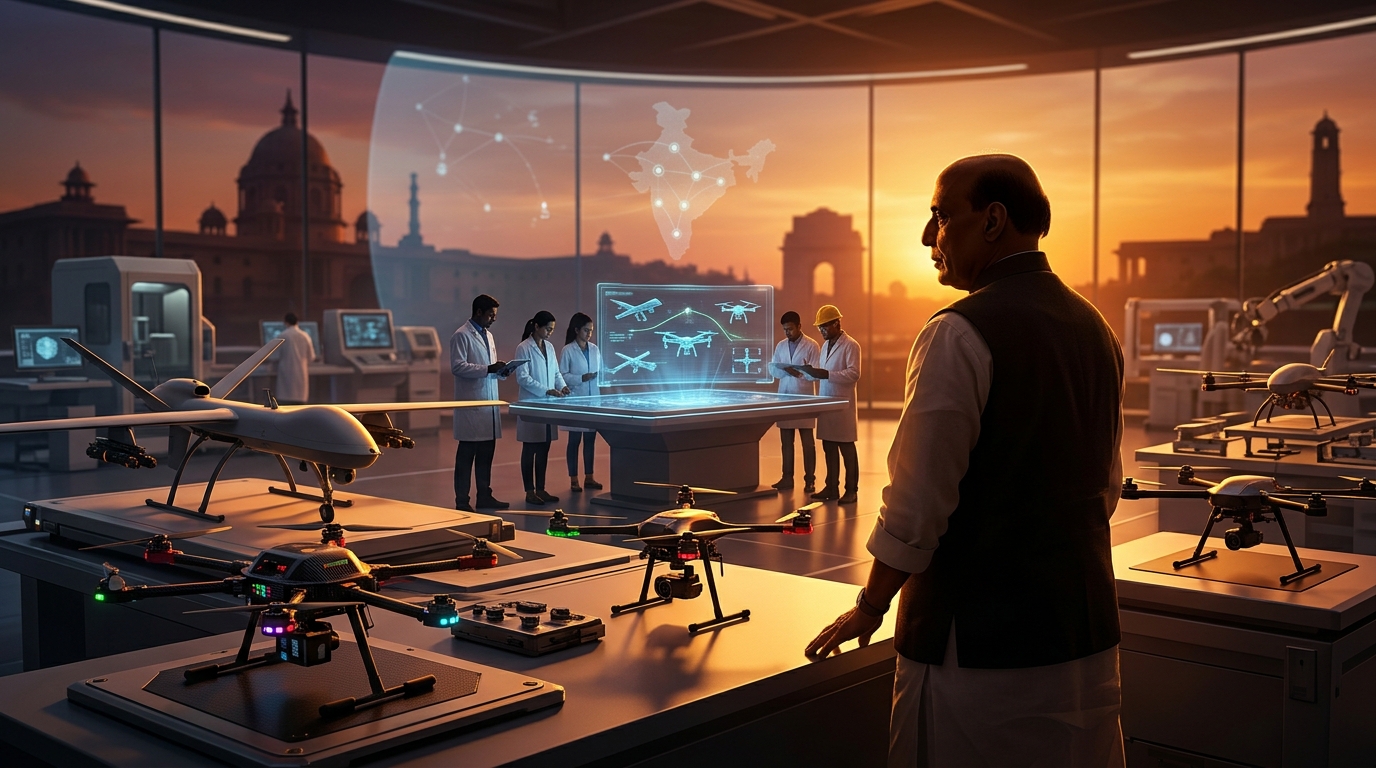
On 19 March 2026, Defence Minister Rajnath Singh urged India to achieve full self‑reliance in drone manufacturing, citing lessons from the Russia‑Ukraine and Iran‑Israel wars. He highlighted the need for indigenous production of drones and their components, alongside AI, robotics and counter‑drone technologies, to bolster strategic autonomy and defence preparedness.
Overview On 19 March 2026 , Defence Minister Rajnath Singh addressed the National Defence Industries Conclave . He highlighted the lessons from the Russia‑Ukraine and Iran‑Israel wars, urging India to build a fully indigenous drone ecosystem. Key Developments Emphasis on self‑reliance at both product and component levels, from airframe moulds to software, engines and batteries. Call for accelerated development of counter‑drone technologies to safeguard Indian airspace. Integration of artificial intelligence , robotics and simulation tools in manufacturing. Appeal to industry leaders, especially defence public sector undertakings , to improve product quality and reduce reliance on imports. Important Facts The minister noted that most countries manufacturing drones still import critical components from a few nations, making true self‑sufficiency challenging. He stressed that India must develop indigenous capabilities for: Airframe moulds and composite materials Propulsion engines and power‑dense batteries Embedded software and navigation systems UPSC Relevance Understanding India's push for a domestic drone manufacturing ecosystem is vital for GS III (Security & Defence) and GS II (Polity) questions on defence procurement, Make‑in‑India, and strategic autonomy. The discussion also links to GS III topics on emerging technologies (AI, robotics) and their impact on warfare. Way Forward Formulate a dedicated Drone Production Policy with incentives for R&D, MSMEs and start‑ups. Establish a national testing and certification centre for counter‑drone solutions. Promote public‑private partnerships to co‑develop critical components such as batteries and avionics. Integrate AI‑driven simulation platforms in defence training institutes to accelerate design cycles. These steps aim to secure India's strategic autonomy, reduce import dependence, and position the nation as a future leader in unmanned warfare.
  1. Home
  2. Prepare
  3. Current Affairs
  4. Defence Minister Rajnath Singh Calls for Self‑Reliant Drone Manufacturing Ecosystem in India
Must Review
Login to bookmark articles
Login to mark articles as complete

Overview

Push for Indigenous Drone Ecosystem to Secure Strategic Autonomy and Reduce Import Dependence

Key Facts

  1. 19 March 2026: Defence Minister Rajnath Singh addressed the National Defence Industries Conclave.
  2. Self‑reliance emphasized for airframe moulds, composite materials, propulsion engines, power‑dense batteries, embedded software and navigation systems.
  3. Accelerated development of counter‑drone technologies urged to safeguard Indian airspace.
  4. Integration of AI, robotics and simulation tools in UAV manufacturing; call for public‑private partnerships and DPSU participation.
  5. Proposal for a dedicated Drone Production Policy with R&D incentives for MSMEs and start‑ups, and a national testing & certification centre for counter‑drone systems.
  6. Globally, most drone‑producing nations import critical components, underscoring the challenge of true self‑sufficiency.

Background & Context

The drive aligns with the Make‑in‑India agenda and the broader goal of strategic autonomy in defence procurement, a key theme in GS‑III. It also intersects with emerging‑technology topics—AI, robotics, and advanced materials—highlighted in the syllabus under Science & Technology and Security & Defence.

UPSC Syllabus Connections

Essay•Science, Technology and SocietyGS3•IT, Space, Computers, Robotics, Nano-technology, Bio-technology and IPREssay•International Relations and GeopoliticsPrelims_GS•Science and Technology ApplicationsPrelims_GS•Ecology and Biodiversity

Mains Answer Angle

GS‑III: Evaluate how an indigenous drone manufacturing ecosystem can enhance India's strategic autonomy and defence preparedness, focusing on policy measures, technology integration and public‑private collaboration.

Full Article

Read Original on hindu

Analysis

Practice Questions

Prelims
Medium
Prelims MCQ

Strategic lessons from Russia‑Ukraine and Iran‑Israel conflicts

1 marks
4 keywords
GS3
Easy
Mains Short Answer

Indigenous drone ecosystem – critical components

5 marks
6 keywords
GS3
Hard
Mains Essay

Indigenous drone manufacturing, Make‑in‑India, strategic autonomy

250 marks
6 keywords
Related:Daily•Weekly

Loading related articles...

Loading related articles...

Tip: Click articles above to read more from the same date, or use the back button to see all articles.

Explore:Current Affairs·Editorial Analysis·Govt Schemes·Study Materials·Previous Year Questions·UPSC GPT