DISHA & NALSA Initiatives Expand Free Legal Aid and Tele‑Law Services Across India (FY 2025‑26) — UPSC Current Affairs | March 13, 2026
DISHA & NALSA Initiatives Expand Free Legal Aid and Tele‑Law Services Across India (FY 2025‑26)
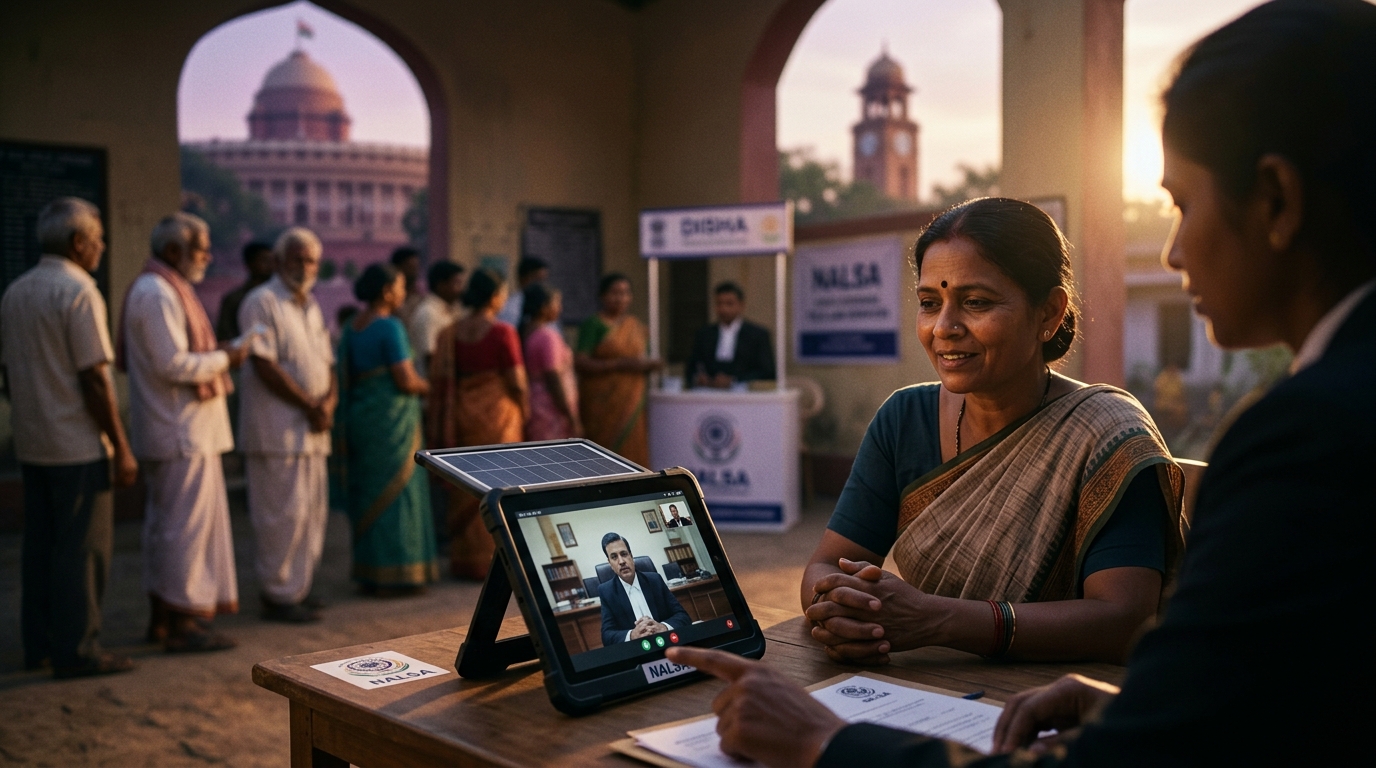
The Ministry of Law and Justice, through the DISHA scheme and NALSA, is expanding free legal aid via Tele‑Law, Nyaya Bandhu, and the Legal Aid Defense Counsel System, reaching over 1.12 crore pre‑litigation advices and aiding more than 16 lakh beneficiaries in FY 2025‑26, underscoring the government’s push for holistic access to justice.
The Ministry of Law and Justice has intensified efforts to provide affordable, accessible justice through the DISHA programme and the statutory body NALSA . These measures align with the Legal Services Authorities (LSA) Act, 1987 and aim to bridge the justice gap for marginalized citizens. Key Developments (FY 2025‑26) More than 1.12 crore pre‑litigation advices delivered under the Tele‑Law platform, leveraging a network of 2.5 lakh CSCs across 777 districts. Registration of 10,263 advocates under Nyaya Bandhu , fostering a pro‑bono culture. Legal Literacy and Legal Awareness Programme reached 1,21,48,172 beneficiaries through partnerships with ministries, schools and grassroots workers. The LADCS operates in 680 districts, disposing 8,71,581 cases out of 12,62,857 assigned, and providing representation to 2,76,476 under‑trial prisoners, leading to the release of 59,630 inmates. Overall, 16,60,249 persons received free legal aid and advice, while 4,91,990 legal‑awareness camps attracted 4,04,59,246 participants. Important Institutional Framework Legal services institutions span from the Supreme Court down to Taluk level, comprising the Supreme Court Legal Services Committee, 38 High Court Legal Services Committees, 37 State Legal Services Authorities, 715 District Legal Services Authorities and 2,475 Taluk Legal Services Committees. Their core functions include legal aid, advice, awareness camps, legal clinics, Lok Adalats and the Victim Compensation Scheme. UPSC Relevance Understanding these schemes is vital for GS 2 (Polity) as they illustrate the government's commitment to judicial accessibility, the functioning of statutory bodies, and the implementation of welfare‑oriented legislation. The scale of digital outreach via CSCs also links to GS 3 (Economy) topics on e‑governance and digital inclusion. Moreover, the pro‑bono initiatives reflect civil‑society participation, relevant for GS 4 (Ethics) discussions on public‑spirit and professional responsibility. Way Forward Expand Tele‑Law to cover remaining aspirational districts and improve connectivity in remote areas. Strengthen monitoring mechanisms to ensure quality of pro‑bono services under Nyaya Bandhu and track outcomes for beneficiaries. Integrate legal literacy modules into school curricula to sustain long‑term awareness. Enhance data‑driven evaluation of LADCS to reduce case pendency and improve prison decongestion. Collectively, these initiatives demonstrate a multi‑pronged approach—technology, pro‑bono advocacy, and institutional strengthening—to realize the constitutional guarantee of equal justice for all.
Login to bookmark articles
Login to mark articles as complete
Overview
DISHA & NALSA drive digital legal aid, narrowing justice gap for marginalized citizens
Key Facts
1.12 crore pre‑litigation advices delivered via Tele‑Law through 2.5 lakh CSCs across 777 districts in FY 2025‑26.
10,263 advocates registered under Nyaya Bandhu to provide pro‑bono assistance.
Legal Literacy Programme reached 1.21 crore beneficiaries via partnerships with ministries, schools and grassroots workers.
LADCS operated in 680 districts, handling 12.62 lakh cases, disposing 8.71 lakh, representing 2.76 lakh under‑trial prisoners and securing release of 59,630 inmates.
Legal services institutional framework: 1 Supreme Court LSC, 38 High Court LSCs, 37 State Legal Services Authorities, 715 District LSAs, 2,475 Taluk LSAs.
DISHA, launched by the Ministry of Law & Justice, operationalises the Legal Services Authorities Act, 1987 for holistic access to justice.
Background & Context
The Constitution guarantees equal justice under Article 21, operationalised through the Legal Services Authorities Act, 1987 and NALSA. DISHA leverages the extensive Common Service Centre network to digitise legal aid, aligning with the government's e‑governance and devolution agenda, and reflects the broader push for inclusive governance and reduction of case pendency.
UPSC Syllabus Connections
Prelims_GS•Constitution and Political SystemPrelims_GS•Panchayati Raj and Local GovernanceGS2•Executive and Judiciary - structure, organization and functioningPrelims_GS•National Current AffairsGS2•Devolution of powers and finances to local levelsEssay•Philosophy, Ethics and Human ValuesGS4•Information sharing, transparency, RTI, codes of ethics and conductGS2•Parliament and State Legislatures - structure, functioning, powers and privilegesGS4•Dimensions of ethics - private and public relationshipsGS2•Functions and responsibilities of Union and States
Mains Answer Angle
GS 2 – Evaluate the impact of technology‑driven legal aid (DISHA, Tele‑Law) and statutory mechanisms (NALSA, LADCS) on bridging the justice gap, and suggest policy measures to enhance their effectiveness.