Loading page, please wait…
HomeCurrent AffairsEditorialsGovt SchemesLearning ResourcesUPSC SyllabusPricingAboutBest UPSC AIUPSC AI ToolAI for UPSCUPSC ChatGPT

© 2026 Vaidra. All rights reserved.

PrivacyTerms
Vaidra Logo
Vaidra

Top 4 items + smart groups

UPSC GPT
New
Current Affairs
Daily Solutions
Daily Puzzle
Mains Evaluator

Version 2.0.0 • Built with ❤️ for UPSC aspirants

Draft Tribal Welfare Plan for Great Nicobar Project Sparks Confusion Over Relocation and Forest Rights — UPSC Current Affairs | April 3, 2026
Draft Tribal Welfare Plan for Great Nicobar Project Sparks Confusion Over Relocation and Forest Rights
The Andaman and Nicobar administration has circulated a draft <strong>Comprehensive Tribal Welfare Plan</strong> to relocate Nicobarese families affected by the <strong>Great Nicobar Island (GNI) mega‑infrastructure project</strong>. Tribal leaders argue the plan is vague on relocation sites, ignores the <span class="key-term" data-definition="Forest Rights Act, 2006 — legislation that recognises the rights of forest‑dwelling tribal communities over land and resources; crucial for understanding tribal land issues (GS2: Polity, GS3: Environment)">Forest Rights Act</span> and conflicts with earlier promises that the project would not displace tribes, raising legal and policy challenges in the <span class="key-term" data-definition="Calcutta High Court — the high court of West Bengal, which adjudicates constitutional and statutory matters, including those related to tribal consent (GS2: Polity)">Calcutta High Court</span>.
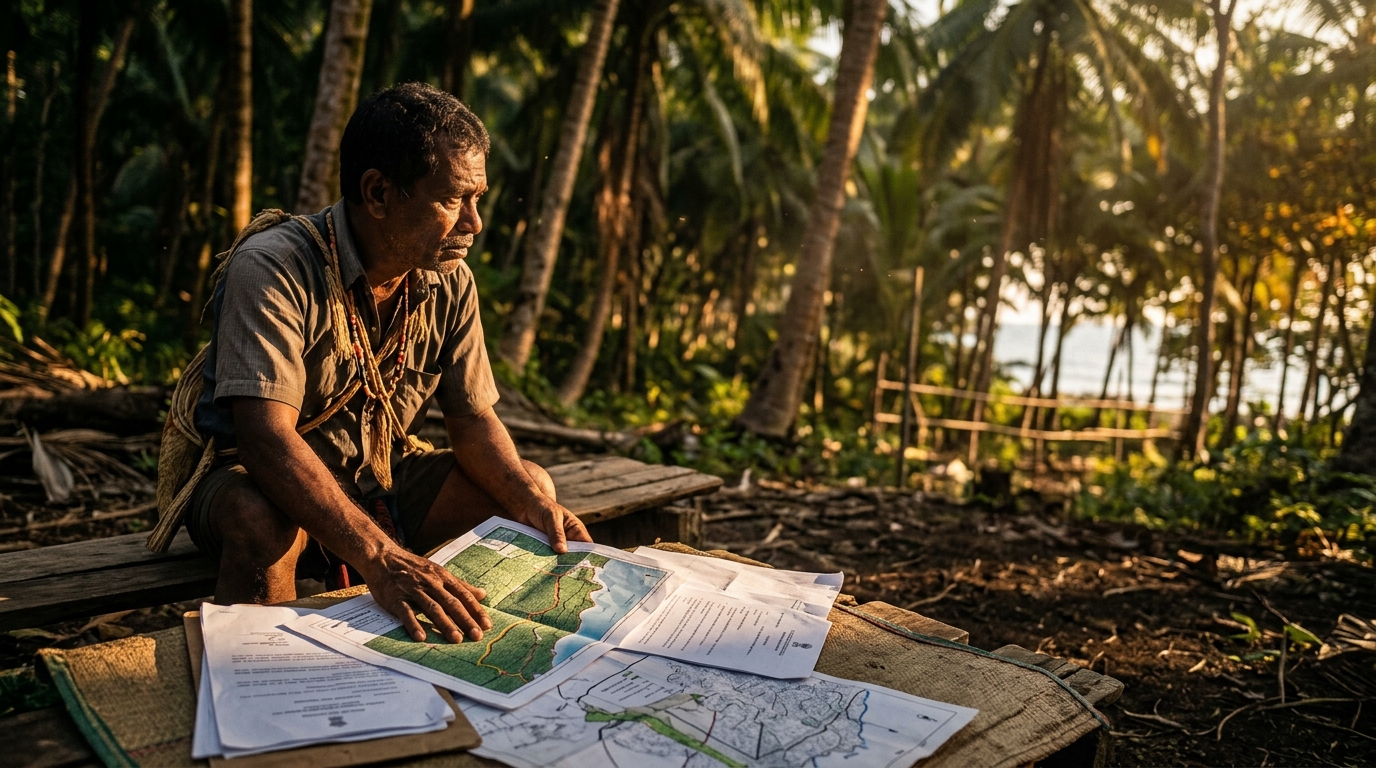
The Andaman and Nicobar Islands administration has sent a draft Comprehensive Tribal Welfare Plan to district officials for consultation on 24 March 2026 . The plan proposes a ₹42.52 crore scheme over 24 months to relocate Nicobarese tribal families from areas affected by the 2004 tsunami or the GNI mega‑infrastructure project . However, tribal leaders say the document is ambiguous about relocation sites and ignores their forest‑rights claims. Key Developments Draft plan circulated on 13 March 2026 to Nicobar district officials for inter‑departmental and Tribal Council consultation. Tribal Council of Great and Little Nicobar received the draft on 28 March 2026 and was summoned for meetings on 31 March and 1 April 2026 . Council submitted a letter on 1 April 2026 requesting a Hindi translation and a one‑month review period. The Union government told the Calcutta High Court on 30 March 2026 that it needed 15 days to prove tribal consent for the project. The draft mentions relocation to existing encampments at Rajiv Nagar (32 households, 101 persons) and New Chingenh (30 households, 117 persons), with a proposed new site at Pulobhabi on the western coast. Important Facts The plan allocates funds for housing upgrades, land development, annuity/employment programmes, subsistence grants, transport support, fishing rights, resettlement allowances, and community infrastructure (roads, water, sanitation, education, health). Financial tables show upgrading of 62 homes and construction of only 30 new homes, while another section promises permanent shelters of 50 sq m for all 62 households, without specifying location. The Tribal Council points out that only 13 pre‑tsunami villages are listed, whereas Nicobarese historically inhabited many more villages along the west coast. Community leaders allege the administration falsely certified that their rights under the Forest Rights Act have been settled, although no formal process was undertaken. The draft cites compliance with the 2013 RFCTLARR Act and the 1956 Protection of Aboriginal Tribes Act , but makes no mention of the Forest Rights Act . UPSC Relevance Illustrates the clash between large‑scale strategic infrastructure (defence, trade) and tribal rights, a recurring theme in GS2 (Polity) and GS3 (Economy). Highlights procedural safeguards under the Forest Rights Act and the 2013 RFCTLARR Act , useful for answer writing on land acquisition and tribal welfare. Shows the role of the judiciary, especially the Calcutta High Court , in enforcing consent provisions under the Forest Rights Act . Provides a case study for governance challenges in remote Union Territories, relevant for GS1 (Geography) and GS2 (Polity). Way Forward Clear demarcation of project boundaries and relocation sites, with maps in local languages, to ensure informed tribal consent. Formal initiation of the Forest Rights Act verification process, involving Gram Sabhas and independent observers. Transparent budgeting that specifies the number and location of new houses, aligning with the 2013 RFCTLARR Act provisions. Regular monitoring by the Ministry of Tribal Affairs and the National Human Rights Commission to safeguard tribal rights and prevent project‑related displacement.
  1. Home
  2. Prepare
  3. Current Affairs
  4. Draft Tribal Welfare Plan for Great Nicobar Project Sparks Confusion Over Relocation and Forest Rights
Login to bookmark articles
Login to mark articles as complete

Overview

Great Nicobar Project pits strategic development against tribal rights, testing FRA and consent norms

Key Facts

  1. Draft Comprehensive Tribal Welfare Plan of ₹42.52 crore released on 24 Mar 2026 to relocate Nicobarese families affected by the GNI mega‑project.
  2. Plan proposes upgrading 62 existing homes and constructing 30 new houses, with 50 sq m permanent shelters for all 62 households, but relocation locations are unspecified.
  3. Relocation sites cited: Rajiv Nagar (32 households, 101 persons), New Chingenh (30 households, 117 persons) and a proposed new site at Pulobhabi.
  4. Tribal Council received the draft on 28 Mar 2026, asked for a Hindi translation and a one‑month review; submitted its letter on 1 Apr 2026.
  5. Union government informed the Calcutta High Court on 30 Mar 2026 that it needed 15 days to prove tribal consent for the project.
  6. Draft references compliance with the RFCTLARR Act 2013 and the Protection of Aboriginal Tribes Act 1956, but omits the Forest Rights Act 2006 despite tribal claims.
  7. Only 13 pre‑tsunami villages are listed in the plan, whereas historically Nicobarese inhabited many more villages along the west coast.

Background & Context

The Great Nicobar Island mega‑infrastructure project, a ₹92,000‑crore strategic development, raises constitutional and statutory issues under the Forest Rights Act 2006, the RFCTLARR Act 2013 and the Protection of Aboriginal Tribes Act 1956. It exemplifies the tension between national security‑driven infrastructure and the rights of indigenous communities, a recurring theme in GS‑2 (Polity) and GS‑3 (Economy & Environment).

UPSC Syllabus Connections

GS3•Linkages between development and spread of extremismGS2•Role of civil services in a democracyEssay•Democracy, Governance and Public AdministrationEssay•Economy, Development and InequalityGS4•Information sharing, transparency, RTI, codes of ethics and conductPrelims_GS•Physical Geography of IndiaGS2•Executive and Judiciary - structure, organization and functioningEssay•Society, Gender and Social Justice

Mains Answer Angle

In a Mains answer, candidates can analyse the adequacy of procedural safeguards for tribal consent and rehabilitation, linking it to the broader debate on development versus rights. Likely GS‑2 or GS‑3 question: ‘Evaluate the challenges of balancing strategic infrastructure projects with tribal and environmental rights in India.’

Full Article

Read Original on hindu

Analysis

Practice Questions

GS2
Easy
Prelims MCQ

Forest Rights Act, 2006 and tribal consent

1 marks
4 keywords
GS3
Medium
Mains Short Answer

Tribal welfare, displacement, policy gaps

20 marks
6 keywords
GS2
Hard
Mains Essay

Development vs. tribal rights, strategic projects, environmental governance

250 marks
7 keywords
Related:Daily•Weekly

Loading related articles...

Loading related articles...

Tip: Click articles above to read more from the same date, or use the back button to see all articles.

Explore:Current Affairs·Editorial Analysis·Govt Schemes·Study Materials·Previous Year Questions·UPSC GPT