Loading page, please wait…
HomeCurrent AffairsEditorialsGovt SchemesLearning ResourcesUPSC SyllabusPricingAboutBest UPSC AIUPSC AI ToolAI for UPSCUPSC ChatGPT

© 2026 Vaidra. All rights reserved.

PrivacyTerms
Vaidra Logo
Vaidra

Top 4 items + smart groups

UPSC GPT
New
Current Affairs
Daily Solutions
Daily Puzzle
Mains Evaluator

Version 2.0.0 • Built with ❤️ for UPSC aspirants

G7 Summit at Vaux-de-Cernay: US‑Iran Conflict, Strategic Oil Reserves and Ukraine Support — UPSC Current Affairs | March 26, 2026
G7 Summit at Vaux-de-Cernay: US‑Iran Conflict, Strategic Oil Reserves and Ukraine Support
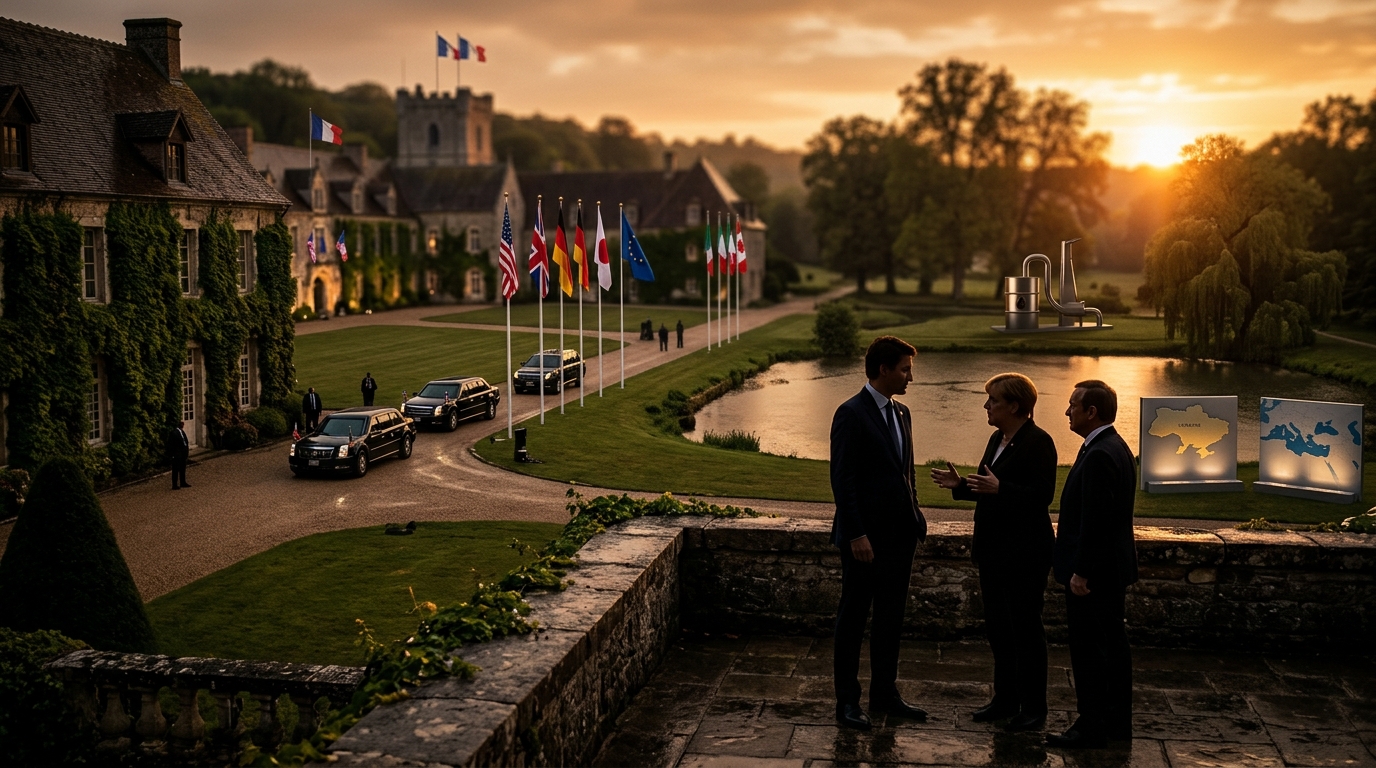
Foreign ministers of the <span class="key-term" data-definition="G7 – Group of Seven, an informal bloc of the world’s largest advanced economies; relevant to GS2: International Relations">G7</span> met near Paris on 26‑27 March 2026 to manage the escalating US‑Iran conflict, discuss release of <span class="key-term" data-definition="Strategic oil reserves – emergency stockpiles of crude oil held by countries to stabilise supply and prices during crises (GS3: Economy)">strategic oil reserves</span>, and reaffirm support for Ukraine. The summit also invited emerging‑market foreign ministers, highlighting France’s rotating presidency and the broader geopolitical balancing act.
Overview On 26‑27 March 2026 , foreign ministers of the G7 gathered at the Vaux‑de‑Cernay Abbey outside Paris. The meeting, chaired by France under its rotating G7 presidency , aimed to narrow differences with the United States over the war on Iran while keeping the Ukraine and Gaza crises on the agenda. Key Developments U.S. Secretary of State Marco Rubio attended the second day, joining counterparts from Canada, Germany, Italy, France, Japan and the U.K. France invited foreign ministers of Brazil, India, Ukraine, Saudi Arabia and South Korea to broaden the summit’s scope. President Donald Trump warned of “unleashing hell” if Iran rejects a deal, while European allies urged de‑escalation. German Finance Minister Lars Klingbeil criticised Trump’s Middle‑East policy as harmful to Germany’s economy. British Foreign Minister Yvette Cooper expressed concern that the Iran‑Israel war diverted attention from the Gaza peace plan and West Bank violence. G7 finance, central‑bank and energy ministers will discuss the release of strategic oil reserves to offset disruptions in the Strait of Hormuz . Important Facts The conflict stems from a U.S.-Israeli operation against Iran, with Iran‑backed Hezbollah firing rockets into Israel. Iran rejected a peace proposal conveyed through Pakistan, according to Iranian state TV. The IEA members agreed on 11 March 2026 to release stocks from their reserves, with chief Fatih Birol indicating further releases if needed. France’s foreign minister Jean‑Noël Barrot reaffirmed continued support for the Ukrainian resistance and pressure on Russia. UPSC Relevance The summit illustrates the dynamics of multilateral diplomacy (GS2), the role of energy security in foreign policy (GS3), and the impact of regional conflicts on global economics (GS3). Understanding the functioning of the G7 and its rotating presidency helps aspirants analyse how major powers coordinate responses to crises. The discussion on strategic oil reserves links directly to topics on global oil markets, OPEC, and supply‑demand shocks, all part of the Economy syllabus. Way Forward Analysts expect the G7 to push for a diplomatic resolution with Iran while maintaining a united front on Ukraine and Gaza. The release of strategic reserves could mitigate short‑term price spikes caused by disruptions in the Strait of Hormuz . Continued engagement with emerging‑market partners may broaden consensus, reducing the risk of a unilateral US approach that could strain trans‑Atlantic ties.
  1. Home
  2. Prepare
  3. Current Affairs
  4. G7 Summit at Vaux-de-Cernay: US‑Iran Conflict, Strategic Oil Reserves and Ukraine Support
Login to bookmark articles
Login to mark articles as complete

Overview

G7’s coordinated push on Iran‑US rift and oil‑reserve release underscores multilateral diplomacy in energy security

Key Facts

  1. 26‑27 March 2026: G7 foreign ministers met at Vaux‑de‑Cernay Abbey, France, under the rotating French presidency.
  2. US Secretary of State Marco Rubio attended the second day, joining Canada, Germany, Italy, Japan, the UK and France.
  3. President Donald Trump warned of “unleashing hell” if Iran rejects a deal, while European ministers urged de‑escalation.
  4. IEA members agreed on 11 March 2026 to release strategic oil reserves to cushion potential supply shocks from the Strait of Hormuz.
  5. France invited Brazil, India, Ukraine, Saudi Arabia and South Korea, expanding the summit’s diplomatic outreach.
  6. German Finance Minister Lars Klingbeil criticised Trump’s Middle‑East policy as detrimental to Germany’s economy.
  7. British Foreign Minister Yvette Cooper highlighted that the Iran‑Israel conflict diverts attention from the Gaza peace plan and West Bank violence.

Background & Context

The summit reflects the G7’s role as a premier multilateral forum where advanced economies coordinate foreign‑policy and economic responses to regional crises. It also showcases how energy security considerations—through strategic oil‑reserve releases—are integrated into diplomatic deliberations, linking international relations with macro‑economic stability.

UPSC Syllabus Connections

Prelims_GS•International Current AffairsEssay•International Relations and GeopoliticsGS2•Bilateral, regional and global groupings involving IndiaGS1•World Wars and redrawal of national boundariesGS2•Important international institutions and agencies

Mains Answer Angle

GS2 – Analyse how the G7’s collective diplomacy seeks to manage the US‑Europe split over the Iran conflict while safeguarding global energy markets; a likely question could probe the effectiveness of such groupings in crisis management.

Full Article

Read Original on hindu

Analysis

Practice Questions

Prelims
Easy
Prelims MCQ

International Energy Security

1 marks
3 keywords
GS2
Medium
Mains Short Answer

Multilateral Groupings – G7

10 marks
5 keywords
GS2
Hard
Mains Essay

International Relations – US‑Europe coordination, Energy security

250 marks
6 keywords
Related:Daily•Weekly

Loading related articles...

Loading related articles...

Tip: Click articles above to read more from the same date, or use the back button to see all articles.

Explore:Current Affairs·Editorial Analysis·Govt Schemes·Study Materials·Previous Year Questions·UPSC GPT