Overview
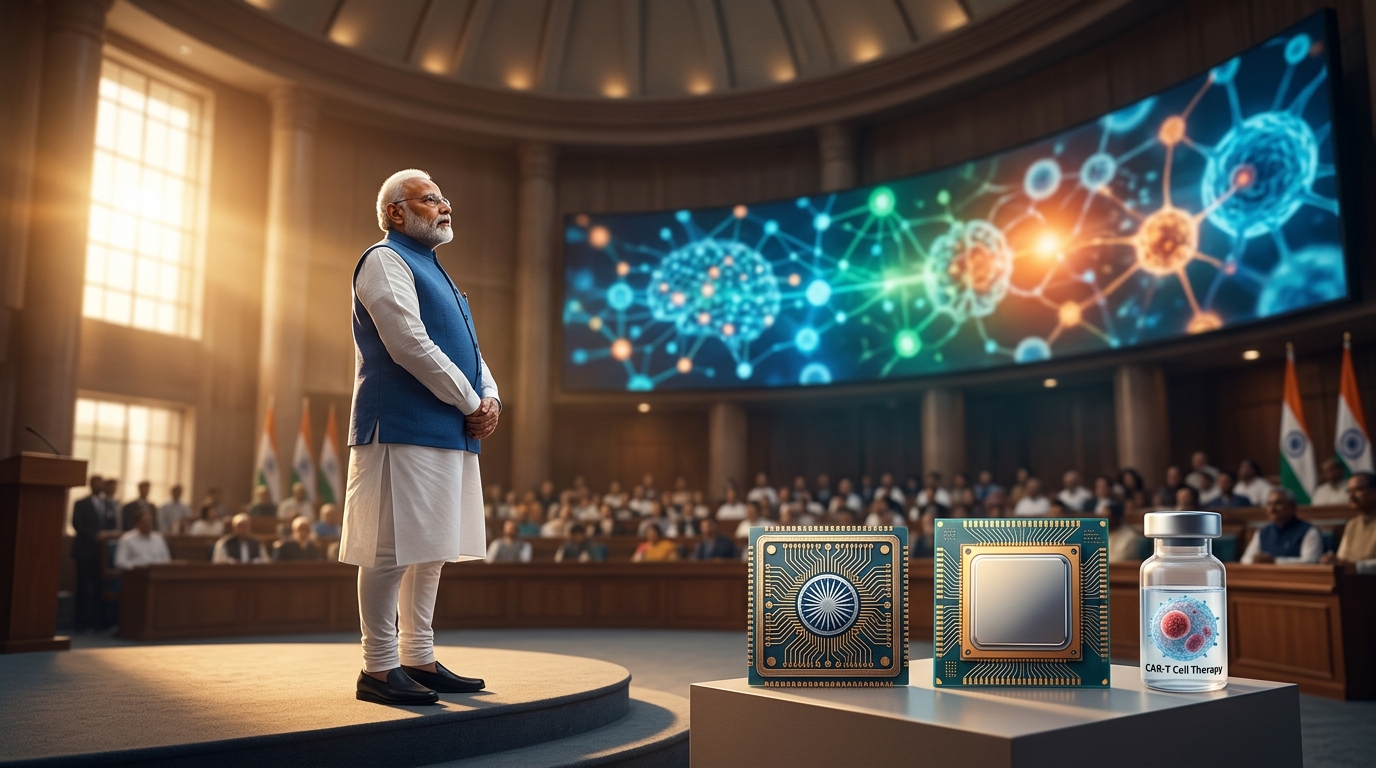
Hon’ble Prime Minister Shri. Narendra Modi gifted three pathbreaking innovations to the Nation during the ongoing Emerging Science, Technology & Innovation Conclave ESTIC2025. These include: QSIP: India’s own quantum security chip; 25-qubit QPU: India’s first quantum computing chip, powering the future of computation; and CAR-T Cell Therapy: India’s 1st indigenous cancer cell therapy developed by Indian Innovators with the support of the Ministry of Science and Technology. The CAR-T Cell Therapy, named NexCAR19, developed by ImmunoACT, is a groundbreaking innovation truly “Made in India, for the world” and was supported by DBT and BIRAC.
Key Developments
CAR-T Cell Therapy (NexCAR19)
The Chimeric Antigen Receptor T-cell (CAR-T) therapy has emerged as a breakthrough in cancer treatment. Clinical trials conducted globally have shown promising results, especially in patients suffering from Acute Lymphocytic Leukemia. NexCAR19, India’s first living drug, has made gene therapies both affordable and accessible without compromising scientific rigour or patient safety.
- NexCAR19: India’s first indigenous CAR-T cell therapy.
- ImmunoACT: Developer of NexCAR19, an IIT Bombay spin-off.
- Support: Received funding, mentorship, and resources from the BioNest initiative of BIRAC.
Government Support and Funding
The development and scaling up of NexCAR19 have been significantly supported by the Department of Biotechnology (DBT) and the Biotechnology Industry Research Assistance Council (BIRAC).
- 2021: DBT and BIRAC partially supported Lentivirus manufacturing and clinical trial of India’s first CAR-T at ACTREC center at Tata Memorial Hospital, through the National Biopharma Mission for the NEXCAR-19 trial in pediatric patients.
- Recent Funding: DBT via the Biomanufacturing initiative under the BioE3 Policy gave funding to ImmunoAct for setting up a 200L GMP lentiviral vector and plasmid platforms to scale up the production and also to make this new therapeutic modality more affordable.
- Impact: The GMP grade gene delivery vector can help at least 1000 patients per year for cell and gene therapy.
Future Directions
DBT is also promoting early and late translational research to develop novel & indigenous CAR-T based therapeutics to combat various cancers by supporting interdisciplinary teams to venture into immunotherapeutic solutions for broader spectrum of cancers including both liquid and solid cancers and also ways to overcome the associated toxicities. This includes cancers like Multiple myeloma (MM), Acute Lymphocytic Leukemia, refractory or relapsed B cell Acute Lymphoblastic Leukemia, glioblastoma etc.
Exam Relevance
This article is relevant to the UPSC syllabus under GS3: Science and Technology, specifically in the areas of biotechnology and healthcare innovation. It also touches upon GS2: Health, concerning government policies and interventions for the health sector. The development of indigenous technologies like CAR-T cell therapy and quantum computing chips is crucial for India's self-reliance and technological advancement.
Potential Exam Questions
- Discuss the significance of CAR-T cell therapy in cancer treatment and India's progress in developing indigenous therapies.
- Analyze the role of government initiatives like DBT and BIRAC in promoting biotechnology innovation and entrepreneurship in India.
- Evaluate the potential of quantum computing and quantum security technologies for India's future, and the challenges associated with their development and deployment.
Important Facts
- NexCAR19 is the world’s first humanized CAR-T therapy developed in India.
- ImmunoACT is an IIT Bombay spin-off supported by BIRAC’s BioNest initiative.
- DBT supports CAR-T therapy development through the National Biopharma Mission and the BioE3 Policy.
- The GMP grade gene delivery vector can help at least 1000 patients per year.