Loading page, please wait…
HomeCurrent AffairsEditorialsGovt SchemesLearning ResourcesUPSC SyllabusPricingAboutBest UPSC AIUPSC AI ToolAI for UPSCUPSC ChatGPT

© 2026 Vaidra. All rights reserved.

PrivacyTerms
Vaidra Logo
Vaidra

Top 4 items + smart groups

UPSC GPT
New
Current Affairs
Daily Solutions
Daily Puzzle
Mains Evaluator

Version 2.0.0 • Built with ❤️ for UPSC aspirants

IAF Opens Registration for Mehar Baba Competition‑3 on Drone Surveillance Radars (27 Apr 2026)

IAF Opens Registration for Mehar Baba Competition‑3 on Drone Surveillance Radars (27 Apr 2026)
The Indian Air Force has opened registration for Mehar Baba Competition‑3, focusing on collaborative drone‑based surveillance radars, with the deadline starting on 27 Apr 2026. The contest seeks innovative swarm‑drone radar solutions, offering funding and awards, and reflects India’s push for indigenous defence technology development.
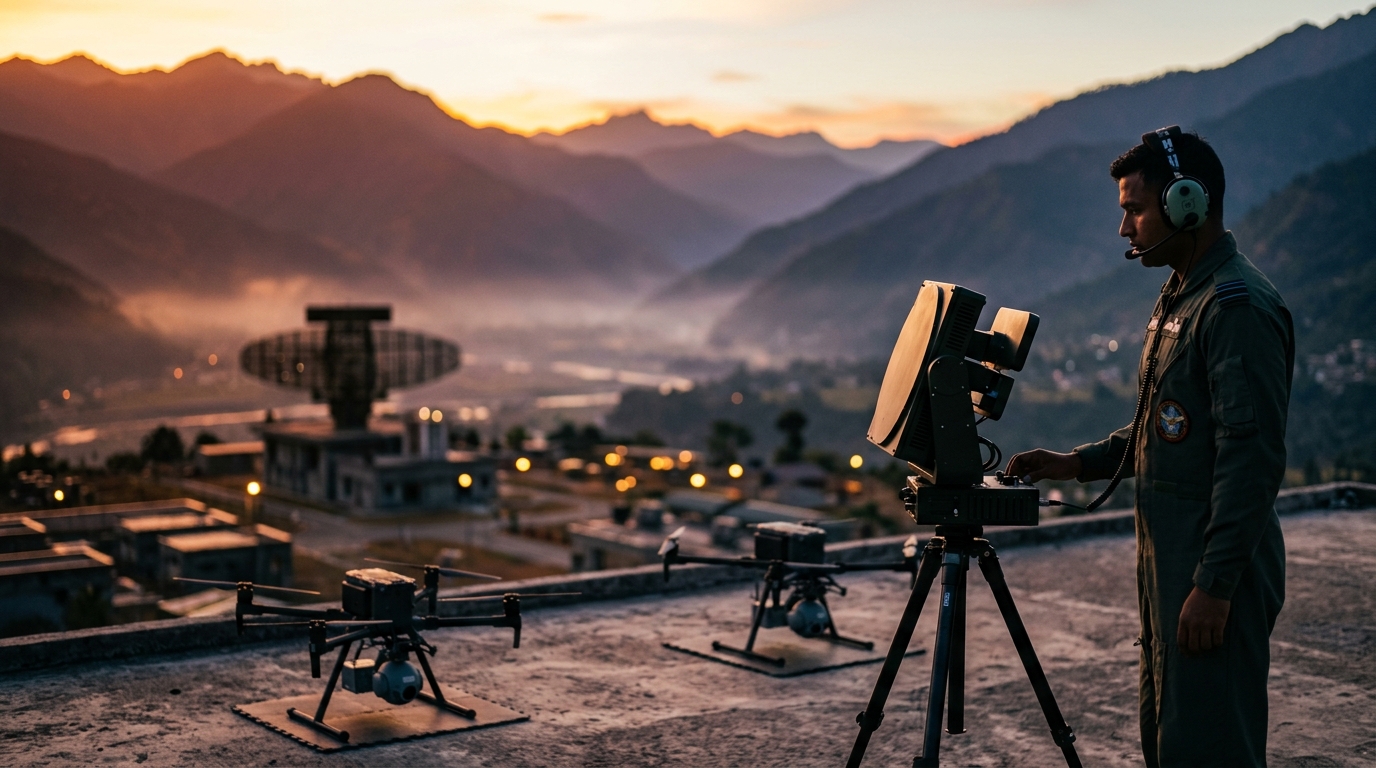
IAF Launches Mehar Baba Competition‑3 (MBC‑3) The Indian Air Force (IAF) has opened registration for the third edition of the Mehar Baba Competition (MBC‑3). The theme this year is Collaborative Drone‑Based Surveillance Radars . Registration starts on 27 Apr 2026 and will run for a limited period. Key Developments Launch of MBC‑3 with a focus on UAS swarm‑radar integration. Funding and awards for meritorious participants; top three winners receive cash prizes and development support from the IAF. Open invitation to Indian industries, start‑ups, academic institutions and research establishments. Full competition details available in the ‘Vision Document’ on the official IAF website. Important Facts The competition was first announced by the Raksha Rajya Mantri , Shri Sanjay Seth, at Aero India 2025. MBC‑3 aims to develop a proof‑of‑concept for a collaborative swarm of swarm drones that function as an airborne radar, capable of detecting, tracking and reporting aerial targets in a contested environment, and relaying precise location data to a central monitoring station. Since its inception in 2018 , the competition has generated orders worth approximately Rs. 2000 Crores for the unmanned systems industry. The first two editions dealt with humanitarian assistance, disaster relief, and foreign‑object debris detection on aircraft surfaces, receiving strong responses from industry, start‑ups and academia. UPSC Relevance Understanding MBC‑3 helps aspirants grasp the nexus between defence policy, indigenous technology development, and the ‘Make in India’ drive. It illustrates how the Ministry of Defence leverages public‑private partnerships to accelerate innovation in critical sectors (GS3: Defence Production). The competition also showcases the role of strategic leadership (GS2: Polity) in shaping defence R&D priorities. Way Forward Stakeholders are encouraged to submit proposals before the deadline, aligning their projects with the competition’s objectives of autonomous swarm coordination and radar integration. Successful participants will not only receive financial backing but also gain access to IAF testing facilities, potentially leading to larger contracts and contributing to India’s self‑reliance in defence technology.
  1. Home
  2. Prepare
  3. Current Affairs
  4. IAF Opens Registration for Mehar Baba Competition‑3 on Drone Surveillance Radars (27 Apr 2026)
Login to bookmark articles
Login to mark articles as complete

Overview

gs.gs378% UPSC Relevance

IAF’s MBC‑3 drives indigenous swarm‑radar tech, bolstering defence self‑reliance

Key Facts

  1. Registration for Mehar Baba Competition‑3 (MBC‑3) opened on 27 Apr 2026.
  2. MBC‑3’s theme is Collaborative Drone‑Based Surveillance Radars – swarm drones acting as airborne radar.
  3. The competition is open to Indian industries, start‑ups, academic and research institutions.
  4. Top three winners receive cash prizes, development support and access to IAF testing facilities.
  5. First announced by Defence Minister Shri Sanjay Seth at Aero India 2025; the competition began in 2018.
  6. Since 2018, MBC initiatives have generated orders worth approx. Rs 2000 crore for the unmanned systems sector.
  7. MBC‑3 aims to develop a proof‑of‑concept for swarm‑drone radar capable of detecting and tracking aerial targets in contested airspace.

Background & Context

The IAF’s Mehar Baba Competition aligns with the ‘Make in India’ drive and the Ministry of Defence’s push for indigenous defence production. It exemplifies public‑private partnership (PPP) in high‑tech R&D, linking aerospace technology, internal security and strategic autonomy – core themes of GS‑3.

UPSC Syllabus Connections

Essay•Science, Technology and SocietyEssay•Economy, Development and InequalityGS3•Various security forces and agenciesGS3•Developments in science and technology and their applications

Mains Answer Angle

GS‑3 – Discuss how initiatives like MBC‑3 can strengthen India’s defence self‑reliance through indigenous R&D and PPP, and assess the challenges in scaling such technologies.

Full Article

<h2>IAF Launches Mehar Baba Competition‑3 (MBC‑3)</h2> <p>The <span class="key-term" data-definition="Indian Air Force — the aerial branch of the Indian Armed Forces responsible for defending Indian airspace and supporting national security objectives (GS1: Defence)">Indian Air Force</span> (IAF) has opened registration for the third edition of the <span class="key-term" data-definition="Mehar Baba Competition — an IAF‑initiated contest to foster indigenous development of niche aviation technologies, named after Air Commodore Mehar Singh (MBC) (GS1: History, GS2: Polity)">Mehar Baba Competition</span> (MBC‑3). The theme this year is <span class="key-term" data-definition="Collaborative Drone‑Based Surveillance Radars — a system where multiple drones work together to act as an airborne radar, detecting and tracking aerial targets in contested airspace (GS3: Technology)">Collaborative Drone‑Based Surveillance Radars</span>. Registration starts on <strong>27 Apr 2026</strong> and will run for a limited period.</p> <h3>Key Developments</h3> <ul> <li>Launch of MBC‑3 with a focus on <span class="key-term" data-definition="Unmanned Aerial Systems — aircraft without a human pilot onboard, used for surveillance, reconnaissance and combat roles (GS3: Technology)">UAS</span> swarm‑radar integration.</li> <li>Funding and awards for meritorious participants; top three winners receive cash prizes and development support from the IAF.</li> <li>Open invitation to Indian industries, start‑ups, academic institutions and research establishments.</li> <li>Full competition details available in the ‘Vision Document’ on the official IAF website.</li> </ul> <h3>Important Facts</h3> <p>The competition was first announced by the <span class="key-term" data-definition="Raksha Rajya Mantri — the Union Minister of Defence, responsible for policy formulation and implementation in the defence sector (GS2: Polity)">Raksha Rajya Mantri</span>, Shri Sanjay Seth, at Aero India 2025. MBC‑3 aims to develop a proof‑of‑concept for a collaborative swarm of <span class="key-term" data-definition="Swarm drones — multiple autonomous drones that coordinate their actions to achieve a common mission, enhancing coverage and resilience (GS3: Technology)">swarm drones</span> that function as an airborne radar, capable of detecting, tracking and reporting aerial targets in a contested environment, and relaying precise location data to a central monitoring station.</p> <p>Since its inception in <strong>2018</strong>, the competition has generated orders worth approximately <strong>Rs. 2000 Crores</strong> for the unmanned systems industry. The first two editions dealt with humanitarian assistance, disaster relief, and foreign‑object debris detection on aircraft surfaces, receiving strong responses from industry, start‑ups and academia.</p> <h3>UPSC Relevance</h3> <p>Understanding MBC‑3 helps aspirants grasp the nexus between defence policy, indigenous technology development, and the ‘Make in India’ drive. It illustrates how the Ministry of Defence leverages public‑private partnerships to accelerate innovation in critical sectors (GS3: Defence Production). The competition also showcases the role of strategic leadership (GS2: Polity) in shaping defence R&D priorities.</p> <h3>Way Forward</h3> <p>Stakeholders are encouraged to submit proposals before the deadline, aligning their projects with the competition’s objectives of autonomous swarm coordination and radar integration. Successful participants will not only receive financial backing but also gain access to IAF testing facilities, potentially leading to larger contracts and contributing to India’s self‑reliance in defence technology.</p>
Read Original on pib

Analysis

Practice Questions

GS3
Easy
Prelims MCQ

Drone‑based surveillance, Radar technology innovation

1 marks
3 keywords
GS3
Medium
Mains Short Answer

Defence research and development, Public‑private partnership

10 marks
4 keywords
GS3
Hard
Mains Essay

Defence production, Innovation policy, Strategic autonomy

250 marks
6 keywords
Related:Daily•Weekly

Loading related articles...

Loading related articles...

Tip: Click articles above to read more from the same date, or use the back button to see all articles.

Quick Reference

Key Insight

IAF’s MBC‑3 drives indigenous swarm‑radar tech, bolstering defence self‑reliance

Key Facts

  1. Registration for Mehar Baba Competition‑3 (MBC‑3) opened on 27 Apr 2026.
  2. MBC‑3’s theme is Collaborative Drone‑Based Surveillance Radars – swarm drones acting as airborne radar.
  3. The competition is open to Indian industries, start‑ups, academic and research institutions.
  4. Top three winners receive cash prizes, development support and access to IAF testing facilities.
  5. First announced by Defence Minister Shri Sanjay Seth at Aero India 2025; the competition began in 2018.
  6. Since 2018, MBC initiatives have generated orders worth approx. Rs 2000 crore for the unmanned systems sector.
  7. MBC‑3 aims to develop a proof‑of‑concept for swarm‑drone radar capable of detecting and tracking aerial targets in contested airspace.

Background

The IAF’s Mehar Baba Competition aligns with the ‘Make in India’ drive and the Ministry of Defence’s push for indigenous defence production. It exemplifies public‑private partnership (PPP) in high‑tech R&D, linking aerospace technology, internal security and strategic autonomy – core themes of GS‑3.

UPSC Syllabus

  • Essay — Science, Technology and Society
  • Essay — Economy, Development and Inequality
  • GS3 — Various security forces and agencies
  • GS3 — Developments in science and technology and their applications

Mains Angle

GS‑3 – Discuss how initiatives like MBC‑3 can strengthen India’s defence self‑reliance through indigenous R&D and PPP, and assess the challenges in scaling such technologies.

Explore:Current Affairs·Editorial Analysis·Govt Schemes·Study Materials·Previous Year Questions·UPSC GPT
IAF Opens Registration for Mehar Baba Comp... | UPSC Current Affairs

Related Topics

  • 📚Subject TopicMake in India Celebrates 10 Years
  • 📚Subject TopicWhat is the ‘Make in India’ Initiative?
  • 📚Subject TopicWhat are the Major Initiatives Taken to Enable Make in India?
  • 📰Current AffairsYouth Congress Protest in Shivamogga (Feb 2026): Allegations Against PM Modi on International Image, US Trade Deal & ‘Make in India’
  • 📰Current AffairsPLI Schemes under Make in India draw ₹2.16 L cr investment, spur ₹20.41 L cr output & 14.39 L jobs