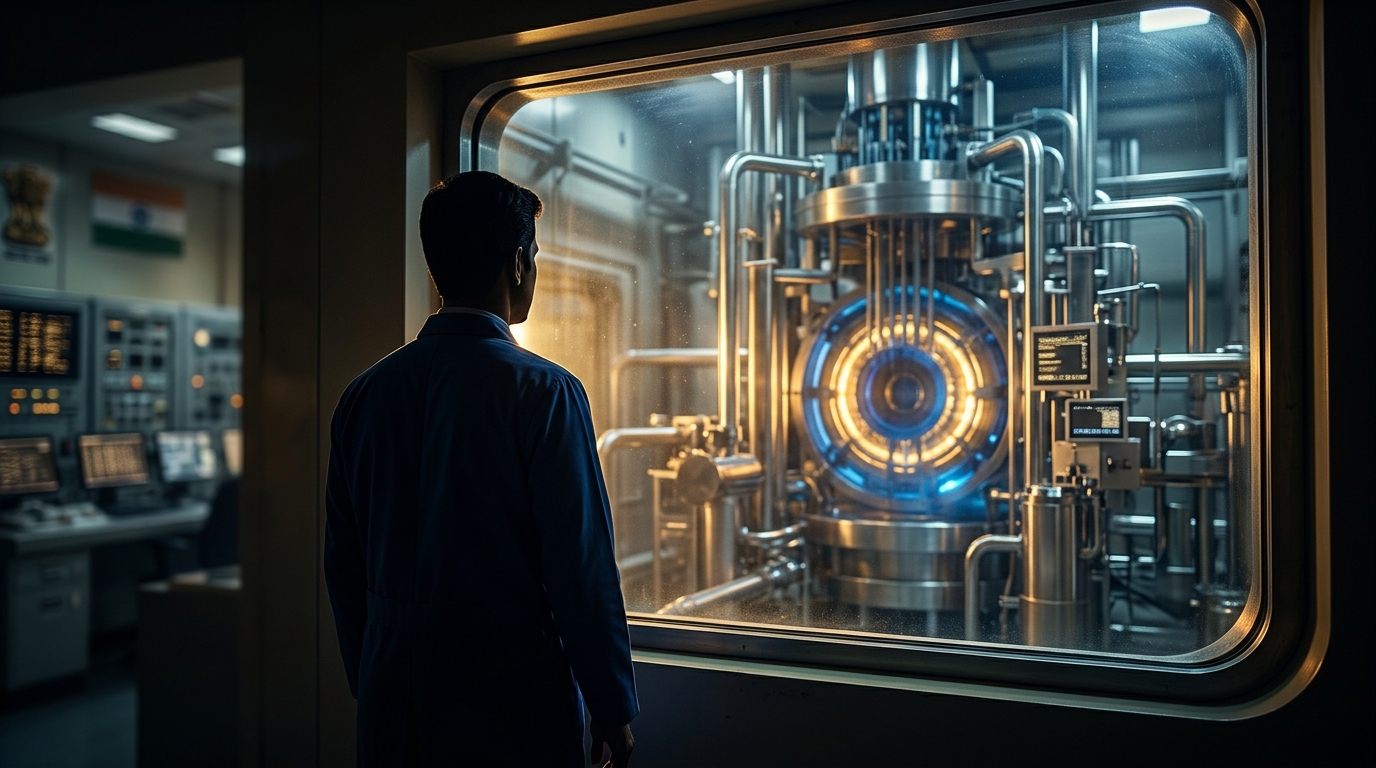
<h2>Overview</h2>
<p>On <strong>6 April 2026</strong>, Prime Minister <strong>Narendra Modi</strong> announced on X that the <span class="key-term" data-definition="Prototype Fast Breeder Reactor – a 500 MW sodium‑cooled reactor built at Kalpakkam, marking the start of the second stage of India’s three‑stage nuclear programme (GS3: Energy).">PFBR</span> has attained <span class="key-term" data-definition="Criticality – the point at which a nuclear chain reaction becomes self‑sustaining; a prerequisite for power generation (GS3: Energy).">criticality</span>. This is the first time a fast breeder reactor in India has reached a self‑sustaining nuclear reaction, paving the way for larger scale use of indigenous thorium resources.</p>
<h3>Key Developments</h3>
<ul>
<li>PFBR reached criticality after fuel loading on <strong>18 October 2025</strong>.</li>
<li>Design capacity: <strong>500 MWe</strong> with a projected life of 40 years.</li>
<li>Six additional 600 MW fast breeder units (FBR‑600) are planned, with twin units to be co‑located at Kalpakkam.</li>
<li>The <span class="key-term" data-definition="Fast Reactor Fuel Cycle Facility – a re‑processing plant at Kalpakkam to recover plutonium from spent fast‑breeder fuel, essential for closing the fuel cycle (GS3: Energy).">FRFCF</span> is slated for completion by December 2027.</li>
</ul>
<h3>Important Facts</h3>
<p>India’s nuclear fleet currently comprises 18‑20 <span class="key-term" data-definition="Pressurised Heavy Water Reactors – reactors that use natural uranium and heavy water as moderator, producing plutonium as a by‑product (GS3: Energy).">PHWRs</span>, totalling about <strong>7.48 GW(e)</strong>. These reactors generate the plutonium needed for the second stage, where fast neutrons in the PFBR convert fertile <span class="key-term" data-definition="Uranium‑238 – a non‑fissile isotope that, when bombarded by fast neutrons, breeds plutonium‑239 (GS3: Energy).">U‑238</span> into fissile <span class="key-term" data-definition="Plutonium‑239 – a fissile material produced in fast reactors, used as fuel or in weapons (GS3: Energy).">Pu‑239</span>. The ultimate goal is to breed <span class="key-term" data-definition="Uranium‑233 – fissile material obtained from thorium‑232, intended for the third stage of India’s nuclear programme (GS3: Energy).">U‑233</span> from abundant <span class="key-term" data-definition="Thorium‑232 – a fertile isotope abundant in India, which can be converted to U‑233 in the third stage (GS3: Energy).">thorium‑232</span>.</p>
<p>The PFBR uses <span class="key-term" data-definition="Uranium‑Plutonium Mixed Oxide (MOX) fuel – a blend of uranium and plutonium oxides that enables fast reactors to achieve higher breeding ratios (GS3: Energy).">MOX</span> fuel and a blanket of U‑238. Its coolant is liquid <span class="key-term" data-definition="Sodium coolant – a low‑pressure, high‑thermal‑conductivity coolant used in fast reactors; its chemical reactivity poses safety challeng