<h2>Overview</h2>
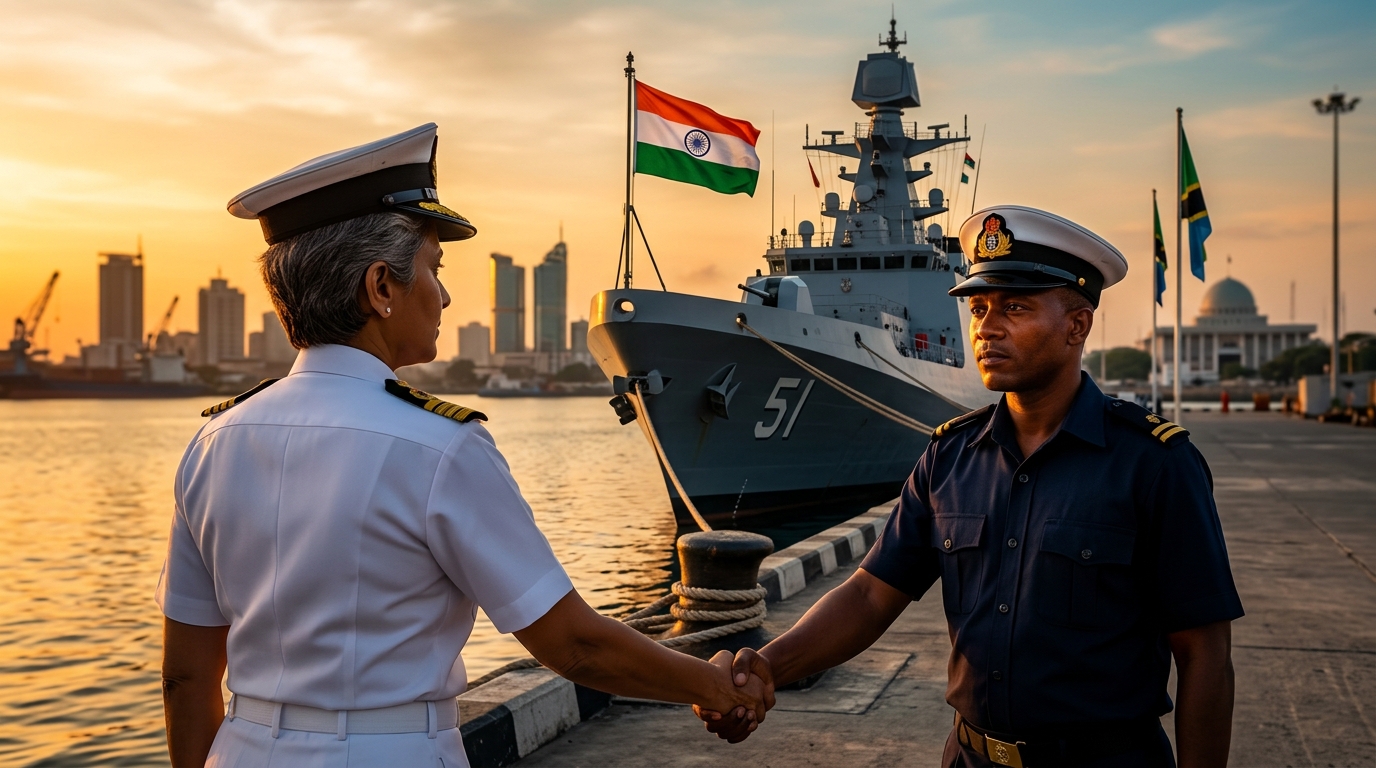
<p>The <span class="key-term" data-definition="Indian Navy's frontline guided‑missile frigate, equipped for anti‑surface, anti‑air and anti‑submarine warfare. (GS3: Security & Defence)">INS Trikand</span> arrived at <strong>Dar‑es‑Salaam, Tanzania</strong> on <strong>03 April 2026</strong> as part of its deployment in the <span class="key-term" data-definition="South West Indian Ocean Region – maritime zone covering the southwestern part of the Indian Ocean, strategically important for trade routes and naval presence. (GS3: Security & Defence)">South West Indian Ocean Region</span>. The visit, organised by the <strong>Ministry of Defence</strong>, aims to deepen maritime cooperation, enhance interoperability with the <span class="key-term" data-definition="Tanzania People's Defence Forces – the armed forces of the United Republic of Tanzania, comprising the Army, Navy and Air Force. (GS2: Polity)">Tanzania People's Defence Forces</span>, and showcase India’s <span class="key-term" data-definition="MAHASAGAR – India’s strategic vision for maritime cooperation and security across regions, emphasizing mutual advancement and growth. (GS2: Polity & GS3: Security)">MAHASAGAR</span> initiative.</p>
<h2>Key Developments</h2>
<ul>
<li>Joint training exercises with the <span class="key-term" data-definition="Interoperability – ability of naval forces to operate together effectively through common procedures, communication and equipment. (GS3: Security & Defence)">interoperability</span> focus, enhancing tactical coordination.</li>
<li>Transfer of critical stores and equipment from India to Tanzania.</li>
<li>People‑to‑people engagements: friendly sports fixtures, yoga sessions and a cultural evening aboard the frigate.</li>
<li>Official meeting of <strong>Captain Sachin Kulkarni</strong> with senior Tanzanian defence and government officials.</li>
</ul>
<h2>Important Facts</h2>
<ul>
<li>Ship: <span class="key-term" data-definition="Guided‑missile frigate – a warship equipped with surface‑to‑air and surface‑to‑surface missiles, used for multi‑role operations. (GS3: Security & Defence)">guided‑missile frigate</span> commissioned in 2024.</li>
<li>Deployment: Ongoing Indian Navy presence in the Indian Ocean to safeguard sea‑lines of communication.</li>
<li>Strategic outcome: Reinforces India’s role as a net‑security provider in the Indian Ocean Region (IOR).</li>
<li>Diplomatic angle: Aligns with India’s “Act East” and “Neighbourhood First” policies, extending to East Africa.</li>
</ul>
<h2>UPSC Relevance</h2>
<p>For GS II (Polity & International Relations) and GS III (Security & Defence), the port call illustrates:
<ul>
<li>India’s maritime diplomacy and the use of naval assets to project soft power.</li>
<li>Implementation of the <span class="key-term" data-definition="MAHASAGAR – India’s strategic vision for maritime cooperation and security across regions, emphasizing mutual advancement and growth. (GS2: Polity & GS3: Security)">MAHASAGAR</span> framework, a case study for strategic partnerships.</li>
<li>Regional security dynamics in the Indian Ocean, especially concerning trade routes, piracy and great‑power competition.</li>
</ul>
</p>
<h2>Way Forward</h2>
<p>Continued naval engagements, including regular joint exercises and logistics support, can deepen defence ties and ensure a stable maritime environment. Monitoring the impact of such visits on regional security architecture will be crucial for future policy formulation.</p>