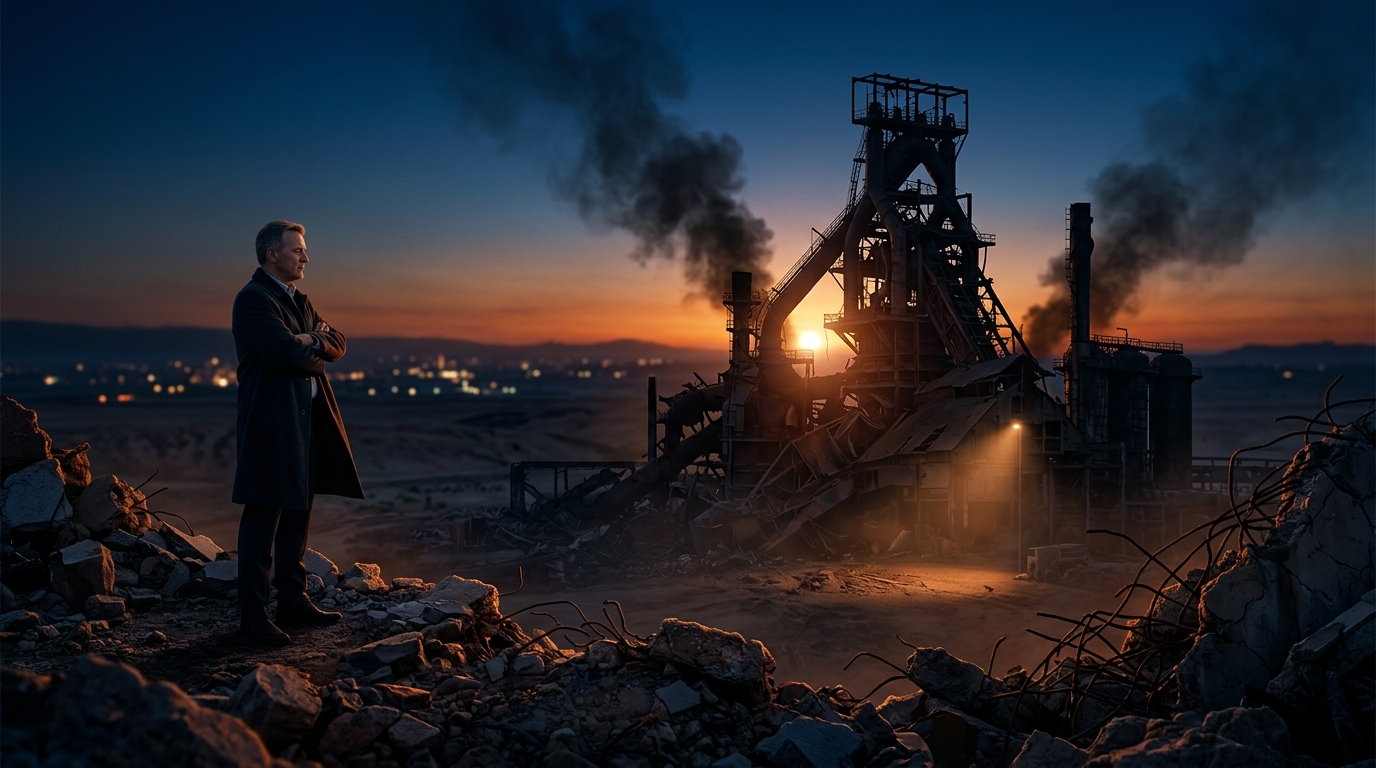
Israel Says 70% of Iran's Steel Capacity Destroyed – Implications for Regional Security — UPSC Current Affairs | April 3, 2026
Israel Says 70% of Iran's Steel Capacity Destroyed – Implications for Regional Security
On 3 April 2026, Israeli Prime Minister <strong>Benjamin Netanyahu</strong> announced that joint strikes with the United States had destroyed about 70% of <span class="key-term" data-definition="Iran — Islamic Republic of Iran; its nuclear and regional ambitions are a key topic in GS1 (International Relations) and security studies.">Iran</span>'s steel production capacity, aiming to cripple the <span class="key-term" data-definition="Revolutionary Guard Corps (IRGC) — Elite Iranian military force controlling significant economic assets; crucial for understanding Iran’s security and economy (GS1, GS3).">Revolutionary Guards</span>. Iran retaliated with missile attacks on Israel and Gulf nations, raising concerns over regional security and global energy supplies.
Overview On 3 April 2026 , Israel announced that its recent air strikes, conducted with the United States, had destroyed roughly 70% of Iran's steel production capacity . The move is aimed at crippling the Revolutionary Guards ’ ability to fund and manufacture weapons. The announcement came amid a broader escalation that saw Iran launch missiles at Israel and several Gulf nations , set fire to a refinery in Kuwait, and trigger explosions in Tehran and Isfahan . Key Developments (Bullet Points) Prime Minister Benjamin Netanyahu declared the destruction of about 70% of Iran's steel production capacity . Joint operations with the United States targeted steel plants , bridges, and command centres. Iran retaliated by firing missiles at Israel and at facilities in Gulf nations , igniting a refinery in Kuwait. Explosions were reported in Tehran and Isfahan , indicating escalation beyond conventional battlefield. The United States announced further reinforcement of its military presence in West Asia . Important Facts 70% reduction in Iran's steel output hampers its capacity to produce artillery, tanks, and missile casings. Targeted infrastructure includes bridges and energy facilities, signalling a shift to economic warfare . Iran's missile launch underscores its retained strategic strike capability despite industrial setbacks. U.S. force buildup may involve additional air assets, naval presence, and forward‑deployed troops. UPSC Relevance The episode touches upon several GS topics: GS1 – International Relations: The Israel‑Iran confrontation, U.S. involvement, and the broader security dynamics of West Asia . GS2 – Polity & Foreign Policy: Decision‑making by Benjamin Netanyahu and U.S. strategic coordination. GS3 – Economy & Strategic Industries: Impact of destroying steel production capacity on Iran’s defence budget and global steel markets. GS4 – Security & Ethics: Use of economic targets in warfare raises questions about proportionality and civilian impact. Way Forward For policymakers and aspirants, the following points merit attention: Monitor how the reduction in steel output affects Iran’s long‑term defence procurement and its willingness to negotiate on nuclear or regional issues. Assess the risk of further escalation affecting global energy supplies, especially through the Gulf nations ’ oil infrastructure. Analyse the legal and ethical implications of targeting civilian economic assets under international humanitarian law. Consider diplomatic channels that could de‑escalate tensions while safeguarding regional stability.
Login to bookmark articles
Login to mark articles as complete
Overview
Strategic blow to Iran’s defence industry: 70% steel capacity loss raises regional security stakes
Key Facts
3 April 2026: Israel, with US support, announced destruction of ~70% of Iran's steel production capacity.
Steel plants targeted are vital for artillery, tank hulls, missile casings – linking industry to defence procurement (GS3).
Strikes also hit bridges, energy facilities and command centres, signalling a shift to economic warfare (GS4).
Iran retaliated by firing missiles at Israel and oil facilities in Gulf states, igniting a refinery fire in Kuwait (GS1).
The United States pledged additional air, naval and forward‑deployed forces in West Asia to deter further escalation (GS2).
A 70% cut in steel output could trim Iran's defence budget by $2‑3 billion annually and affect global steel supply (GS3).
The operation highlights the Revolutionary Guard Corps' control over strategic industries and its exposure to external strikes (GS1/GS3).
Background & Context
The Israel‑Iran confrontation reflects the broader contest for strategic dominance in West Asia, where industrial capacity is a critical component of national security. The targeting of steel—an essential input for weapons manufacturing—illustrates the convergence of economic assets and military strategy, a theme central to GS1 (International Relations) and GS3 (Strategic Industries).
UPSC Syllabus Connections
Essay•International Relations and GeopoliticsGS1•World Wars and redrawal of national boundaries
Mains Answer Angle
For GS2, candidates can discuss how the joint Israel‑US strike reshapes regional security dynamics and the policy choices facing India in balancing strategic autonomy with alliance commitments. A likely Mains question may ask to evaluate the implications of economic warfare on geopolitical stability in the Middle East.