Loading page, please wait…
HomeCurrent AffairsEditorialsGovt SchemesLearning ResourcesUPSC SyllabusPricingAboutBest UPSC AIUPSC AI ToolAI for UPSCUPSC ChatGPT

© 2026 Vaidra. All rights reserved.

PrivacyTerms
Vaidra Logo
Vaidra

Top 4 items + smart groups

UPSC GPT
New
Current Affairs
Daily Solutions
Daily Puzzle
Mains Evaluator

Version 2.0.0 • Built with ❤️ for UPSC aspirants

ISRO Study Links Glacier Ice‑Patch Collapse to 2025 Dharali Flash Flood – Implications for Cryospheric Hazard Monitoring — UPSC Current Affairs | March 16, 2026
ISRO Study Links Glacier Ice‑Patch Collapse to 2025 Dharali Flash Flood – Implications for Cryospheric Hazard Monitoring
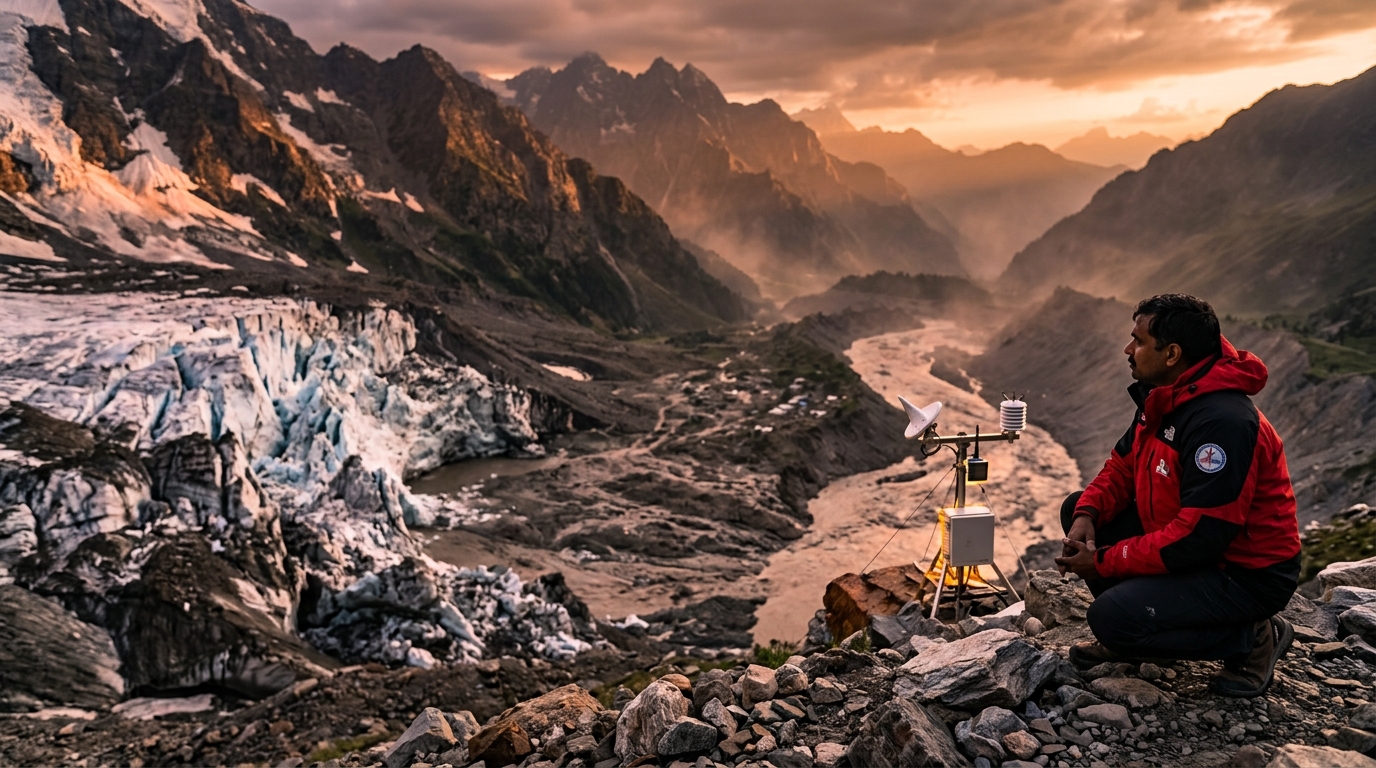
Scientists from the <span class="key-term" data-definition="Indian Space Research Organisation — India's national space agency responsible for space research and satellite missions (GS3: Science & Technology)">ISRO</span> studied the August 5 2025 flash flood in Dharali, Uttarakhand, linking it to the collapse of an exposed ice‑patch on the <span class="key-term" data-definition="Srikanta Glacier — a valley glacier in the upper Bhagirathi basin whose deglaciation triggered the flood (GS3: Environment)">Srikanta Glacier</span>. The research highlights how <span class="key-term" data-definition="Deglaciation — the process of glacier retreat and loss of ice mass due to warming, a key indicator of climate change (GS3: Environment)">deglaciation</span> and <span class="key-term" data-definition="Nivation — erosion and hollow formation beneath snowbanks caused by repeated freeze‑thaw cycles, creating zones vulnerable to ice‑patch collapse (GS3: Environment)">nivation</span> expose ice patches that can rapidly fail, underscoring the need for systematic <span class="key-term" data-definition="Satellite observations — remote sensing data captured from space, used for monitoring terrain, glaciers, and early warning of disasters (GS3: Science & Technology)">satellite monitoring</span> as an early‑warning tool for Himalayan cryospheric hazards.
Overview A recent ISRO study, published in *NPJ Natural Hazards*, analyses the flash flood that struck Dharali village, Uttarakhand on 5 August 2025 . The flood, which claimed six lives, was triggered by the sudden collapse of an exposed ice‑patch on the Srikanta Glacier . The research underscores how warming‑induced deglaciation creates new hazards beyond the well‑known glacial lake outburst floods ( GLOF ). Key Developments Pre‑event satellite observations identified exposed ice patches on north‑facing slopes of the glacier during the ablation season. The exposed ice patch collapsed, releasing ice, meltwater, and debris, which surged down the Khir Gad stream, breaching the village. The study expands recognised Himalayan glacier hazards to include cryospheric instabilities such as ice‑patch failures. Historical context: the region previously suffered massive landslides during the June 2013 floods, indicating a pattern of climate‑linked geomorphic hazards. Important Facts The research area spans the ridge‑to‑valley system from the Srikanta Glacier (elevation 6,133 m) to Dharali (2,650‑2,700 m). The glacier features steep accumulation and ablation zones, extensive nivation hollows, and a history of unstable ice surfaces reported by mountaineers. The flash flood was amplified because the Khir Gad stream bifurcates the village, exposing both banks to sudden water surges. UPSC Relevance Understanding these emerging hazards is vital for multiple GS papers: GS 3 (Environment & Climate Change) : Links between deglaciation , cryospheric processes, and disaster risk. GS 4 (Disaster Management) : Need for early‑warning systems, remote sensing integration, and community‑level preparedness in high‑altitude zones. GS 5 (Science & Technology) : Role of space‑based monitoring in climate adaptation and hazard mitigation. Way Forward Policy makers and disaster‑risk agencies should: Incorporate systematic monitoring of nivation hollows and exposed ice patches across the Himalaya using high‑resolution satellite observations . Expand hazard‑assessment frameworks beyond GLOF scenarios to include ice‑patch collapse and related cryo‑hydrological events. Develop community‑based early‑warning protocols that integrate real‑time remote‑sensing alerts with local communication networks. Promote interdisciplinary research linking glaciology, climatology, and disaster management to refine predictive models. By recognising exposed ice patches as precursors of flash floods, India can enhance its climate‑resilient infrastructure and safeguard vulnerable mountain communities.
  1. Home
  2. Prepare
  3. Current Affairs
  4. ISRO Study Links Glacier Ice‑Patch Collapse to 2025 Dharali Flash Flood – Implications for Cryospheric Hazard Monitoring
Must Review
Login to bookmark articles
Login to mark articles as complete

Overview

Ice‑patch collapse on Himalayan glaciers adds a new flash‑flood hazard, demanding satellite‑based early warning

Key Facts

  1. 5 August 2025: Flash flood in Dharali, Uttarakhand, caused by collapse of an ice‑patch on Srikanta Glacier, killing six people.
  2. Srikanta Glacier head at 6,133 m; Dharali village lies at 2,650‑2,700 m, forming a ridge‑to‑valley hazard corridor.
  3. ISRO study published in *NPJ Natural Hazards* used high‑resolution satellite imagery (LISS‑III, SAR) to map exposed ice patches.
  4. Ice‑patch collapse is a cryospheric instability distinct from Glacial Lake Outburst Floods (GLOFs) and is linked to deglaciation and nivation hollows.
  5. Satellite observations during the ablation season identified the exposed ice patch weeks before its failure.
  6. The 2013 Uttarakhand floods, which triggered massive landslides in the same basin, highlight a pattern of climate‑linked geomorphic hazards.

Background & Context

Rapid deglaciation in the Himalaya is creating novel cryospheric hazards beyond traditional GLOFs, challenging existing disaster‑risk frameworks. Integrating space‑based remote sensing with community‑level early warning is crucial for climate‑resilient governance under GS‑3 (Environment) and GS‑4 (Disaster Management).

UPSC Syllabus Connections

GS3•Disaster and disaster managementGS1•Important Geophysical PhenomenaPrelims_GS•Science and Technology Applications

Mains Answer Angle

In GS‑3/GS‑4 answers, discuss how emerging ice‑patch failures expand Himalayan flood risks and why satellite‑driven monitoring should be institutionalised in the National Disaster Management Plan.

Full Article

Read Original on hindu

Analysis

Practice Questions

GS1
Medium
Prelims MCQ

Cryospheric hazards

1 marks
4 keywords
GS3
Easy
Mains Short Answer

Satellite remote sensing for disaster management

5 marks
5 keywords
GS4
Hard
Mains Essay

Disaster Management and Climate Adaptation

20 marks
5 keywords
Related:Daily•Weekly

Loading related articles...

Loading related articles...

Tip: Click articles above to read more from the same date, or use the back button to see all articles.

Explore:Current Affairs·Editorial Analysis·Govt Schemes·Study Materials·Previous Year Questions·UPSC GPT