Keel Laying of Two Next‑Gen Offshore Patrol Vessels for Indian Coast Guard – Strengthening Maritime Security — UPSC Current Affairs | March 18, 2026
Keel Laying of Two Next‑Gen Offshore Patrol Vessels for Indian Coast Guard – Strengthening Maritime Security
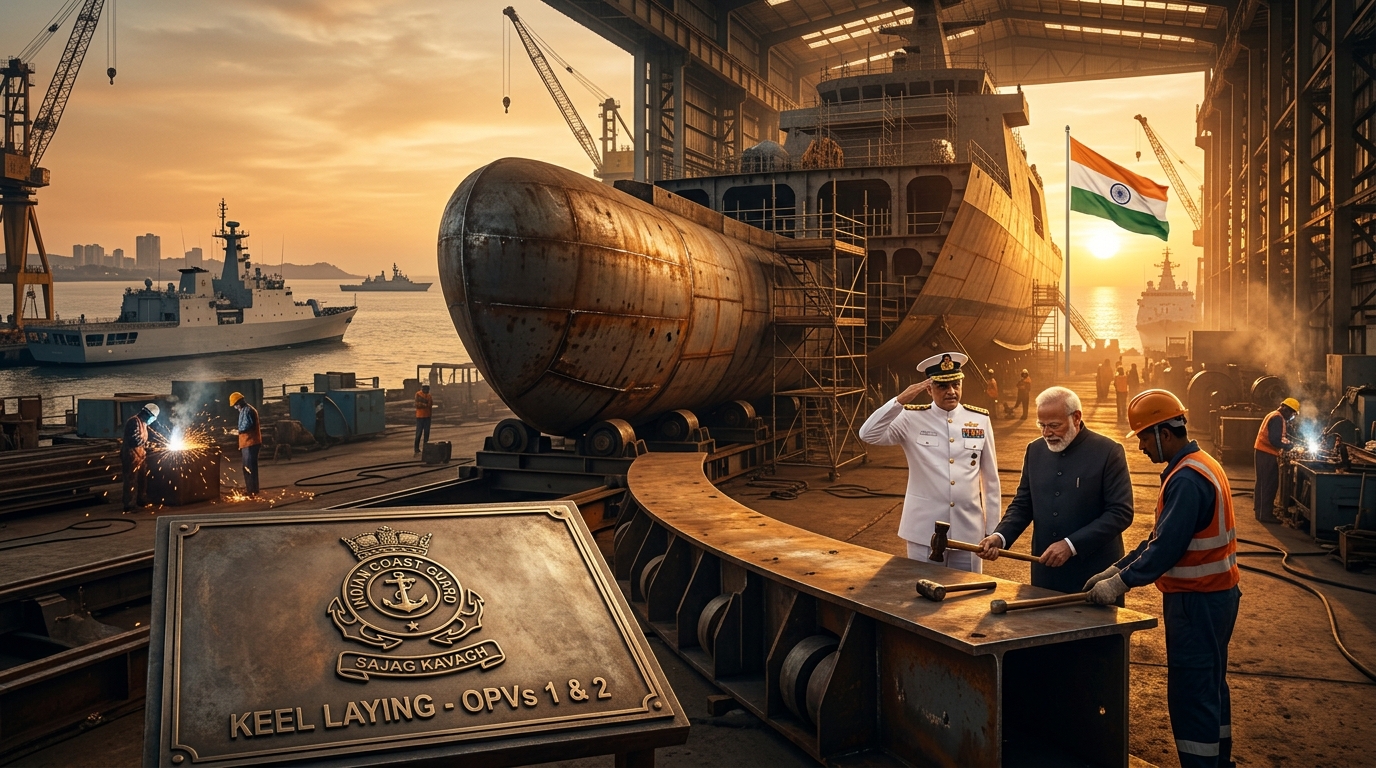
The Ministry of Defence laid the keels of two ships (Yard 16402 & 16403) of the six‑vessel Next Generation Offshore Patrol Vessel (NGOPV) programme for the Indian Coast Guard at YMPL, Ratnagiri on 17 March 2026. Built indigenously by <span class="key-term" data-definition="Mazagon Dock Limited — A leading Indian shipyard under the Ministry of Defence, responsible for constructing warships and submarines (GS2: Polity).">MDL</span> under the <span class="key-term" data-definition="Buy (Indian-IDDM) category — An Indian procurement policy favoring domestically designed and manufactured defence equipment to promote self‑reliance (GS3: Security/Economy).">Buy (Indian‑IDDM)</span> scheme, the vessels feature advanced systems such as AI‑based predictive maintenance, remote‑piloted drones, and integrated bridge and platform management, enhancing India’s coastal security and Atmanirbhar Bharat goals.
The Ministry of Defence conducted the keel‑laying ceremony for Yard 16402 and 16403, the second and third ships of a six‑vessel Next Generation Offshore Patrol Vessels (NGOPVs) programme. The event took place at M/s YMPL, Ratnagiri on 17 March 2026 and was presided over by IG Sudhir Sahni, TM, DDG (M&M) in the presence of senior officials from the Indian Coast Guard and MDL. Key Developments Keel laying of two NGOPVs (Yard 16402 & 16403) marking progress in the six‑ship contract signed on 20 December 2023 . Ships designed for a range of 5,000 nautical miles and a top speed of 23 knots . Crew complement of 11 officers and 110 sailors per vessel. Incorporation of cutting‑edge technologies: AI‑based predictive maintenance, Remote Piloted Drones, Integrated Bridge System (IBS) , and Integrated Platform Management System (IPMS) . Construction undertaken by MDL under the Buy (Indian‑IDDM) category, aligning with the Atmanirbhar Bharat vision. Important Facts The NGOPV programme aims to modernise the ICG fleet, providing extended endurance for patrol, surveillance, and humanitarian missions. The vessels' advanced sensor suite and drone capability will enhance situational awareness in the Indian Ocean Region, a strategically vital maritime zone. UPSC Relevance Security & Defence Policy: Illustrates India's push for indigenous defence production and maritime capability building, a recurring theme in GS 2 and GS 3. Economic Implications: The Buy (Indian‑IDDM) policy supports domestic shipbuilding, generating employment and reducing import dependence, relevant for questions on self‑reliance and defence economics. Technology Integration: Adoption of AI, drones, and integrated systems reflects the role of emerging technologies in modern warfare, pertinent to GS 3 (Science & Technology). Maritime Governance: Strengthening the ICG aligns with India's maritime security strategy, a key topic under GS 2 (International Relations) and GS 4 (Ethics – security governance). Way Forward To fully realise the strategic benefits, the government should ensure timely delivery of the remaining four vessels, invest in crew training for high‑tech systems, and integrate the NGOPVs with coastal radar and satellite surveillance networks. Continuous evaluation of indigenous procurement policies will be essential to sustain the momentum of the Atmanirbhar Bharat drive in the defence sector.
Must Review
Login to bookmark articles
Login to mark articles as complete
Overview
Indigenous NGOPVs boost India’s maritime security and self‑reliance in defence
Key Facts
Keel‑laying of Yard 16402 & 16403 (2nd & 3rd NGOPVs) held on 17 Mar 2026 at YMPL, Ratnagiri.
Six‑ship NGOPV contract signed on 20 Dec 2023 with Mazagon Dock Limited (MDL).
Each vessel has a range of 5,000 nautical miles and a top speed of 23 knots.
Crew complement: 11 officers and 110 sailors per vessel.
Incorporates AI‑based predictive maintenance, remote‑piloted drones, Integrated Bridge System (IBS) and Integrated Platform Management System (IPMS).
Programme falls under the ‘Buy (Indian‑IDDM)’ category, aligning with Atmanirbhar Bharat.
NGOPVs will enhance ICG’s patrol, surveillance and humanitarian capabilities in the Indian Ocean Region.
Background & Context
The Indian Coast Guard’s fleet modernization is critical for safeguarding the vast Indian Ocean Region, where maritime trade, energy routes and strategic interests converge. Indigenous shipbuilding under the Buy (Indian‑IDDM) policy not only strengthens defence capabilities but also advances the Atmanirbhar Bharat vision by creating domestic expertise and reducing import dependence.
Mains Answer Angle
GS 3 – Discuss how indigenous defence production, exemplified by the NGOPV programme, contributes to maritime security and economic self‑reliance. Possible question: ‘Evaluate the role of indigenous shipbuilding in enhancing India’s maritime security.’