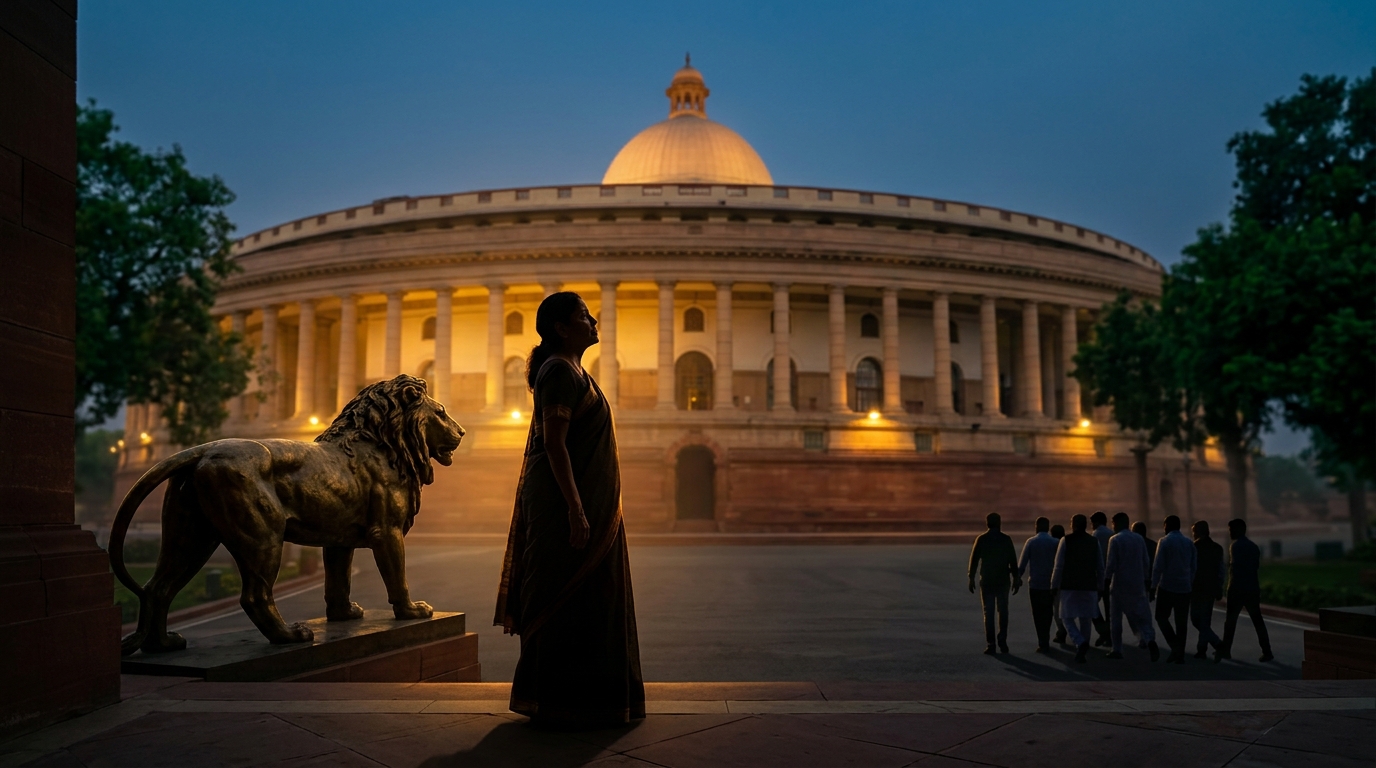
<p>On <strong>18 April 2026</strong>, the <span class="key-term" data-definition="Constitution Amendment Bill — a legislative proposal to amend the Indian Constitution; such bills require a special majority in Parliament (GS2: Polity)">Constitution Amendment Bill</span> that sought to introduce <span class="key-term" data-definition="Women’s reservation — a policy to reserve a certain number of seats for women in legislative bodies, aimed at enhancing gender representation (GS1: Polity)">women’s reservation</span> in the <span class="key-term" data-definition="Lok Sabha — the lower house of India’s Parliament, representing the people and holding the majority of legislative power (GS2: Polity)">Lok Sabha</span> was defeated. The defeat was hailed by <span class="key-term" data-definition="Congress — one of India’s major national parties, historically dominant and currently in opposition (GS2: Polity)"><strong>Congress</strong></span> general secretary <strong>Priyanka Gandhi Vadra</strong> as a triumph for democracy, <span class="key-term" data-definition="Federalism — the constitutional division of powers between the Union and the States, a core principle of Indian governance (GS2: Polity)">federalism</span>, and a united <span class="key-term" data-definition="Opposition — political parties and legislators not in government, whose role includes checking the executive and presenting alternative policies (GS2: Polity)">Opposition</span>.</p>
<h3>Key Developments</h3>
<ul>
<li>The amendment bill, framed as a step toward gender parity, was rejected in the Lok Sabha.</li>
<li>Priyanka Gandhi Vadra described the Centre’s push as a "conspiracy to permanently stay in power" and an attempt to reshape the federal structure under the pretext of women’s reservation.</li>
<li>A cross‑party coalition of opposition parties voted together, preventing the bill’s passage.</li>
</ul>
<h3>Important Facts</h3>
<ul>
<li>The bill required a <strong>special majority</strong> (two‑thirds of members present and voting) to amend the Constitution.</li>
<li>Women’s reservation has been a contentious issue, with previous attempts stalled in the Rajya Sabha.</li>
<li>The defeat underscores the procedural strength of the parliamentary system where even a ruling party cannot bypass constitutional safeguards without broad consensus.</li>
</ul>
<h3>UPSC Relevance</h3>
<p>Understanding this episode helps aspirants grasp:</p>
<ul>
<li>The legislative process for constitutional amendments (GS2: Polity).</li>
<li>The role of <span class="key-term" data-definition="Federalism — the constitutional division of powers between the Union and the States, a core principle of Indian governance (GS2: Polity)">federalism</span> and how attempts to alter it are scrutinised.</li>
<li>The dynamics of <span class="key-term" data-definition="Opposition — political parties and legislators not in government, whose role includes checking the executive and presenting alternative policies (GS2: Polity)">Opposition</span></li>
</ul>