Loading page, please wait…
HomeCurrent AffairsEditorialsGovt SchemesLearning ResourcesUPSC SyllabusPricingAboutBest UPSC AIUPSC AI ToolAI for UPSCUPSC ChatGPT

© 2026 Vaidra. All rights reserved.

PrivacyTerms
Vaidra Logo
Vaidra

Top 4 items + smart groups

UPSC GPT
New
Current Affairs
Daily Solutions
Daily Puzzle
Mains Evaluator

Version 2.0.0 • Built with ❤️ for UPSC aspirants

NASA’s Artemis‑II Crew Returns Safely After First Lunar Flyby in 50 Years | GS3 UPSC Current Affairs April 2026
NASA’s Artemis‑II Crew Returns Safely After First Lunar Flyby in 50 Years
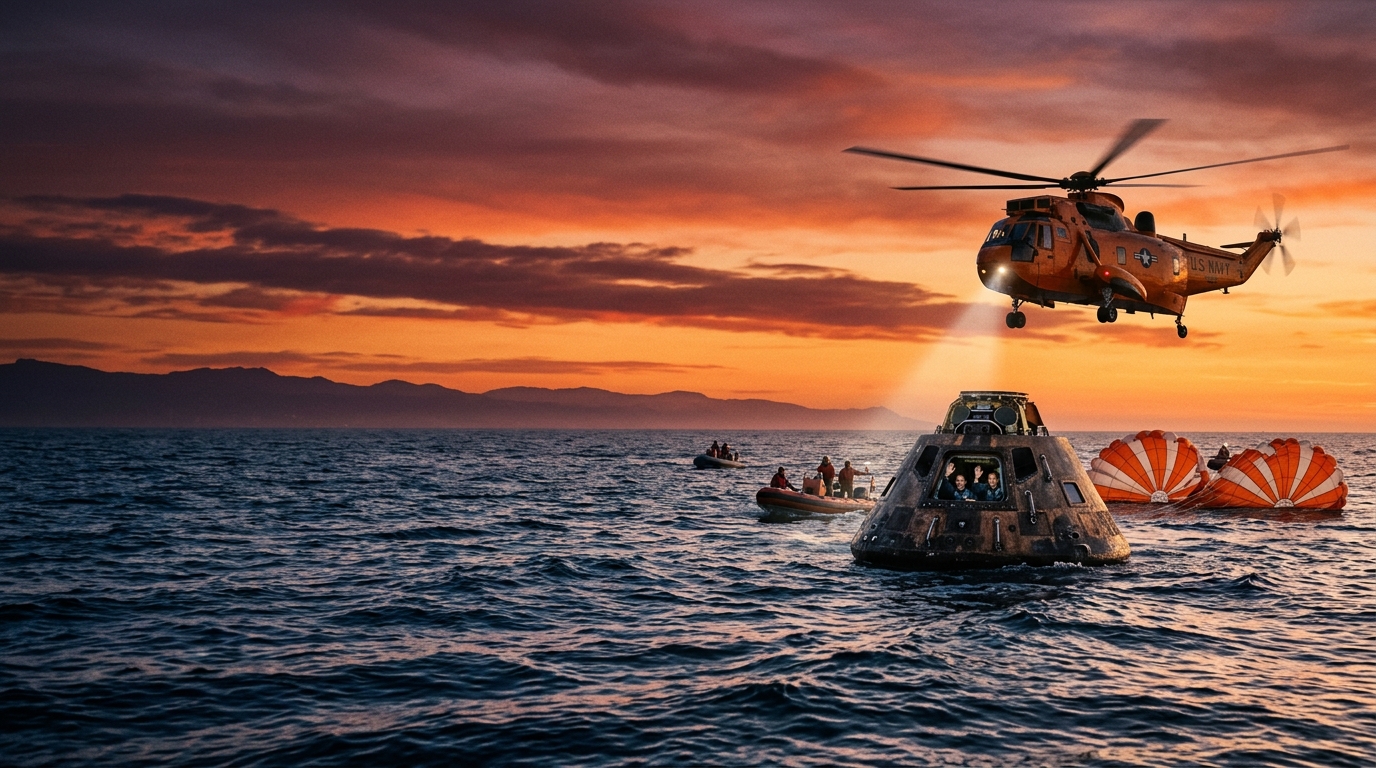
On April 10, 2026, NASA’s Artemis‑II crew of four astronauts (three Americans and one Canadian) safely splashed down off California after completing the first lunar flyby in over 50 years. The mission’s success underscores India’s need to monitor global space initiatives, given their implications for technology, security, and international cooperation.
Overview The NASA celebrated on April 10, 2026 the successful completion of its first lunar flyby in more than five decades. Four astronauts — three Americans and one Canadian — splashed down off the California coast , marking the end of a high‑profile crewed test mission that gathered spectacular lunar imagery. Key Developments Four crew members completed a 30‑day mission that included a close approach of approximately 100 km to the Moon’s surface. The spacecraft re‑entered Earth’s atmosphere without any anomaly, demonstrating reliable heat‑shield performance. High‑resolution images of the Moon’s far side were transmitted, providing fresh data for geological studies and future landing site selection. The mission underscored international cooperation by involving a Canadian astronaut, strengthening bilateral ties in space science. Important Facts Mission duration: 30 days (launch to splash‑down). Crew composition: 3 Americans, 1 Canadian . Landing site: Pacific Ocean, near San Diego, California . Primary objectives: test deep‑space navigation, validate life‑support systems, acquire lunar imagery. UPSC Relevance The mission illustrates the strategic importance of space exploration in national security, scientific advancement, and international diplomacy—core topics for GS II (International Relations) and GS III (Science & Technology). It also highlights the role of public sector agencies in driving high‑technology projects, a recurring theme in GS III. Aspirants should note the policy implications of sustained lunar programs, budget allocations, and the need for skilled human resources. Way Forward Building on the success, NASA plans to launch a crewed landing mission by the late 2020s, with further participation from allied nations. Continued investment in propulsion, habitat modules, and lunar surface science will be essential to maintain leadership in deep‑space exploration.
  1. Home
  2. Prepare
  3. Current Affairs
  4. NASA’s Artemis‑II Crew Returns Safely After First Lunar Flyby in 50 Years
Must Review
Login to bookmark articles
Login to mark articles as complete

Overview

gs.gs380% UPSC Relevance

Artemis‑II’s safe lunar flyby underscores space’s growing strategic and diplomatic weight for India.

Key Facts

  1. Artemis‑II crew returned safely on 10 April 2026 after a 30‑day mission.
  2. The mission performed a lunar flyby at ~100 km altitude – the first in 50 years.
  3. Four astronauts (3 Americans, 1 Canadian) splashed down in the Pacific Ocean near San Diego, California.
  4. High‑resolution images of the Moon’s far side were transmitted for scientific and landing‑site studies.
  5. The flight validated deep‑space navigation, life‑support systems and heat‑shield performance, underscoring US‑Canada space cooperation.

Background & Context

Artemis‑II marks the revival of crewed lunar exploration after the Apollo era, aligning with India's own lunar ambitions under ISRO. The mission showcases how public‑sector agencies drive high‑technology projects, influencing national security, scientific research and diplomatic ties – core themes of GS III (Science & Technology) and GS II (International Relations).

Mains Answer Angle

In a Mains answer, discuss the strategic importance of sustained lunar programmes for India’s scientific self‑reliance, international cooperation and defence capabilities (GS III). A possible question could ask about policy measures to strengthen India’s role in deep‑space missions.

Full Article

<h3>Overview</h3> <p>The <span class="key-term" data-definition="National Aeronautics and Space Administration — U.S. agency responsible for civilian space exploration, satellite deployment and scientific research (GS3: Science &amp; Technology)">NASA</span> celebrated on <strong>April 10, 2026</strong> the successful completion of its first <span class="key-term" data-definition="Lunar flyby — a spacecraft trajectory that passes around the Moon without landing, used to test navigation and deep‑space capabilities (GS3: Science &amp; Technology)">lunar flyby</span> in more than five decades. Four <span class="key-term" data-definition="Astronaut — a trained individual who travels into space to conduct scientific, technical, or exploratory tasks (GS3: Science &amp; Technology)">astronauts</span> — three Americans and one Canadian — splashed down off the <strong>California coast</strong>, marking the end of a high‑profile <span class="key-term" data-definition="Crewed test mission — a spaceflight that carries astronauts to validate spacecraft systems and operational procedures before full‑scale missions (GS3: Science &amp; Technology)">crewed test mission</span> that gathered spectacular lunar imagery.</p> <h3>Key Developments</h3> <ul> <li>Four crew members completed a 30‑day mission that included a close approach of <strong>approximately 100 km</strong> to the Moon’s surface.</li> <li>The <span class="key-term" data-definition="Spacecraft — vehicle designed for travel or operation in outer space, encompassing launch vehicle, crew module, and re‑entry capsule (GS3: Science &amp; Technology)">spacecraft</span> re‑entered Earth’s atmosphere without any anomaly, demonstrating reliable heat‑shield performance.</li> <li>High‑resolution images of the Moon’s far side were transmitted, providing fresh data for geological studies and future landing site selection.</li> <li>The mission underscored <span class="key-term" data-definition="International cooperation in space — collaborative efforts among nations for exploration, research, and technology sharing, reflecting diplomatic and strategic dimensions (GS2: International Relations)">international cooperation</span> by involving a Canadian astronaut, strengthening bilateral ties in space science.</li> </ul> <h3>Important Facts</h3> <ul> <li>Mission duration: <strong>30 days</strong> (launch to splash‑down).</li> <li>Crew composition: <strong>3 Americans, 1 Canadian</strong>.</li> <li>Landing site: <strong>Pacific Ocean, near San Diego, California</strong>.</li> <li>Primary objectives: test deep‑space navigation, validate life‑support systems, acquire lunar imagery.</li> </ul> <h3>UPSC Relevance</h3> <p>The mission illustrates the strategic importance of <strong>space exploration</strong> in national security, scientific advancement, and international diplomacy—core topics for GS II (International Relations) and GS III (Science &amp; Technology). It also highlights the role of public sector agencies in driving high‑technology projects, a recurring theme in GS III. Aspirants should note the policy implications of sustained lunar programs, budget allocations, and the need for skilled human resources.</p> <h3>Way Forward</h3> <p>Building on the success, <span class="key-term" data-definition="National Aeronautics and Space Administration — U.S. agency responsible for civilian space exploration, satellite deployment and scientific research (GS3: Science &amp; Technology)">NASA</span> plans to launch a crewed landing mission by the late 2020s, with further participation from allied nations. Continued investment in propulsion, habitat modules, and lunar surface science will be essential to maintain leadership in deep‑space exploration.</p>
Read Original on hindu

Analysis

Practice Questions

Prelims
Easy
Prelims MCQ

Artemis II mission facts

1 marks
5 keywords
GS3
Medium
Mains Short Answer

Policy implications of international lunar missions

10 marks
5 keywords
GS2
Hard
Mains Essay

Space diplomacy and collaborative missions

25 marks
6 keywords
Related:Daily•Weekly

Loading related articles...

Loading related articles...

Tip: Click articles above to read more from the same date, or use the back button to see all articles.

Quick Reference

Key Insight

Artemis‑II’s safe lunar flyby underscores space’s growing strategic and diplomatic weight for India.

Key Facts

  1. Artemis‑II crew returned safely on 10 April 2026 after a 30‑day mission.
  2. The mission performed a lunar flyby at ~100 km altitude – the first in 50 years.
  3. Four astronauts (3 Americans, 1 Canadian) splashed down in the Pacific Ocean near San Diego, California.
  4. High‑resolution images of the Moon’s far side were transmitted for scientific and landing‑site studies.
  5. The flight validated deep‑space navigation, life‑support systems and heat‑shield performance, underscoring US‑Canada space cooperation.

Background

Artemis‑II marks the revival of crewed lunar exploration after the Apollo era, aligning with India's own lunar ambitions under ISRO. The mission showcases how public‑sector agencies drive high‑technology projects, influencing national security, scientific research and diplomatic ties – core themes of GS III (Science & Technology) and GS II (International Relations).

Mains Angle

In a Mains answer, discuss the strategic importance of sustained lunar programmes for India’s scientific self‑reliance, international cooperation and defence capabilities (GS III). A possible question could ask about policy measures to strengthen India’s role in deep‑space missions.

Explore:Current Affairs·Editorial Analysis·Govt Schemes·Study Materials·Previous Year Questions·UPSC GPT