Loading page, please wait…
HomeCurrent AffairsEditorialsGovt SchemesLearning ResourcesUPSC SyllabusPricingAboutBest UPSC AIUPSC AI ToolAI for UPSCUPSC ChatGPT

© 2026 Vaidra. All rights reserved.

PrivacyTerms
Vaidra Logo
Vaidra

Top 4 items + smart groups

UPSC GPT
New
Current Affairs
Daily Solutions
Daily Puzzle
Mains Evaluator

Version 2.0.0 • Built with ❤️ for UPSC aspirants

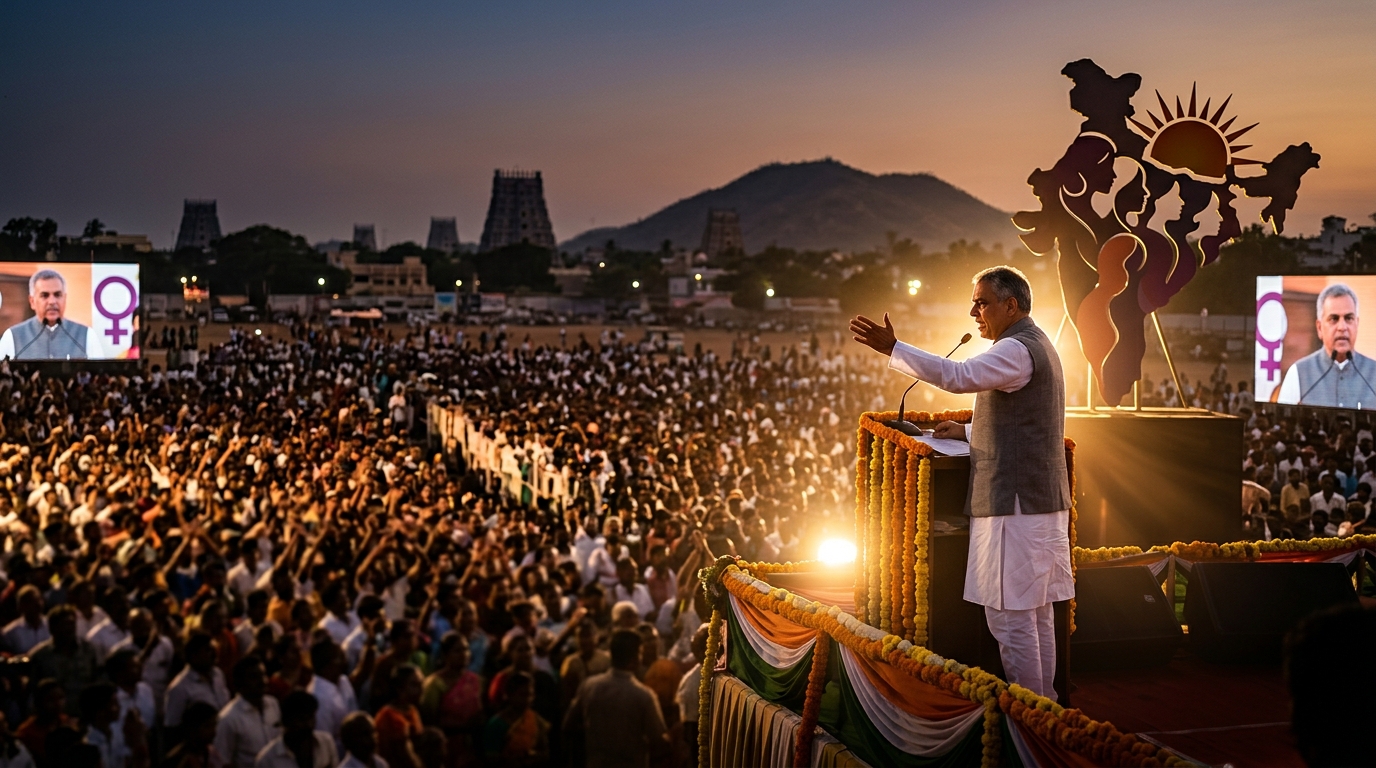
Rajnath Singh Vows to Implement Women's Reservation Act, Criticises DMK in Tenkasi Rally | GS2 UPSC Current Affairs April 2026
Rajnath Singh Vows to Implement Women's Reservation Act, Criticises DMK in Tenkasi Rally
On 19 April 2026, Defence Minister Rajnath Singh pledged to implement the Women's Reservation Act despite its amendment bill being defeated in Parliament, accusing the DMK and Congress of obstruction. Speaking at a Tenkasi rally ahead of the 23 April Assembly polls, he urged voters to reject the DMK over alleged corruption and backed BJP candidate Ananthan Ayyasamy, highlighting the centre‑state tussle over gender‑reservation legislation.
Overview On 19 April 2026 , Defence Minister Rajnath Singh addressed a rally in Tenkasi district ahead of the 23 April 2026 Assembly polls . He condemned the defeat of the amendment to the Women's Reservation Act in Parliament and pledged that the government would pursue its implementation regardless of opposition. Key Developments Singh accused the ruling DMK and the Congress of sabotaging the amendment bill. He asserted that " no power in the world can stop us " from implementing the reservation for women. Singh urged voters to "give a farewell" to the DMK, linking the party to alleged corruption and calling for a clean‑governance vote. The rally was held in support of the BJP candidate Ananthan Ayyasamy for the upcoming state elections. Important Facts The amendment to the Women's Reservation Act sought to increase the number of seats reserved for women in legislative bodies, a long‑standing demand of gender‑rights groups. Its defeat in Parliament has sparked political debate, with the centre insisting on its necessity for achieving gender parity in representation. The upcoming Assembly polls in Tamil Nadu are being closely watched as they will determine the balance of power between the centre and the state, especially after the DMK’s recent alliance shifts. UPSC Relevance Understanding the dynamics of this episode is vital for GS‑2 (Polity) and GS‑4 (Ethics) papers. The issue touches upon: Centre‑state relations and the role of the Union Cabinet in pushing social legislation. Gender‑reservation policies and their constitutional underpinnings. Political strategies of national parties (BJP) versus regional parties (DMK) during state elections. Ethical considerations surrounding corruption allegations and the impact on public trust. Way Forward Analysts suggest that the government may resort to constitutional tools—such as a constitutional amendment or a special majority —to pass the reservation bill if regular parliamentary procedures remain blocked. Simultaneously, the upcoming Tamil Nadu elections will test the BJP’s ability to translate central narratives into state‑level victories, while the DMK will need to counter accusations of corruption and defend its governance record. For aspirants, tracking the legislative progress of the Women's Reservation Act and the electoral outcomes in Tamil Nadu will provide concrete examples of policy implementation challenges and political accountability in India’s federal democracy.
  1. Home
  2. Prepare
  3. Current Affairs
  4. Rajnath Singh Vows to Implement Women's Reservation Act, Criticises DMK in Tenkasi Rally
Login to bookmark articles
Login to mark articles as complete

Overview

gs.gs276% UPSC Relevance

Centre vows to enforce Women’s Reservation Bill, slams DMK ahead of Tamil Nadu polls.

Key Facts

  1. 19 April 2026: Defence Minister Rajnath Singh addressed a rally in Tenkasi, Tamil Nadu, ahead of the 23 April 2026 Assembly polls.
  2. Singh pledged that the Government will implement the Women's Reservation Act despite its defeat in Parliament.
  3. The amendment aimed to increase the proportion of seats reserved for women in Parliament and State Legislatures, a demand since the 1990s.
  4. BJP candidate Ananthan Ayyasamy was the party's nominee for the Tenkasi constituency in the 23 April 2026 Tamil Nadu Assembly elections.
  5. Singh accused the DMK and the Congress of sabotaging the reservation bill and linked the DMK to corruption allegations.
  6. Implementation of the Women's Reservation Bill may require a constitutional amendment under Article 368, needing a special majority in both Houses.
  7. The issue underscores centre‑state dynamics, with the Union pushing a social‑justice reform while regional parties resist.

Background & Context

The Women's Reservation Bill, a long‑standing gender‑equity proposal, touches upon constitutional provisions (Article 368) and the Union's power to enact social legislation. Its defeat highlights the friction between the central government and regional parties, a key theme in GS‑2 (Polity) and GS‑4 (Ethics).

Mains Answer Angle

GS‑2: Discuss the role of the Union Government in advancing social legislation like the Women's Reservation Bill and the political‑constitutional challenges it faces, especially in a federal setup.

Full Article

<h3>Overview</h3> <p>On <strong>19 April 2026</strong>, <span class="key-term" data-definition="Defence Minister — senior cabinet position responsible for India's defence policy and armed forces (GS2: Polity)">Defence Minister</span> <strong>Rajnath Singh</strong> addressed a rally in <strong>Tenkasi district</strong> ahead of the <strong>23 April 2026 Assembly polls</strong>. He condemned the defeat of the amendment to the <span class="key-term" data-definition="Women's Reservation Act — legislation aimed at reserving seats for women in legislative bodies, a key gender‑equity measure (GS1: Polity, GS4: Ethics)">Women's Reservation Act</span> in Parliament and pledged that the government would pursue its implementation regardless of opposition.</p> <h3>Key Developments</h3> <ul> <li>Singh accused the ruling <span class="key-term" data-definition="Dravida Munnetra Kazhagam (DMK) — regional party governing Tamil Nadu, often in opposition to the BJP at the centre (GS2: Polity)">DMK</span> and the <span class="key-term" data-definition="Indian National Congress (Congress) — the principal opposition party at the centre (GS2: Polity)">Congress</span> of sabotaging the amendment bill.</li> <li>He asserted that "<strong>no power in the world can stop us</strong>" from implementing the reservation for women.</li> <li>Singh urged voters to "give a farewell" to the DMK, linking the party to alleged <span class="key-term" data-definition="Corruption — misuse of public power for private gain, a major governance challenge (GS4: Ethics)">corruption</span> and calling for a clean‑governance vote.</li> <li>The rally was held in support of the <span class="key-term" data-definition="Bharatiya Janata Party (BJP) — the ruling party at the centre, representing right‑wing ideology (GS2: Polity)">BJP</span> candidate <strong>Ananthan Ayyasamy</strong> for the upcoming state elections.</li> </ul> <h3>Important Facts</h3> <p>The amendment to the <span class="key-term" data-definition="Women's Reservation Act — legislation aimed at reserving seats for women in legislative bodies, a key gender‑equity measure (GS1: Polity, GS4: Ethics)">Women's Reservation Act</span> sought to increase the number of seats reserved for women in legislative bodies, a long‑standing demand of gender‑rights groups. Its defeat in Parliament has sparked political debate, with the centre insisting on its necessity for achieving gender parity in representation.</p> <p>The upcoming <span class="key-term" data-definition="Assembly polls — state legislative elections to elect MLAs, crucial for federal structure (GS2: Polity, GS3: Economy)">Assembly polls</span> in Tamil Nadu are being closely watched as they will determine the balance of power between the centre and the state, especially after the DMK’s recent alliance shifts.</p> <h3>UPSC Relevance</h3> <p>Understanding the dynamics of this episode is vital for GS‑2 (Polity) and GS‑4 (Ethics) papers. The issue touches upon:</p> <ul> <li>Centre‑state relations and the role of the Union Cabinet in pushing social legislation.</li> <li>Gender‑reservation policies and their constitutional underpinnings.</li> <li>Political strategies of national parties (BJP) versus regional parties (DMK) during state elections.</li> <li>Ethical considerations surrounding corruption allegations and the impact on public trust.</li> </ul> <h3>Way Forward</h3> <p>Analysts suggest that the government may resort to constitutional tools—such as a <strong>constitutional amendment</strong> or a <strong>special majority</strong>—to pass the reservation bill if regular parliamentary procedures remain blocked. Simultaneously, the upcoming Tamil Nadu elections will test the BJP’s ability to translate central narratives into state‑level victories, while the DMK will need to counter accusations of corruption and defend its governance record.</p> <p>For aspirants, tracking the legislative progress of the <span class="key-term" data-definition="Women's Reservation Act — legislation aimed at reserving seats for women in legislative bodies, a key gender‑equity measure (GS1: Polity, GS4: Ethics)">Women's Reservation Act</span> and the electoral outcomes in Tamil Nadu will provide concrete examples of policy implementation challenges and political accountability in India’s federal democracy.</p>
Read Original on hindu

Analysis

Practice Questions

Prelims
Easy
Prelims MCQ

Process of constitutional amendment in Parliament

1 marks
3 keywords
GS2
Medium
Mains Short Answer

Process of constitutional amendment in Parliament

10 marks
4 keywords
GS2
Hard
Mains Essay

Women's Reservation Bill and its constitutional status

250 marks
5 keywords
Related:Daily•Weekly

Loading related articles...

Loading related articles...

Tip: Click articles above to read more from the same date, or use the back button to see all articles.

Quick Reference

Key Insight

Centre vows to enforce Women’s Reservation Bill, slams DMK ahead of Tamil Nadu polls.

Key Facts

  1. 19 April 2026: Defence Minister Rajnath Singh addressed a rally in Tenkasi, Tamil Nadu, ahead of the 23 April 2026 Assembly polls.
  2. Singh pledged that the Government will implement the Women's Reservation Act despite its defeat in Parliament.
  3. The amendment aimed to increase the proportion of seats reserved for women in Parliament and State Legislatures, a demand since the 1990s.
  4. BJP candidate Ananthan Ayyasamy was the party's nominee for the Tenkasi constituency in the 23 April 2026 Tamil Nadu Assembly elections.
  5. Singh accused the DMK and the Congress of sabotaging the reservation bill and linked the DMK to corruption allegations.
  6. Implementation of the Women's Reservation Bill may require a constitutional amendment under Article 368, needing a special majority in both Houses.
  7. The issue underscores centre‑state dynamics, with the Union pushing a social‑justice reform while regional parties resist.

Background

The Women's Reservation Bill, a long‑standing gender‑equity proposal, touches upon constitutional provisions (Article 368) and the Union's power to enact social legislation. Its defeat highlights the friction between the central government and regional parties, a key theme in GS‑2 (Polity) and GS‑4 (Ethics).

Mains Angle

GS‑2: Discuss the role of the Union Government in advancing social legislation like the Women's Reservation Bill and the political‑constitutional challenges it faces, especially in a federal setup.

Explore:Current Affairs·Editorial Analysis·Govt Schemes·Study Materials·Previous Year Questions·UPSC GPT