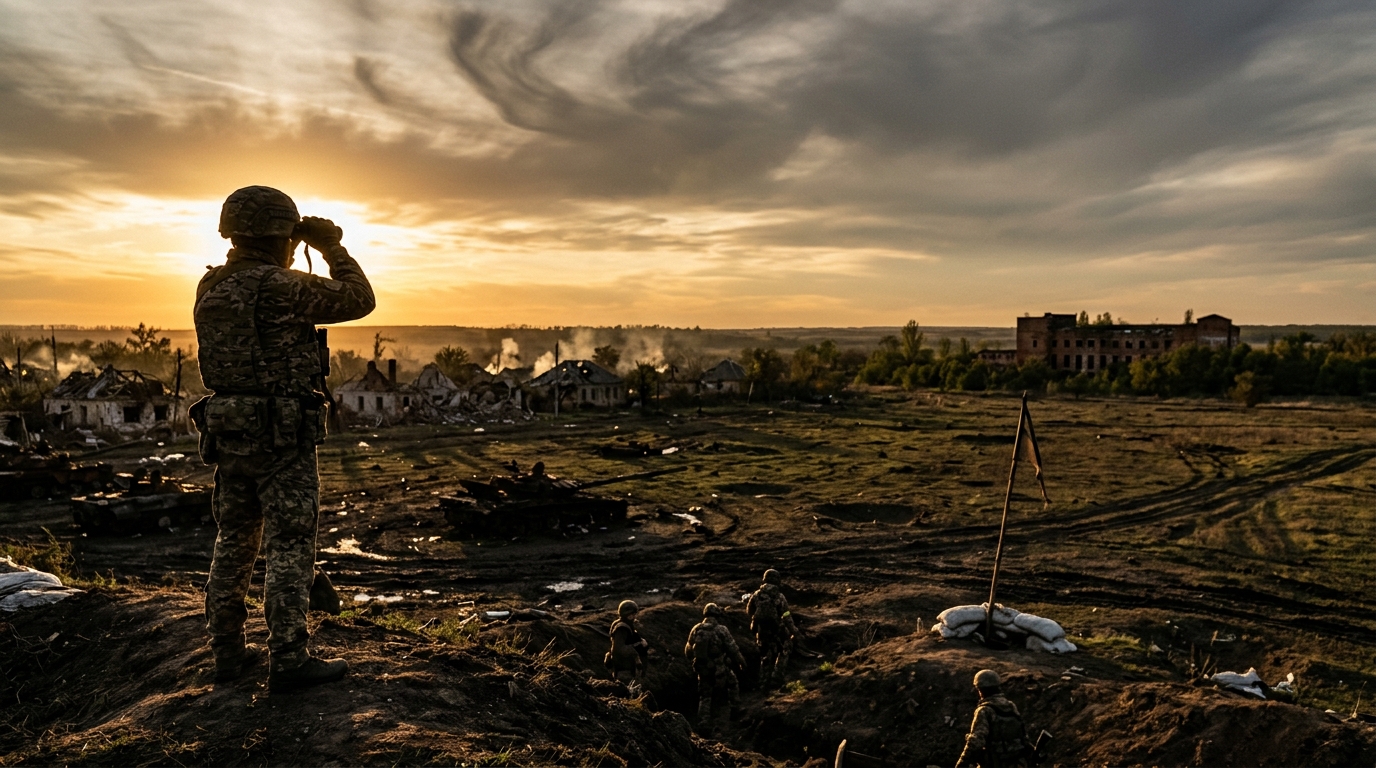
<p>For the first time since the war began, Russia’s army recorded almost no territorial expansion on the Ukrainian front line in March 2026, seizing merely <strong>23 sq km</strong>. This marks the smallest advance in two‑and‑a‑half years and reflects a combination of effective Ukrainian resistance and constraints on Russian communications.</p>
<h3>Key Developments (March 2026)</h3>
<ul>
<li>Russian gains across the entire front line total <strong>23 sq km</strong>, a sharp decline from <strong>123 sq km</strong> in February and <strong>319 sq km</strong> in January.</li>
<li>The slowdown is attributed to vigorous <span class="key-term" data-definition="Ukrainian counter‑offensives — localized military operations by Ukraine to reclaim territory, crucial in slowing Russian advances (GS2: International Relations)">Ukrainian counter‑offensives</span>, a ban on <span class="key-term" data-definition="Starlink — satellite‑based internet service by SpaceX, used by Ukrainian forces for communications; its ban hampers Russian operational coordination (GS3: International Relations)">Starlink</span> terminals in Ukraine, and Kremlin‑imposed restrictions on <span class="key-term" data-definition="Telegram — cloud‑based messaging app popular in Russia; restrictions affect command‑and‑control communications for Russian troops (GS3: International Relations)">Telegram</span>.</li>
<li>Russia lost ground on the southern front between the <span class="key-term" data-definition="Donetsk and Dnipropetrovsk regions — eastern Ukrainian oblasts that form part of the contested front line; control over them influences the war’s strategic balance (GS2: International Relations)">Donetsk and Dnipropetrovsk</span> regions, shrinking from over <strong>400 sq km</strong> in January to <strong>144 sq km</strong> in March.</li>
<li>The data analysis was conducted by the <span class="key-term" data-definition="Institute for the Study of War — a U.S.-based think‑tank that analyses armed conflicts, providing data used by policymakers and scholars (GS3: International Relations)">ISW</span> in partnership with the <span class="key-term" data-definition="Critical Threats Project — research initiative of the American Enterprise Institute focusing on security threats, collaborating with ISW on conflict analysis (GS3: International Relations)">Critical Threats Project</span>, a unit of the <span class="key-term" data-definition="American Enterprise Institute (AEI) — a U.S. public policy think‑tank that conducts research on foreign policy and security issues (GS3: International Relations)">AEI</span>.</li>
</ul>
<h3>Important Facts</h3>
<ul>
<li>January 2026: Russian advance of <strong>319 sq km</strong> – the largest monthly gain since April 2024.</li>
<li>February 2026: Advance fell to <strong>123 sq km</strong>, the smallest since April 2024.</li>
<li>March 2026: Advance further contracted to <strong>23 sq km</strong>, the lowest since September 2023.</li>
<li>Overall, Russia now occupies just over <strong>19 %</strong> of Ukraine’s territory, most of which was seized in the early weeks of the 2022 invasion.</li>
<li>Pre‑invasion, about <strong>7 %</strong> of Ukrainian land (including Crimea and parts of Donbas) was already under Russian or pro‑Russian control.</li>
</ul>
<h3>UPSC Relevance</h3>
<p>The evolving dynamics of the Russia‑Ukraine war are pertinent to several GS papers:</p>
<ul>
<li><strong>GS II (International Relations)</strong>: Understanding the impact of modern communication tools (<span class="key-term" data-definition="Starlink — satellite‑based internet service by SpaceX, used by Ukrainian forces for communications; its ban hampers Russian operational coordination (GS3: International Relations)">Starlink</span>, <span class="key-term" data-definition="Telegram — cloud‑based messaging app popular in Russia; restrictions affect command‑and‑control communications for Russian troops (GS3: International Relations)">Telegram</span>) on warfare strategy.</li>
<li><strong>GS III (Security & Defence)</strong>: Analyzing how think‑tank assessments (<span class="key-term" data-definition="Institute for the Study of War — a U.S.-based think‑tank that analyses armed conflicts, providing data used by policymakers and scholars (GS3: International Relations)">ISW</span>, <span class="key-term" data-definition="Critical Threats Project — research initiative of the American Enterprise Institute focusing on security threats, collaborating with ISW on conflict analysis (GS3: International Relations)">Critical Threats Project</span>) shape policy responses.</li>
<li><strong>GS I (Geography & History)</strong>: Knowledge of the contested oblasts (<span class="key-term" data-definition="Donetsk and Dnipropetrovsk regions — eastern Ukrainian oblasts that form part of the contested front line; control over them influences the war’s strategic balance (GS2: International Relations)">Donetsk and Dnipropetrovsk</span>) and their strategic significance.</li>
</ul>
<h3>Way Forward</h3>
<p>While the March slowdown signals a potential shift in momentum, the conflict’s trajectory will depend on several factors:</p>
<ul>
<li>Continued Ukrainian counter‑offensives that could further erode Russian footholds.</li>
<li>International support for Ukraine’s communications infrastructure, countering the Russian ban on <span class="key-term" data-definition="Starlink — satellite‑based internet service by SpaceX, used by Ukrainian forces for communications; its ban hampers Russian operational coordination (GS3: International Relations)">Starlink</span> and <span class="key-term" data-definition="Telegram — cloud‑based messaging app popular in Russia; restrictions affect command‑and‑control communications for Russian troops (GS3: International Relations)">Telegram</span>.</li>
<li>Diplomatic initiatives that may leverage the reduced Russian advances to negotiate cease‑fire or peace terms.</li>
<li>Monitoring of think‑tank analyses (<span class="key-term" data-definition="Institute for the Study of War — a U.S.-based think‑tank that analyses armed conflicts, providing data used by policymakers and scholars (GS3: International Relations)">ISW</span>) for early indicators of strategic shifts.</li>
</ul>
<p>For UPSC aspirants, tracking these developments offers insight into modern warfare, the role of technology in conflict, and the importance of strategic assessments in shaping national security policy.</p>