Loading page, please wait…
HomeCurrent AffairsEditorialsGovt SchemesLearning ResourcesUPSC SyllabusPricingAboutBest UPSC AIUPSC AI ToolAI for UPSCUPSC ChatGPT

© 2026 Vaidra. All rights reserved.

PrivacyTerms
Vaidra Logo
Vaidra

Top 4 items + smart groups

UPSC GPT
New
Current Affairs
Daily Solutions
Daily Puzzle
Mains Evaluator

Version 2.0.0 • Built with ❤️ for UPSC aspirants

Supreme Court 9‑Judge Bench to Hear Sabarimala Review: Seven Constitutional Questions on Articles 25 & 26 — UPSC Current Affairs | April 7, 2026
Supreme Court 9‑Judge Bench to Hear Sabarimala Review: Seven Constitutional Questions on Articles 25 & 26
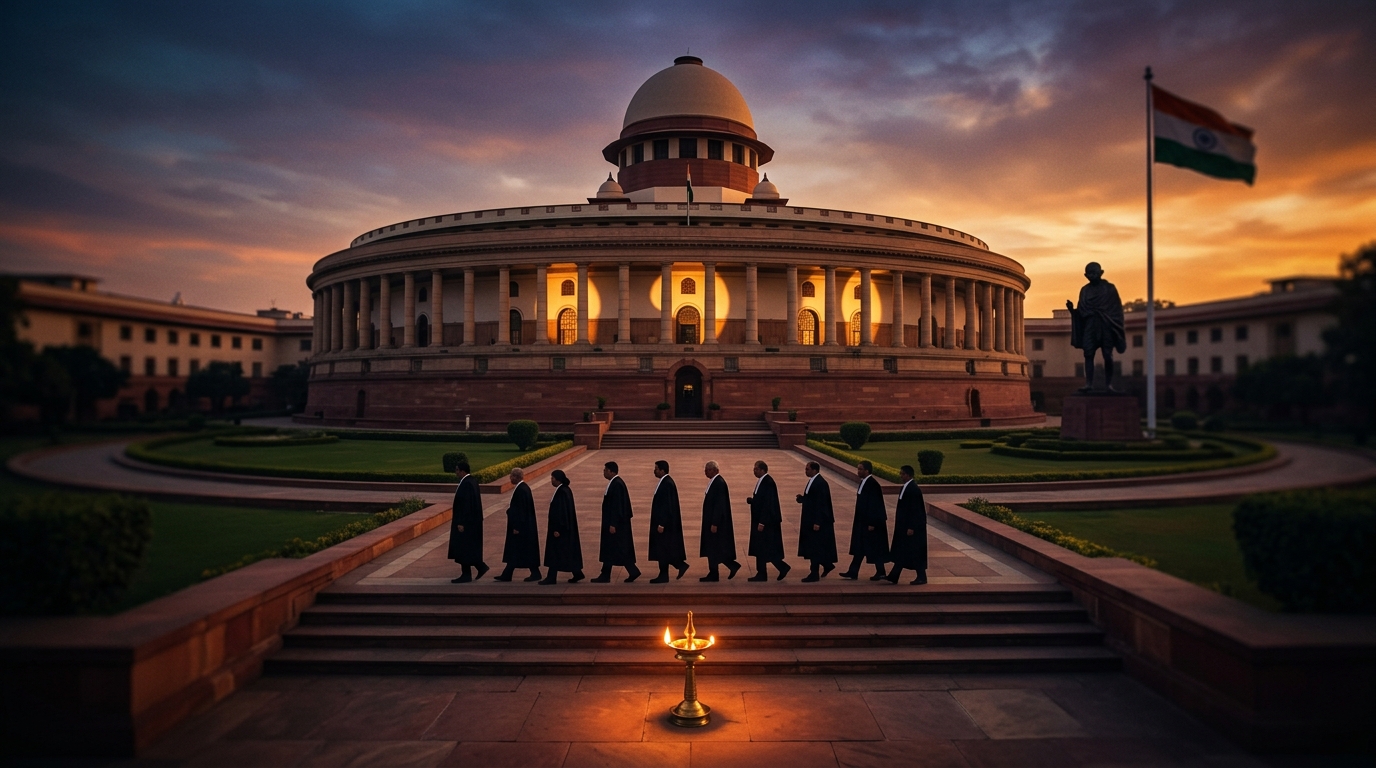
A nine‑judge bench of the <span class="key-term" data-definition="Supreme Court — India's apex judicial body that interprets the Constitution and adjudicates disputes (GS2: Polity)">Supreme Court</span>, headed by <span class="key-term" data-definition="Chief Justice of India (CJI) — the senior-most judge of the Supreme Court, responsible for constituting benches and overseeing judicial administration (GS2: Polity)">CJI Surya Kant</span>, will hear the Sabarimala case, examining seven constitutional questions relating to <span class="key-term" data-definition="Article 25 of the Constitution — guarantees freedom of conscience and the right to freely profess, practice and propagate religion, subject to public order, morality and health (GS2: Polity)">Article 25</span> and <span class="key-term" data-definition="Article 26 of the Constitution — confers the right to manage religious affairs to religious denominations (GS2: Polity)">Article 26</span>. The hearing will clarify the scope of religious freedom, the interplay of rights, and the standing of non‑members to challenge religious practices via a <span class="key-term" data-definition="Public Interest Litigation (PIL) — a legal tool allowing any public‑spirited individual or group to seek judicial redress on matters of public interest (GS2: Polity)">PIL</span>.
The Supreme Court has constituted a nine‑judge bench to examine the constitutional dimensions of the Sabarimala case. The bench, led by CJI Surya Kant , will address seven specific questions that cut to the core of religious freedom under the Constitution. Key Developments Bench composition: Justice BV Nagarathna, Justice MM Sundresh, Justice Ahsanuddin Amanullah, Justice Aravind Kumar, Justice Augustine George Masih, Justice Prasanna B Varale, Justice R Mahadevan, Justice Joymalya Bagchi alongside the CJI. Seven questions focus on the scope of Article 25 , the interplay with Article 26 , and the limits of judicial review. The bench will also consider whether a non‑member of a religious denomination can file a PIL challenging a religious practice. Important Facts Question (i) : Defines the ambit of the right to freedom of religion under Article 25 . Question (ii) : Explores the relationship between individual rights under Article 25 and collective rights of denominations under Article 26 . Question (iii) : Asks whether rights under Article 26 are subject to other provisions of Part III beyond the traditional "public order, morality and health" clause. Question (iv) : Seeks the scope of "morality" in Articles 25 and 26 and whether it includes "constitutional morality". Question (v) : Examines the extent of judicial review over religious practices under Article 25 . Question (vi) : Interprets the phrase “Sections of Hindus” in Article 25(2)(b). Question (vii) : Determines if a person outside a religious denomination can challenge its practices via a PIL . UPSC Relevance Understanding these questions is vital for GS Paper II (Polity) as they delve into the interpretation of fundamental rights, the balance between individual liberty and collective religious autonomy, and the doctrine of constitutional morality. The case also illustrates the role of the judiciary in shaping social policy, a recurring theme in ethics and governance (GS IV). Moreover, the procedural aspect of who can file a PIL touches upon access to justice, an important governance indicator. Way Forward Students should track the bench’s judgments to gauge future jurisprudence on religious freedom and constitutional morality. Analyse how the Court balances Article 25 with Article 26 and other fundamental rights under Part III . Consider the implications of expanding or restricting standing in religious matters for civil society and minority rights. Prepare concise notes linking the Sabarimala debate to broader themes of secularism, gender equality, and judicial activism for answer writing.
  1. Home
  2. Prepare
  3. Current Affairs
  4. Supreme Court 9‑Judge Bench to Hear Sabarimala Review: Seven Constitutional Questions on Articles 25 & 26
Must Review
Login to bookmark articles
Login to mark articles as complete

Overview

gs.gs180% UPSC Relevance

SC’s 9‑Judge Bench on Sabarimala tests religious freedom vs gender equality

Key Facts

  1. 2026: Supreme Court constituted a nine‑judge bench, led by CJI Surya Kant, to hear the Sabarimala review.
  2. Bench members: Justices BV Nagarathna, MM Sundresh, Ahsanuddin Amanullah, Aravind Kumar, Augustine George Masih, Prasanna B Varale, R Mahadevan, Joymalya Bagchi.
  3. Seven questions focus on Articles 25 & 26, especially the scope of "morality" and "constitutional morality".
  4. One question asks if a non‑member of a religious denomination can file a PIL challenging its practices.
  5. The review revisits the 2018 Sabarimala verdict that permitted entry of women of all ages, raising gender‑equality vs religious‑autonomy debate.
  6. Outcome will clarify the interplay between individual fundamental rights (Part III) and collective rights of denominations under Article 26.

Background & Context

The Sabarimala dispute sits at the intersection of fundamental rights (Art 25, Art 26, Part III) and the doctrine of constitutional morality, a recurring theme in UPSC polity. It illustrates how the judiciary mediates between individual liberty, gender equality and collective religious autonomy, impacting governance and social policy.

UPSC Syllabus Connections

Essay•Philosophy, Ethics and Human ValuesPrelims_GS•Constitution and Political SystemGS2•Executive and Judiciary - structure, organization and functioningPrelims_GS•Public Policy and Rights IssuesEssay•Youth, Health and WelfareGS4•Essence, determinants and consequences of Ethics in human actions

Mains Answer Angle

GS II (Polity) – Discuss how the Supreme Court’s nine‑judge bench on Sabarimala reflects the tension between religious freedom and gender equality, and the role of constitutional morality in adjudicating such conflicts.

Full Article

<p>The <span class="key-term" data-definition="Supreme Court — India's apex judicial body that interprets the Constitution and adjudicates disputes (GS2: Polity)">Supreme Court</span> has constituted a nine‑judge bench to examine the constitutional dimensions of the <span class="key-term" data-definition="Sabarimala — a prominent Hindu pilgrimage site in Kerala whose entry rules for women have been the subject of extensive litigation (GS2: Polity)">Sabarimala</span> case. The bench, led by <span class="key-term" data-definition="Chief Justice of India (CJI) — the senior-most judge of the Supreme Court, responsible for constituting benches and overseeing judicial administration (GS2: Polity)">CJI Surya Kant</span>, will address seven specific questions that cut to the core of religious freedom under the Constitution.</p> <h3>Key Developments</h3> <ul> <li>Bench composition: <strong>Justice BV Nagarathna, Justice MM Sundresh, Justice Ahsanuddin Amanullah, Justice Aravind Kumar, Justice Augustine George Masih, Justice Prasanna B Varale, Justice R Mahadevan, Justice Joymalya Bagchi</strong> alongside the CJI.</li> <li>Seven questions focus on the scope of <span class="key-term" data-definition="Article 25 of the Constitution — guarantees freedom of conscience and the right to freely profess, practice and propagate religion, subject to public order, morality and health (GS2: Polity)">Article 25</span>, the interplay with <span class="key-term" data-definition="Article 26 of the Constitution — confers the right to manage religious affairs to religious denominations (GS2: Polity)">Article 26</span>, and the limits of judicial review.</li> <li>The bench will also consider whether a non‑member of a religious denomination can file a <span class="key-term" data-definition="Public Interest Litigation (PIL) — a legal tool allowing any public‑spirited individual or group to seek judicial redress on matters of public interest (GS2: Polity)">PIL</span> challenging a religious practice.</li> </ul> <h3>Important Facts</h3> <ul> <li><strong>Question (i)</strong>: Defines the ambit of the right to freedom of religion under <span class="key-term" data-definition="Article 25 of the Constitution — guarantees freedom of conscience and the right to freely profess, practice and propagate religion, subject to public order, morality and health (GS2: Polity)">Article 25</span>.</li> <li><strong>Question (ii)</strong>: Explores the relationship between individual rights under <span class="key-term" data-definition="Article 25 of the Constitution — guarantees freedom of conscience and the right to freely profess, practice and propagate religion, subject to public order, morality and health (GS2: Polity)">Article 25</span> and collective rights of denominations under <span class="key-term" data-definition="Article 26 of the Constitution — confers the right to manage religious affairs to religious denominations (GS2: Polity)">Article 26</span>.</li> <li><strong>Question (iii)</strong>: Asks whether rights under <span class="key-term" data-definition="Article 26 of the Constitution — confers the right to manage religious affairs to religious denominations (GS2: Polity)">Article 26</span> are subject to other provisions of <span class="key-term" data-definition="Part III of the Constitution — contains the Fundamental Rights guaranteeing civil liberties such as equality, liberty, and freedom of speech (GS2: Polity)">Part III</span> beyond the traditional "public order, morality and health" clause.</li> <li><strong>Question (iv)</strong>: Seeks the scope of "morality" in Articles 25 and 26 and whether it includes "constitutional morality".</li> <li><strong>Question (v)</strong>: Examines the extent of judicial review over religious practices under <span class="key-term" data-definition="Article 25 of the Constitution — guarantees freedom of conscience and the right to freely profess, practice and propagate religion, subject to public order, morality and health (GS2: Polity)">Article 25</span>.</li> <li><strong>Question (vi)</strong>: Interprets the phrase “Sections of Hindus” in Article 25(2)(b).</li> <li><strong>Question (vii)</strong>: Determines if a person outside a religious denomination can challenge its practices via a <span class="key-term" data-definition="Public Interest Litigation (PIL) — a legal tool allowing any public‑spirited individual or group to seek judicial redress on matters of public interest (GS2: Polity)">PIL</span>.</li> </ul> <h3>UPSC Relevance</h3> <p>Understanding these questions is vital for GS Paper II (Polity) as they delve into the interpretation of fundamental rights, the balance between individual liberty and collective religious autonomy, and the doctrine of constitutional morality. The case also illustrates the role of the judiciary in shaping social policy, a recurring theme in ethics and governance (GS IV). Moreover, the procedural aspect of who can file a <span class="key-term" data-definition="Public Interest Litigation (PIL) — a legal tool allowing any public‑spirited individual or group to seek judicial redress on matters of public interest (GS2: Polity)">PIL</span> touches upon access to justice, an important governance indicator.</p> <h3>Way Forward</h3> <ul> <li>Students should track the bench’s judgments to gauge future jurisprudence on religious freedom and constitutional morality.</li> <li>Analyse how the Court balances <span class="key-term" data-definition="Article 25 of the Constitution — guarantees freedom of conscience and the right to freely profess, practice and propagate religion, subject to public order, morality and health (GS2: Polity)">Article 25</span> with <span class="key-term" data-definition="Article 26 of the Constitution — confers the right to manage religious affairs to religious denominations (GS2: Polity)">Article 26</span> and other fundamental rights under <span class="key-term" data-definition="Part III of the Constitution — contains the Fundamental Rights guaranteeing civil liberties such as equality, liberty, and freedom of speech (GS2: Polity)">Part III</span>.</li> <li>Consider the implications of expanding or restricting standing in religious matters for civil society and minority rights.</li> <li>Prepare concise notes linking the Sabarimala debate to broader themes of secularism, gender equality, and judicial activism for answer writing.</li> </ul>
Read Original on livelaw

Analysis

Practice Questions

Prelims
Easy
Prelims MCQ

Fundamental Rights – Article 26

1 marks
3 keywords
GS2
Medium
Mains Short Answer

Constitutional Morality & Religious Freedom

10 marks
5 keywords
GS2
Hard
Mains Essay

Religion, Gender Equality & Judicial Activism

250 marks
7 keywords
Related:Daily•Weekly

Loading related articles...

Loading related articles...

Tip: Click articles above to read more from the same date, or use the back button to see all articles.

Explore:Current Affairs·Editorial Analysis·Govt Schemes·Study Materials·Previous Year Questions·UPSC GPT