Loading page, please wait…
HomeCurrent AffairsEditorialsGovt SchemesLearning ResourcesUPSC SyllabusPricingAboutBest UPSC AIUPSC AI ToolAI for UPSCUPSC ChatGPT

© 2026 Vaidra. All rights reserved.

PrivacyTerms
Vaidra Logo
Vaidra

Top 4 items + smart groups

UPSC GPT
New
Current Affairs
Daily Solutions
Daily Puzzle
Mains Evaluator

Version 2.0.0 • Built with ❤️ for UPSC aspirants

TDB‑DST Funds MiniMines Cleantech for Indigenous Lithium‑Ion Battery Recycling – Boosting Critical Mineral Self‑Reliance — UPSC Current Affairs | March 6, 2026
TDB‑DST Funds MiniMines Cleantech for Indigenous Lithium‑Ion Battery Recycling – Boosting Critical Mineral Self‑Reliance
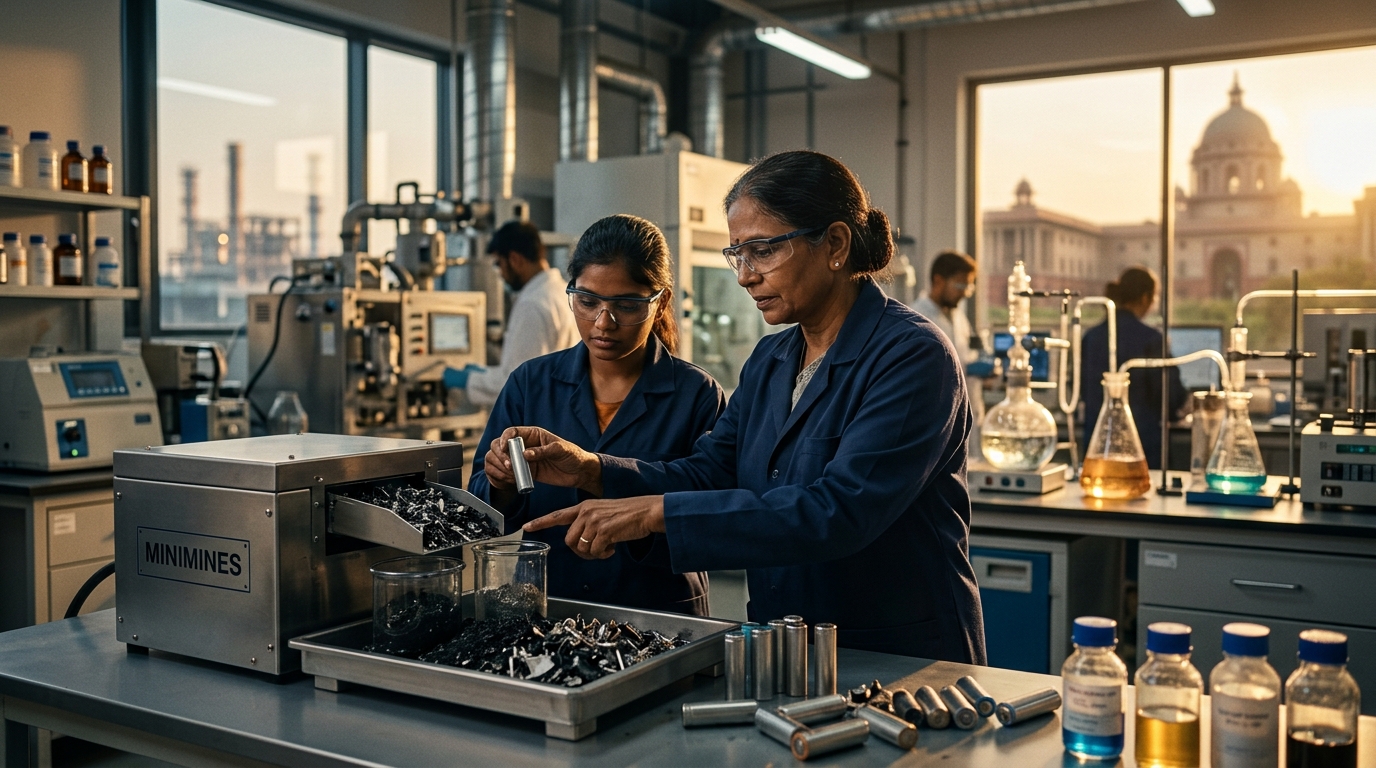
The Technology Development Board, under the Department of Science & Technology, has funded MiniMines Cleantech Solutions to commercialise an indigenous, zero‑discharge recycling process for lithium‑ion batteries, aiming for 99% recovery of critical minerals. This initiative aligns with India’s Aatmanirbhar Bharat and National Critical Minerals Mission, enhancing self‑reliance, energy security, and circular‑economy objectives.
The TDB of the DST has approved funding for MiniMines Cleantech Solutions Pvt. Ltd. to set up a commercial plant for the sustainable recycling of end‑of‑life lithium‑ion batteries. Key Developments Financial support extended to scale up the “Sustainable Recycling of the Waste Lithium‑ion Batteries” project. Commercialisation of an indigenous, zero‑discharge Hybrid Hydrometallurgy™ technology. Target recovery rates of up to 99 % for battery‑grade salts such as lithium carbonate and cobalt sulphate. Integration of EPR services for lithium‑ion batteries. Alignment with the National Critical Minerals Mission and the broader Aatmanirbhar Bharat agenda. Important Facts The company’s end‑to‑end recycling chain covers pre‑assessment, collection, segregation, mechanical processing, and advanced post‑processing stages such as selective separation and beneficiation. All steps are patented and developed domestically, reducing reliance on imported recycling equipment. The recovered materials will meet industry specifications and cater to both domestic demand and export markets, thereby supporting India’s clean‑energy transition. UPSC Relevance Understanding this initiative is crucial for GS III (Economy & Environment) as it illustrates: How India is building strategic autonomy in critical mineral supply chains. The role of public‑private partnerships and government funding mechanisms like TDB in technology commercialization. The practical application of circular‑economy concepts and EPR policies in the electronics sector. Implications for energy security, given the dependence of electric‑vehicle and renewable‑energy storage on lithium‑ion batteries. Way Forward To maximise impact, the government should: Facilitate a robust regulatory framework for battery collection and recycling under the EPR mandate. Encourage scaling of similar indigenous technologies through additional grants and tax incentives. Promote research‑driven innovation in alternative recycling methods to further lower energy consumption and emissions. Integrate recovered critical minerals into domestic manufacturing clusters for batteries and renewable‑energy storage, reducing import bills. Successful implementation will strengthen India’s position in the global clean‑technology landscape while advancing the goals of self‑reliance and sustainable development.
  1. Home
  2. Prepare
  3. Current Affairs
  4. TDB‑DST Funds MiniMines Cleantech for Indigenous Lithium‑Ion Battery Recycling – Boosting Critical Mineral Self‑Reliance
Login to bookmark articles
Login to mark articles as complete

Overview

India funds indigenous lithium‑ion battery recycling to secure critical minerals and boost self‑reliance

Key Facts

  1. Technology Development Board (TDB), under DST, approved funding for MiniMines Cleantech Solutions in FY 2024‑25.
  2. The patented Hybrid Hydrometallurgy™ process claims up to 99% recovery of battery‑grade lithium carbonate and cobalt sulphate.
  3. The technology is zero‑discharge, low‑energy and integrates Extended Producer Responsibility (EPR) services for end‑of‑life batteries.
  4. Project aligns with the National Critical Minerals Mission and Aatmanirbhar Bharat agenda to reduce import dependence on lithium, cobalt, nickel and manganese.
  5. All recycling stages – collection, segregation, mechanical processing, selective separation and beneficiation – are developed and patented in India.

Background & Context

India’s rapid EV and renewable‑energy expansion has heightened dependence on imported critical minerals. The government’s push for a circular economy, backed by policies such as EPR and the National Critical Minerals Mission, seeks to build domestic supply chains and reduce strategic vulnerabilities.

UPSC Syllabus Connections

Essay•Economy, Development and InequalityGS3•Developments in science and technology and their applicationsEssay•Science, Technology and SocietyGS1•Poverty and Developmental IssuesGS3•Environmental Impact AssessmentGS1•Distribution of Key Natural ResourcesPrelims_GS•Sustainable Development and InclusionGS1•Industrial Revolution and its impactGS3•Infrastructure - Energy, Ports, Roads, Airports, Railways

Mains Answer Angle

GS III – Discuss how public‑private partnerships and targeted funding (e.g., TDB) can create strategic autonomy in critical mineral supply chains and advance the circular‑economy vision of Aatmanirbhar Bharat.

Full Article

Read Original on pib

Analysis

Practice Questions

Prelims
Easy
Prelims MCQ

Technology Development Board (TDB) funding

1 marks
4 keywords
GS3
Medium
Mains Short Answer

Lithium‑ion battery recycling & circular economy

5 marks
5 keywords
GS3
Hard
Mains Essay

Critical minerals, self‑reliance, policy & funding

25 marks
6 keywords
Related:Daily•Weekly

Loading related articles...

Loading related articles...

Tip: Click articles above to read more from the same date, or use the back button to see all articles.

Explore:Current Affairs·Editorial Analysis·Govt Schemes·Study Materials·Previous Year Questions·UPSC GPT