Loading page, please wait…
HomeCurrent AffairsEditorialsGovt SchemesLearning ResourcesUPSC SyllabusPricingAboutBest UPSC AIUPSC AI ToolAI for UPSCUPSC ChatGPT

© 2026 Vaidra. All rights reserved.

PrivacyTerms
Vaidra Logo
Vaidra

Top 4 items + smart groups

UPSC GPT
New
Current Affairs
Daily Solutions
Daily Puzzle
Mains Evaluator

Version 2.0.0 • Built with ❤️ for UPSC aspirants

Tribal Clashes over Sijimali Bauxite Mine Road in Odisha Spotlight India's Bauxite Reserves and Aluminium Industry | GS3 UPSC Current Affairs April 2026
Tribal Clashes over Sijimali Bauxite Mine Road in Odisha Spotlight India's Bauxite Reserves and Aluminium Industry
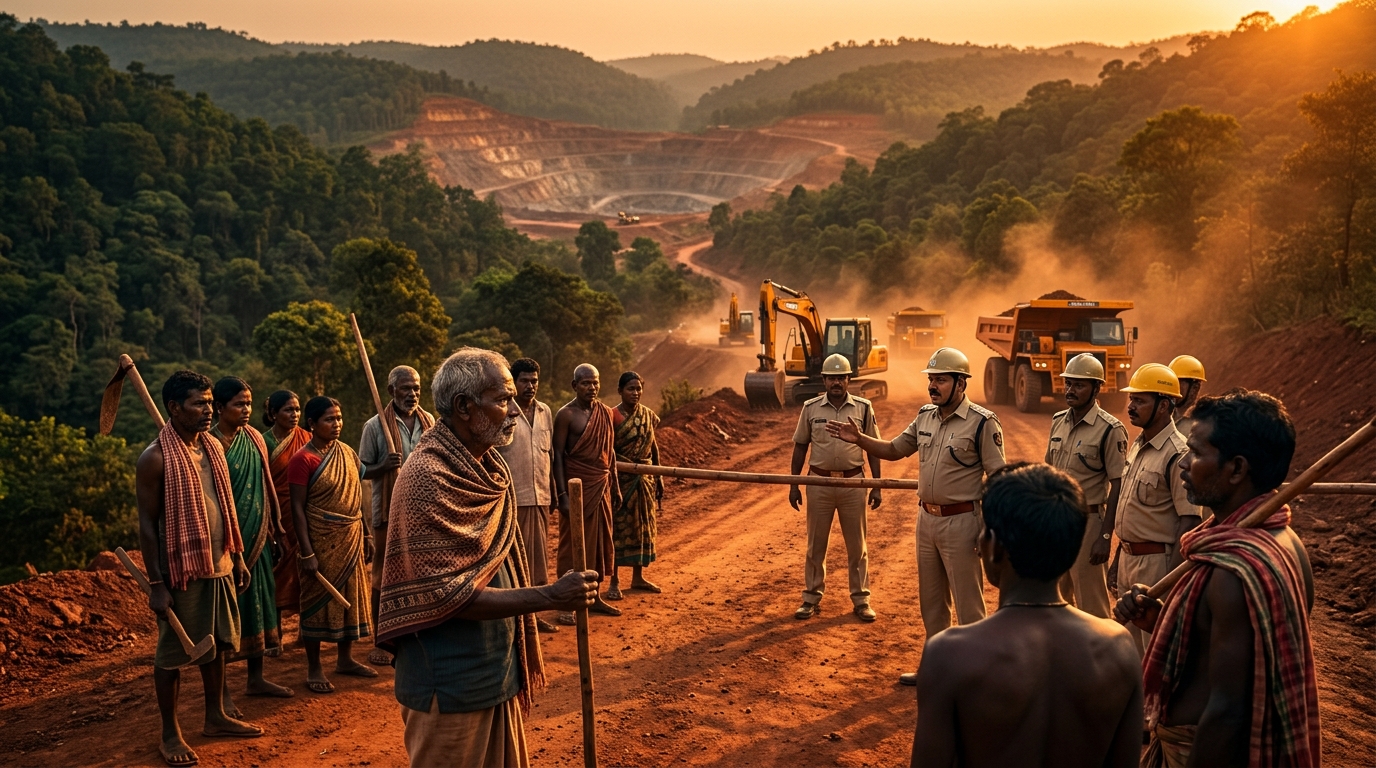
On 7 April 2026, tribal villagers clashed with police in Odisha over a road to the Vedanta‑operated Sijimali bauxite mine, injuring dozens. The incident underscores India's vast bauxite reserves—dominated by Odisha—and the strategic importance of the aluminium value chain, while highlighting tribal rights and sustainable mining concerns relevant for UPSC exams.
Overview On 7 April 2026 , violent clashes erupted between tribal villagers and police in the Rayagada district of Odisha . The dispute centred on a 3‑km approach road to the Sijimali bauxite mine . The incident revives attention on India’s bauxite reserves, the aluminium value chain, and the socio‑environmental challenges of mineral extraction. Key Developments (April 2026) At least 40 police personnel and 25 tribal villagers were injured. The road is intended to improve logistics for the mine operated by Vedanta Limited . Tribal opposition reflects long‑standing grievances since the mine’s auction in 2023. Important Facts about Bauxite and Aluminium Composition : Bauxite is an aluminous rock whose principal constituent is hydrated aluminium oxide . Minor constituents include iron oxide (as haematite or goethite ), silica (as clay), and titania (as leucoxene or rutile). Distribution in India : According to the Indian Minerals Yearbook 2023 , Odisha leads with 41% of reserves, followed by Chhattisgarh (20%), Andhra Pradesh (12%), Gujarat (8%), Jharkhand (6%), Maharashtra (5%) and Madhya Pradesh (4%). World reserves and production : Global bauxite reserves are estimated at 31 billion tonnes , concentrated in Guinea (24%), Vietnam (19%), Australia (16%) and Brazil (9%). Top producers are Guinea (26%) and Australia (25%), with India contributing about 6% of world output (BGS 2018‑2022). The Bayer Process : Bauxite is first refined to alumina ( ) via the Bayer process using caustic soda. Roughly 3–3.5 tonnes of bauxite yield 1 tonne of alumina . Alumina is then electrolysed to produce aluminium, with 2 tonnes of alumina giving 1 tonne of aluminium . Key end‑use sectors in India include aerospace & defence, power & electronics, solar‑energy structures, automobiles, railways and construction – all sectors highlighted in the UPSC syllabus under GS3 (Economy) and GS4 (Ethics & Governance of Technology). UPSC Relevance Understanding the mineral’s composition and processing links to questions on aluminium industry. State‑wise reserve data are classic factual questions for prelims (GS3). Tribal resistance raises issues of tribal rights and mining policy , relevant for essay and interview preparation. Private‑sector participation (Vedanta) versus public interest tests concepts of PPP and regulatory oversight. Way Forward For sustainable exploitation, policymakers should: Ensure strict compliance with the FRA and conduct free, prior, and informed consent (FPIC) before project clearance. Promote value‑addition within India – setting up alumina refineries and aluminium smelters to capture higher economic rents. Invest in environmentally sound mining practices, including waste‑water treatment and rehabilitation of mined‑out areas. Diversify the aluminium supply chain to reduce dependence on imports of primary aluminium and downstream products. These steps would address both the developmental aspirations of mineral‑rich states and the livelihood concerns of tribal communities, a balance frequently examined in UPSC mains.
  1. Home
  2. Prepare
  3. Current Affairs
  4. Tribal Clashes over Sijimali Bauxite Mine Road in Odisha Spotlight India's Bauxite Reserves and Aluminium Industry
Login to bookmark articles
Login to mark articles as complete

Overview

gs.gs375% UPSC Relevance

Tribal clash over Sijimali road underscores mining‑tribal rights dilemma in Odisha

Key Facts

  1. 7 April 2026: Violent clashes erupted in Rayagada, Odisha over a 3‑km approach road to Vedanta’s Sijimali bauxite mine.
  2. Injuries: 40 police personnel and 25 tribal villagers were reported injured.
  3. Odisha accounts for 41% of India’s bauxite reserves and contributed about 73% of national bauxite production in 2022‑23.
  4. Bauxite‑to‑alumina conversion ratio is approximately 3–3.5 tonnes of bauxite to 1 tonne of alumina; alumina‑to‑aluminium ratio is 2 tonnes of alumina to 1 tonne of aluminium.
  5. The Forest Rights Act, 2006 requires free, prior and informed consent (FPIC) before mining on forest‑dwelling tribal lands.
  6. India’s total bauxite reserves are about 31 billion tonnes, contributing roughly 6% of global bauxite output.
  7. Vedanta Limited was awarded the Sijimali bauxite mine lease in 2023 under a private‑sector mining contract.

Background & Context

The clash highlights the intersection of mineral resource policy, tribal land rights under the Forest Rights Act, and the economic importance of bauxite for India’s aluminium sector. It reflects broader governance challenges of PPP‑driven mining projects in mineral‑rich states like Odisha, a recurring theme in GS‑3 (Economy) and GS‑2 (Polity).

UPSC Syllabus Connections

GS1•Distribution of Key Natural ResourcesPrelims_GS•Social and Economic Geography of IndiaPrelims_GS•National Current AffairsPrelims_GS•Physics and Chemistry in Everyday LifeGS3•Infrastructure - Energy, Ports, Roads, Airports, RailwaysGS2•Constitutional posts, bodies and their powers and functionsGS2•Comparison with other countries constitutional schemesGS4•Information sharing, transparency, RTI, codes of ethics and conductGS2•Government policies and interventions for development

Mains Answer Angle

GS‑3 (Economy) – Discuss the policy dilemma of exploiting bauxite reserves while safeguarding tribal rights; GS‑2 (Polity) – Evaluate the effectiveness of the Forest Rights Act in mining clearances.

Full Article

<h2>Overview</h2> <p>On <strong>7 April 2026</strong>, violent clashes erupted between tribal villagers and police in the Rayagada district of <span class="key-term" data-definition="Odisha – An eastern Indian state rich in mineral resources, especially bauxite; frequently features in GS2 (Polity) and GS3 (Economy) questions concerning mining policies and tribal rights.">Odisha</span>. The dispute centred on a <strong>3‑km approach road</strong> to the <span class="key-term" data-definition="Sijimali bauxite mine – A mining project awarded to Vedanta Limited in 2023; its development has triggered local opposition and is a case study for GS3 (Economy) and GS2 (Polity) on resource extraction and tribal displacement.">Sijimali bauxite mine</span>. The incident revives attention on India’s bauxite reserves, the aluminium value chain, and the socio‑environmental challenges of mineral extraction.</p> <h3>Key Developments (April 2026)</h3> <ul> <li>At least <strong>40 police personnel</strong> and <strong>25 tribal villagers</strong> were injured.</li> <li>The road is intended to improve logistics for the mine operated by <span class="key-term" data-definition="Vedanta Limited – A multinational mining and metals conglomerate; its Indian operations, especially in bauxite, are often cited in GS3 (Economy) for private sector participation in natural resource extraction.">Vedanta Limited</span>.</li> <li>Tribal opposition reflects long‑standing grievances since the mine’s auction in 2023.</li> </ul> <h3>Important Facts about Bauxite and Aluminium</h3> <p><strong>Composition</strong>: Bauxite is an aluminous rock whose principal constituent is <span class="key-term" data-definition="Hydrated aluminium oxide – The chemical form of aluminium present in bauxite (Al₂O₃·nH₂O); its proportion determines ore quality (GS3: Economy).">hydrated aluminium oxide</span>. Minor constituents include iron oxide (as <em>haematite</em> or <em>goethite</em>), silica (as clay), and titania (as leucoxene or rutile).</p> <p><strong>Distribution in India</strong>: According to the <span class="key-term" data-definition="Indian Minerals Yearbook – Annual government publication providing data on mineral reserves and production; a standard reference for GS3 (Economy) questions.">Indian Minerals Yearbook 2023</span>, <span class="key-term" data-definition="Odisha – Holds 41% of India’s bauxite reserves and contributed about 73% of national production in 2022‑23 (GS3: Economy).">Odisha</span> leads with 41% of reserves, followed by Chhattisgarh (20%), Andhra Pradesh (12%), Gujarat (8%), Jharkhand (6%), Maharashtra (5%) and Madhya Pradesh (4%).</p> <p><strong>World reserves and production</strong>: Global bauxite reserves are estimated at <strong>31 billion tonnes</strong>, concentrated in Guinea (24%), Vietnam (19%), Australia (16%) and Brazil (9%). Top producers are Guinea (26%) and Australia (25%), with India contributing about <strong>6%</strong> of world output (BGS 2018‑2022).</p> <p><strong>The Bayer Process</strong>: Bauxite is first refined to alumina (<span class="key-term" data-definition="Alumina – Aluminium oxide (Al₂O₃) obtained from bauxite; a key intermediate in aluminium production, relevant for GS3 (Economy)."></span>) via the Bayer process using caustic soda. Roughly <strong>3–3.5 tonnes of bauxite</strong> yield <strong>1 tonne of alumina</strong>. Alumina is then electrolysed to produce aluminium, with <strong>2 tonnes of alumina</strong> giving <strong>1 tonne of aluminium</strong>.</p> <p><strong>Key end‑use sectors in India</strong> include aerospace & defence, power & electronics, solar‑energy structures, automobiles, railways and construction – all sectors highlighted in the UPSC syllabus under GS3 (Economy) and GS4 (Ethics & Governance of Technology).</p> <h3>UPSC Relevance</h3> <ul> <li>Understanding the mineral’s composition and processing links to questions on <span class="key-term" data-definition="Aluminium – The second most used metal after steel; its production chain (bauxite → alumina → aluminium) is a frequent GS3 (Economy) topic.">aluminium</span> industry.</li> <li>State‑wise reserve data are classic factual questions for prelims (GS3).</li> <li>Tribal resistance raises issues of <span class="key-term" data-definition="Forest Rights Act (FRA) – Legislation safeguarding tribal rights over forest land; often examined in GS2 (Polity) and GS4 (Ethics).">tribal rights and mining policy</span>, relevant for essay and interview preparation.</li> <li>Private‑sector participation (Vedanta) versus public interest tests concepts of <span class="key-term" data-definition="Public‑Private Partnership (PPP) – Collaborative model between government and private firms for infrastructure; a GS3 (Economy) theme.">PPP</span> and regulatory oversight.</li> </ul> <h3>Way Forward</h3> <p>For sustainable exploitation, policymakers should:</p> <ol> <li>Ensure strict compliance with the <span class="key-term" data-definition="Forest Rights Act – Provides legal recognition to forest‑dwelling tribal communities; central to GS2 (Polity) and GS4 (Ethics).">FRA</span> and conduct free, prior, and informed consent (FPIC) before project clearance.</li> <li>Promote value‑addition within India – setting up alumina refineries and aluminium smelters to capture higher economic rents.</li> <li>Invest in environmentally sound mining practices, including waste‑water treatment and rehabilitation of mined‑out areas.</li> <li>Diversify the aluminium supply chain to reduce dependence on imports of primary aluminium and downstream products.</li> </ol> <p>These steps would address both the developmental aspirations of mineral‑rich states and the livelihood concerns of tribal communities, a balance frequently examined in UPSC mains.</p>
Read Original on indianexpress

Analysis

Practice Questions

GS1
Easy
Prelims MCQ

Bauxite reserves and distribution in India

1 marks
3 keywords
GS2
Medium
Mains Short Answer

Tribal opposition and land rights

10 marks
4 keywords
GS3
Hard
Mains Essay

Policy framework for mineral extraction and tribal rights

25 marks
6 keywords
Related:Daily•Weekly

Loading related articles...

Loading related articles...

Tip: Click articles above to read more from the same date, or use the back button to see all articles.

Quick Reference

Key Insight

Tribal clash over Sijimali road underscores mining‑tribal rights dilemma in Odisha

Key Facts

  1. 7 April 2026: Violent clashes erupted in Rayagada, Odisha over a 3‑km approach road to Vedanta’s Sijimali bauxite mine.
  2. Injuries: 40 police personnel and 25 tribal villagers were reported injured.
  3. Odisha accounts for 41% of India’s bauxite reserves and contributed about 73% of national bauxite production in 2022‑23.
  4. Bauxite‑to‑alumina conversion ratio is approximately 3–3.5 tonnes of bauxite to 1 tonne of alumina; alumina‑to‑aluminium ratio is 2 tonnes of alumina to 1 tonne of aluminium.
  5. The Forest Rights Act, 2006 requires free, prior and informed consent (FPIC) before mining on forest‑dwelling tribal lands.
  6. India’s total bauxite reserves are about 31 billion tonnes, contributing roughly 6% of global bauxite output.
  7. Vedanta Limited was awarded the Sijimali bauxite mine lease in 2023 under a private‑sector mining contract.

Background

The clash highlights the intersection of mineral resource policy, tribal land rights under the Forest Rights Act, and the economic importance of bauxite for India’s aluminium sector. It reflects broader governance challenges of PPP‑driven mining projects in mineral‑rich states like Odisha, a recurring theme in GS‑3 (Economy) and GS‑2 (Polity).

UPSC Syllabus

  • GS1 — Distribution of Key Natural Resources
  • Prelims_GS — Social and Economic Geography of India
  • Prelims_GS — National Current Affairs
  • Prelims_GS — Physics and Chemistry in Everyday Life
  • GS3 — Infrastructure - Energy, Ports, Roads, Airports, Railways
  • GS2 — Constitutional posts, bodies and their powers and functions
  • GS2 — Comparison with other countries constitutional schemes
  • GS4 — Information sharing, transparency, RTI, codes of ethics and conduct
  • GS2 — Government policies and interventions for development

Mains Angle

Explore:Current Affairs·Editorial Analysis·Govt Schemes·Study Materials·Previous Year Questions·UPSC GPT

GS‑3 (Economy) – Discuss the policy dilemma of exploiting bauxite reserves while safeguarding tribal rights; GS‑2 (Polity) – Evaluate the effectiveness of the Forest Rights Act in mining clearances.