<h3>Overview</h3>
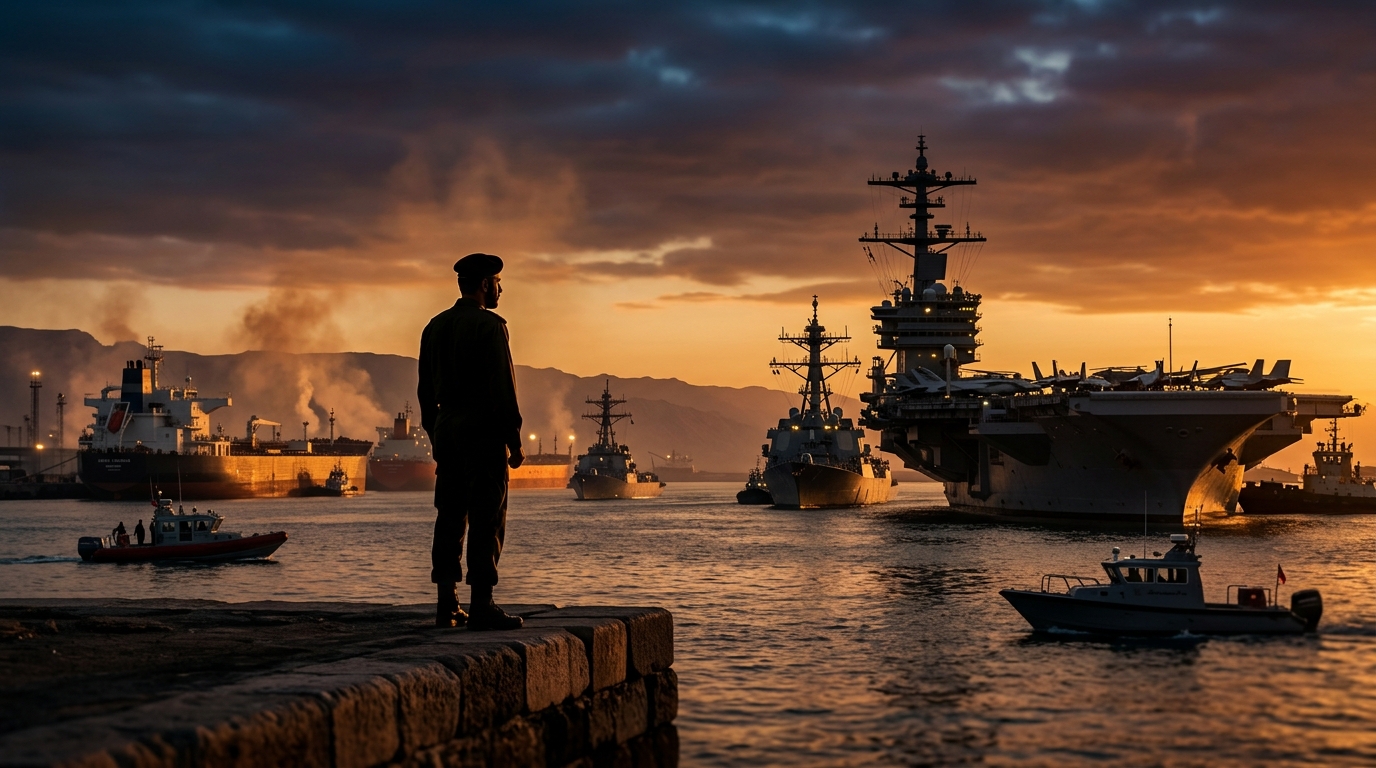
<p>On <strong>April 17, 2026</strong>, <span class="key-term" data-definition="President of the United States — the chief executive who shapes foreign policy; his statements influence international security dynamics (GS2: Polity)">President Donald Trump</span> warned that the United States would keep its <span class="key-term" data-definition="U.S. blockade — a naval or economic restriction imposed by the United States to prevent goods reaching a target, used as a tool of coercive diplomacy (GS2: Polity)">blockade</span> of Iranian ports if a peace settlement with Tehran is not reached, and hinted that the cease‑fire may not be extended after it lapses. At the same time, Iran reopened the <span class="key-term" data-definition="Strait of Hormuz — a narrow waterway between Oman and Iran through which about 20% of global oil passes; a strategic chokepoint in world energy security (GS3: Economy)">Strait of Hormuz</span> following a cease‑fire agreement between <span class="key-term" data-definition="Israel — a Middle‑Eastern state and key U.S. ally, often involved in regional security issues (GS2: Polity)">Israel</span> and <span class="key-term" data-definition="Lebanon — a neighboring state to Israel, home to Hezbollah, and a focal point of Middle‑East geopolitics (GS2: Polity)">Lebanon</span>. Tehran warned it could shut the waterway again if the U.S. blockade persists.</p>
<h3>Key Developments</h3>
<ul>
<li>Trump’s statement signals a hard‑line stance: continuation of the <span class="key-term" data-definition="U.S. blockade — a naval or economic restriction imposed by the United States to prevent goods reaching a target, used as a tool of coercive diplomacy (GS2: Polity)">blockade</span> on Iranian ports unless a diplomatic settlement is achieved.</li>
<li>Iran temporarily reopened the <span class="key-term" data-definition="Strait of Hormuz — a narrow waterway between Oman and Iran through which about 20% of global oil passes; a strategic chokepoint in world energy security (GS3: Economy)">Strait of Hormuz</span> after a cease‑fire between <span class="key-term" data-definition="Israel — a Middle‑Eastern state and key U.S. ally, often involved in regional security issues (GS2: Polity)">Israel</span> and <span class="key-term" data-definition="Lebanon — a neighboring state to Israel, home to Hezbollah, and a focal point of Middle‑East geopolitics (GS2: Polity)">Lebanon</span>.</li>
<li>Tehran warned of a possible re‑closure of the waterway if the U.S. maintains its <span class="key-term" data-definition="U.S. blockade — a naval or economic restriction imposed by the United States to prevent goods reaching a target, used as a tool of coercive diplomacy (GS2: Polity)">blockade</span>.</li>
</ul>
<h3>Important Facts</h3>
<ul>
<li>Iranian ports have been under a U.S. naval restriction since <strong>2024</strong>, aimed at curbing Iran’s regional influence and its support to proxy groups.</li>
<li>The <span class="key-term" data-definition="Ceasefire deal — a temporary suspension of hostilities between warring parties, often a precursor to peace negotiations (GS2: Polity)">ceasefire</span> between Israel and Lebanon was brokered on <strong>April 16, 2026</strong>, reducing immediate combat risk in the Levant.</li>
<li>The <span class="key-term" data-definition="Strait of Hormuz — a narrow waterway between Oman and Iran through which about 20% of global oil passes; a strategic chokepoint in world energy security (GS3: Economy)">Strait of Hormuz</span> handles roughly <strong>18 million barrels of oil per day</strong>, making any closure a major shock to global oil markets.</li>
</ul>
<h3>UPSC Relevance</h3>
<p>The episode illustrates several core UPSC themes: (i) <strong>India’s foreign policy</strong> challenges in balancing relations with the U.S., Iran, and Gulf states; (ii) the strategic importance of maritime chokepoints like the <span class="key-term" data-definition="Strait of Hormuz — a narrow waterway between Oman and Iran through which about 20% of global oil passes; a strategic chokepoint in world energy security (GS3: Economy)">Strait of Hormuz</span> for energy security (GS3); (iii) the use of economic coercion (blockades) as a tool of <span class="key-term" data-definition="U.S. blockade — a naval or economic restriction imposed by the United States to prevent goods reaching a target, used as a tool of coercive diplomacy (GS2: Polity)">blockade</span> in international diplomacy (GS2); and (iv) the impact of regional cease‑fires on broader geopolitical stability (GS2).</p>
<h3>Way Forward</h3>
<ul>
<li>Diplomatic engagement: Encourage multilateral talks involving the U.S., Iran, and regional actors to prevent a prolonged blockade and ensure the <span class="key-term" data-definition="Strait of Hormuz — a narrow waterway between Oman and Iran through which about 20% of global oil passes; a strategic chokepoint in world energy security (GS3: Economy)">Strait of Hormuz</span> remains open.</li>
<li>Strategic hedging: India should diversify oil import routes and maintain naval readiness to safeguard its maritime interests.</li>
<li>Monitoring: Track any escalation that could affect global oil prices and Indian energy security, feeding insights into policy formulation.</li>
</ul>