Overview
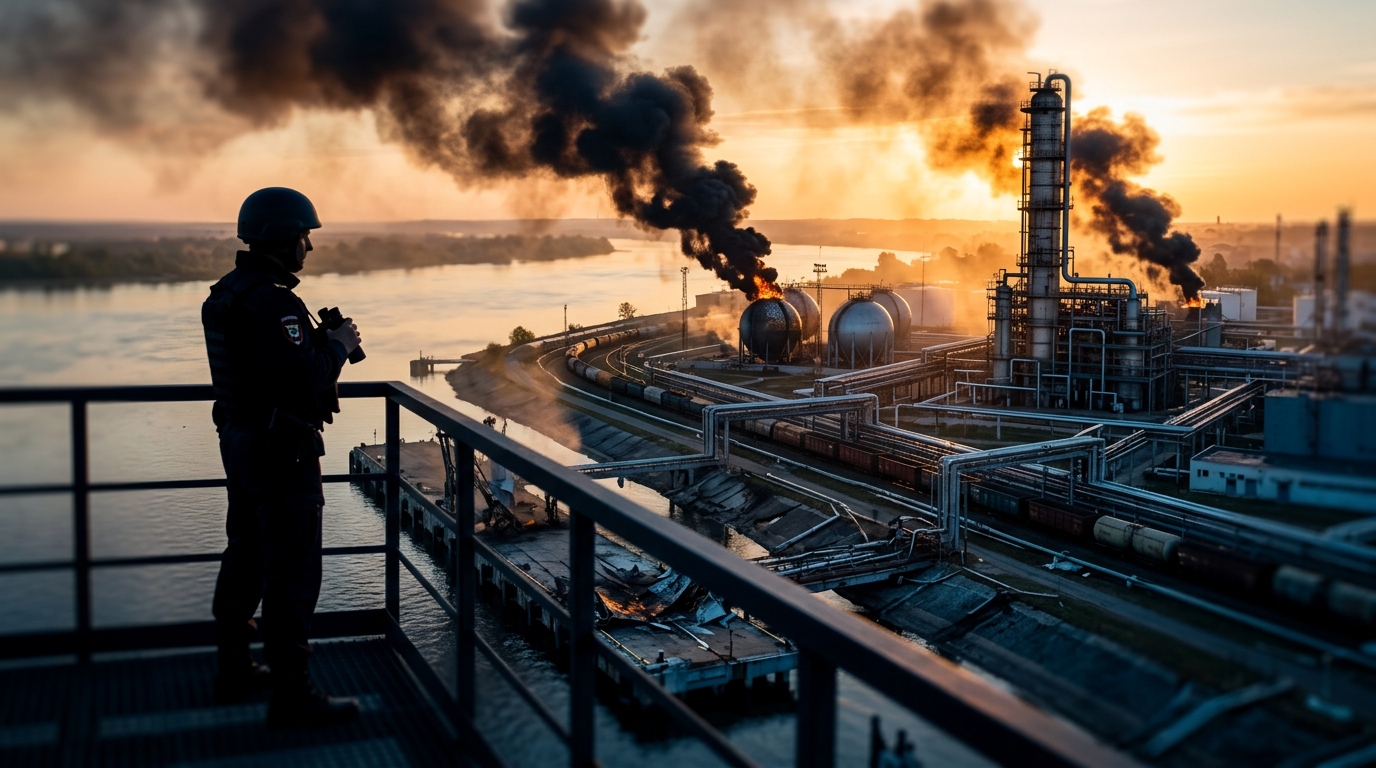
On 5 April 2026, Ukrainian drone attacks hit two critical nodes of Russia’s oil export infrastructure. A fuel reservoir at the Primorsk port leaked, while the NORSI refinery caught fire after being struck.
Key Developments
- The governor of the Leningrad region, Alexander Drozdenko, clarified that the pipeline was intact; the leak resulted from shrapnel hitting a fuel reservoir.
- Satellite imagery showed that 40 % of Primorsk’s storage facilities were already damaged in earlier Ukrainian drone strikes.
- In the Nizhny Novgorod region, Governor Gleb Nikitin reported a fire affecting two units of the NORSI plant, along with damage to a power station and nearby houses, but no casualties.
- Overall, about 40 % of Russia’s oil‑exporting capability was disrupted last month due to attacks, the shutdown of the Druzhba pipeline in Ukraine, and the seizure of Russian‑linked tankers.
- Air alerts were raised in Novorossiysk, temporarily halting oil loadings, including shipments from the CPC pipeline.
Important Facts
- Primorsk can handle 1 million barrels per day; the recent leak threatens a key export gateway.
- NORSI refinery processes 16 million metric tons of crude annually (≈320,000 bpd), making it the fourth‑largest in Russia and the second‑largest gasoline producer.
- Ukrainian drone operations have intensified over the past month, targeting both storage infrastructure and processing facilities.
- Disruptions have reduced Russia’s oil export earnings, a major source of state revenue used to fund its defence budget.
Exam Relevance
Energy security is a recurring theme in GS 3 (Economy & Environment). The attacks illustrate how geopolitical conflicts can directly affect a nation’s export earnings, balance of payments, and fiscal capacity. Understanding the strategic importance of pipelines like the Druzhba and ports such as Primorsk helps answer questions on energy geopolitics, sanctions, and the economic impact of warfare.
From a GS 2 (Polity) perspective, the role of regional governors in crisis communication and the use of platforms like Telegram reflect the central‑regional dynamics in Russia’s governance model.
Way Forward
- Russia may bolster air‑defence and surveillance over critical energy assets to mitigate further drone incursions.
- Diversifying export routes—e.g., increasing reliance on Black Sea ports or overland pipelines—could reduce vulnerability.
- International diplomatic channels could be leveraged to de‑escalate the use of unmanned aerial systems against civilian infrastructure, aligning with global norms on the protection of economic assets.
For UPSC aspirants, tracking the evolving nexus of energy infrastructure, conflict tactics, and economic repercussions is essential for answering questions on national security, economic resilience, and foreign policy.