Loading page, please wait…
India’s E-Waste Management - UPSC Environment And Ecology
What is India’s E-Waste Management in UPSC Environment And Ecology?
India’s E-Waste Management is a key topic under Environment And Ecology for UPSC Civil Services Examination. Key points include: India is the 3rd largest e-waste generator globally, with 1.751 million MT in 2023-24.. Approximately 57% (990,000 MT) of India's e-waste remains untreated annually.. The E-Waste (Management) Rules, 2022, introduced Extended Producer Responsibility (EPR) for 106 EEE items.. Understanding this topic is essential for both UPSC Prelims and Mains preparation.
Why is India’s E-Waste Management important for UPSC exam?
India’s E-Waste Management is a Medium-level topic in UPSC Environment And Ecology. It is tested in both Prelims (factual MCQs) and Mains (analytical answer writing). Previous year UPSC questions have frequently covered aspects of India’s E-Waste Management, making it essential for comprehensive IAS preparation.
How to prepare India’s E-Waste Management for UPSC?
To prepare India’s E-Waste Management for UPSC: (1) Study the comprehensive notes covering all key concepts on Vaidra. (2) Practice previous year questions on this topic. (3) Connect it with current affairs using daily updates. (4) Revise using key takeaways and mind maps available for Environment And Ecology. (5) Write practice answers linking India’s E-Waste Management to related GS Paper topics.
Key takeaways of India’s E-Waste Management for UPSC
- India is the 3rd largest e-waste generator globally, with 1.751 million MT in 2023-24.
- Approximately 57% (990,000 MT) of India's e-waste remains untreated annually.
- The E-Waste (Management) Rules, 2022, introduced Extended Producer Responsibility (EPR) for 106 EEE items.
- Recent amendments (2023, 2024) focus on sustainable refrigerant management and EPR certificate trading.
- Key international conventions India is party to include Basel, Bamako, Minamata, and Stockholm.
- The informal sector dominates e-waste handling, posing significant environmental and health risks due to unsafe practices.
India’s E-Waste Management
Medium⏱️ 6 min read
environment and ecology
📖 Introduction
Understanding E-Waste
Electronic waste (e-waste) refers to discarded electrical and electronic equipment (EEE) that is old or has reached its end-of-life. This category encompasses a wide range of devices, from household appliances to complex office equipment.
Toxic Components: E-waste contains numerous hazardous chemicals and heavy metals. Key examples include lead, cadmium, mercury, and nickel, which pose significant environmental and health risks if not managed properly.
The State of E-Waste in India
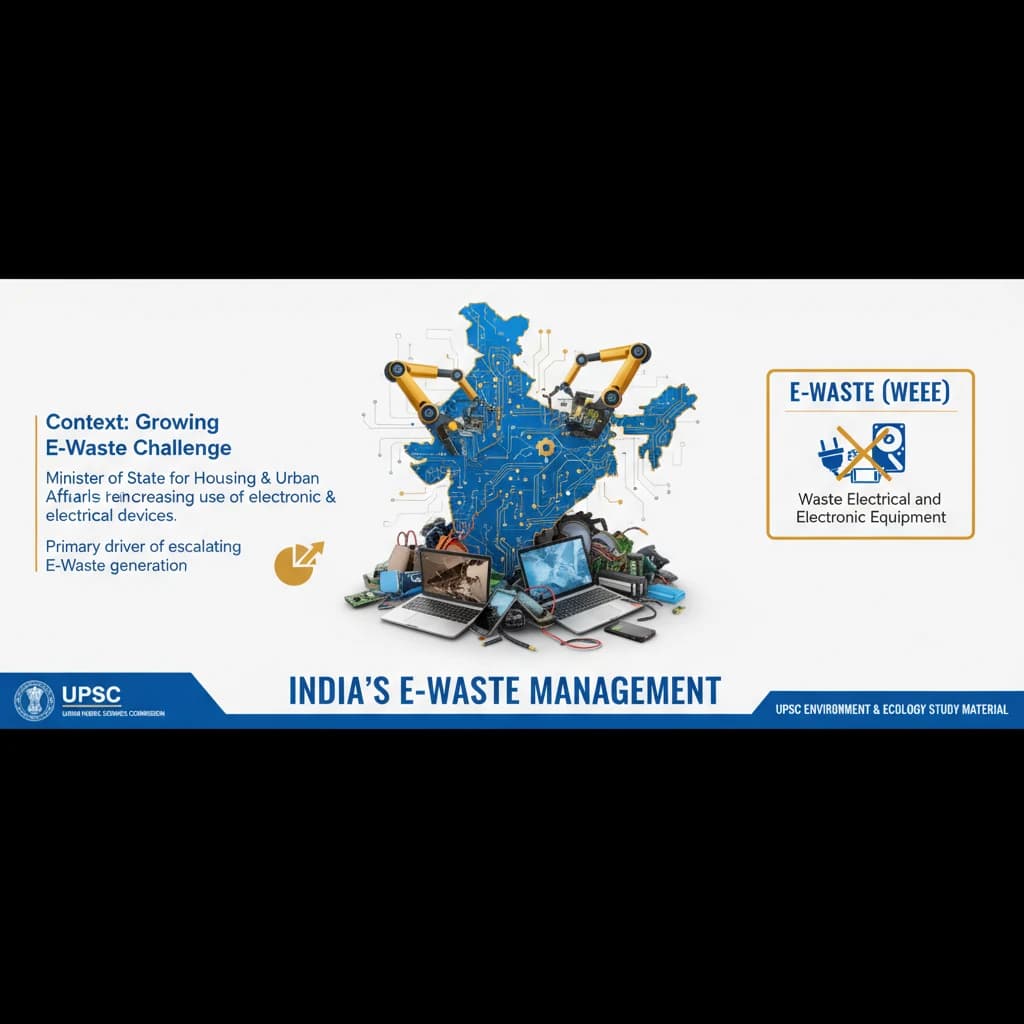
India is experiencing a substantial increase in e-waste generation, reflecting the growing use of electronic and electrical devices across the country.
Volume Growth: India witnessed a 72.54% rise in e-waste generation over five years, from 1.01 million metric tonnes (MT) in 2019-20 to 1.751 million MT in 2023-24.
Untreated Waste: Approximately 57% of the total e-waste generated annually, equivalent to 990,000 MT, remains untreated.
Concentrated Generation: The top 65 cities in India generate over 60% of the total e-waste, with 10 states accounting for 70% of the total.
Despite the growing volume, the recycling rate has shown some improvement.
Recycling Rate: Only 22.7% of e-waste was recycled in 2020-21, a notable increase from 12% in 2019-20.
Informal Sector Dominance: A significant challenge in India is the dominance of the informal sector in handling e-waste. This sector often operates without adequate environmental safeguards, leading to hazardous practices and pollution.
Globally, India holds a prominent position in e-waste generation.
Global Context: India is the third-largest e-waste generator globally, following only China and the United States. Worldwide, approximately 53.6 MT of e-waste was generated in 2019, according to UN estimates.
E-Waste (Management) Rules, 2022
The E-Waste (Management) Rules, 2022, represent a significant step in India's efforts to manage electronic waste effectively. These rules introduced several key provisions:
- Extended Producer Responsibility (EPR): Producers are legally mandated to achieve specific annual recycling targets. Compliance is ensured through the procurement of EPR certificates from registered recyclers.
- Expanded Product Coverage: The scope of regulated items was significantly broadened to include 106 Electrical and Electronic Equipment (EEE) items from FY 2023-24, a substantial increase from the previous 21 items.
- Integration of Bulk Consumers: Public institutions and offices, classified as bulk consumers, are now required to dispose of their e-waste exclusively through registered recyclers or refurbishers.
Key Amendments to E-Waste Rules
India's e-waste management framework is continuously evolving with recent amendments.
- E-Waste (Management) Second Amendment Rules, 2023: These rules added Clause 4 to Rule 5 of the 2022 Rules. Its primary aim is to ensure safe, accountable, and sustainable refrigerant management in the manufacturing of refrigeration and air-conditioning equipment.
- E-Waste (Management) Amendment Rules, 2024: This amendment empowers the Central Government to establish platforms for the trading of Extended Producer Responsibility (EPR) certificates. These platforms will operate under guidelines issued by the Central Pollution Control Board (CPCB).
CPCB Role in EPR Certificates: The Central Pollution Control Board is tasked with setting the price range for EPR certificates. The maximum price will be 100% and the minimum 30% of the environmental compensation applicable for non-compliance.
International Conventions on E-Waste
India is a signatory to several international agreements addressing hazardous waste, including e-waste.
- Basel Convention on the Control of Transboundary Movements of Hazardous Wastes and Their Disposal (1989): This convention aims to reduce the movement of hazardous waste between nations and prevent its transfer from developed to less developed countries. India is a party to this convention.
- Bamako Convention (1991): This regional convention specifically prohibits the import of hazardous waste (including e-waste) into Africa and controls its transboundary movement within the continent.
- Minamata Convention on Mercury (2013): This global treaty aims to protect human health and the environment from the adverse effects of mercury. India ratified the Minamata Convention in 2018.
- Stockholm Convention on Persistent Organic Pollutants (POPs) (2001): This convention seeks to eliminate or restrict the production and use of persistent organic pollutants. India ratified the Stockholm Convention and implements its provisions through domestic laws.
National Framework for Waste Management
Beyond the specific e-waste rules, India has broader national policies and regulations for waste management.
- Hazardous and Other Wastes (Management and Transboundary Movement) Rules, 2016: These rules provide a comprehensive framework for the management of various hazardous wastes, complementing the e-waste specific regulations.
- National Action Plan for Chemical and Waste Management: This plan reflects India's commitments to international conventions like the Stockholm and Rotterdam Conventions, promoting sound management of chemicals and waste.
Common E-Waste Disposal Methods in India
Various methods are employed for e-waste disposal, each with its own implications.
- Landfilling: This involves burying e-waste in excavated pits, which are then sealed with layers of earth.
Concern with Landfilling: A major environmental risk is the potential for hazardous substances to leach into the soil and groundwater, causing significant contamination.
- Incineration: This method involves the controlled burning of e-waste at very high temperatures, typically between 900–10,000°C.
Benefits of Incineration: It effectively reduces the volume of waste and can neutralize some hazardous substances present in the e-waste.
- Recycling: This is the most environmentally sound method, involving the dismantling of e-waste to recover valuable materials and safely dispose of toxic components.
Benefits of Recycling: It significantly reduces the release of hazardous substances like mercury, cadmium, and lead, thereby minimizing environmental pollution and health risks.
Examples of Recycled Items: Common items recycled include printed circuit boards, CRTs (Cathode Ray Tubes), mobile phones, and various types of wires.
💡 Key Takeaways
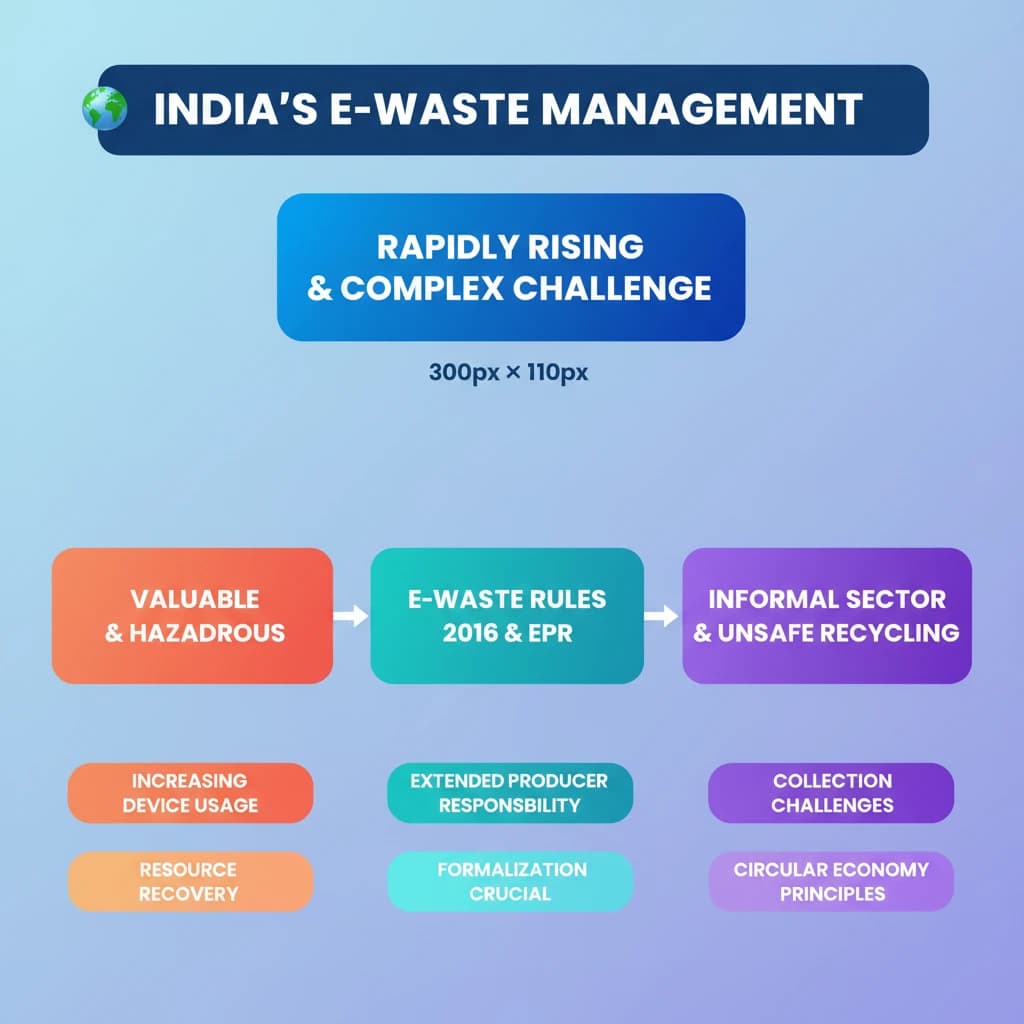
- •India is the 3rd largest e-waste generator globally, with 1.751 million MT in 2023-24.
- •Approximately 57% (990,000 MT) of India's e-waste remains untreated annually.
- •The E-Waste (Management) Rules, 2022, introduced Extended Producer Responsibility (EPR) for 106 EEE items.
- •Recent amendments (2023, 2024) focus on sustainable refrigerant management and EPR certificate trading.
- •Key international conventions India is party to include Basel, Bamako, Minamata, and Stockholm.
- •The informal sector dominates e-waste handling, posing significant environmental and health risks due to unsafe practices.
🧠 Memory Techniques
95% Verified Content