Loading page, please wait…
What are the Three stages of India’s Nuclear Energy Program? - UPSC Science And Technology
What is What are the Three stages of India’s Nuclear Energy Program? in UPSC Science And Technology?
What are the Three stages of India’s Nuclear Energy Program? is a key topic under Science And Technology for UPSC Civil Services Examination. Key points include: India's nuclear program is a three-stage plan for long-term energy security, leveraging indigenous resources.. Stage 1 uses Pressurised Heavy Water Reactors (PHWRs) with natural uranium, producing plutonium as a byproduct.. Stage 2 employs Fast Breeder Reactors (FBRs) to multiply plutonium inventory, crucial for future thorium utilization.. Understanding this topic is essential for both UPSC Prelims and Mains preparation.
Why is What are the Three stages of India’s Nuclear Energy Program? important for UPSC exam?
What are the Three stages of India’s Nuclear Energy Program? is a Medium-level topic in UPSC Science And Technology. It is tested in both Prelims (factual MCQs) and Mains (analytical answer writing). Previous year UPSC questions have frequently covered aspects of What are the Three stages of India’s Nuclear Energy Program?, making it essential for comprehensive IAS preparation.
How to prepare What are the Three stages of India’s Nuclear Energy Program? for UPSC?
To prepare What are the Three stages of India’s Nuclear Energy Program? for UPSC: (1) Study the comprehensive notes covering all key concepts on Vaidra. (2) Practice previous year questions on this topic. (3) Connect it with current affairs using daily updates. (4) Revise using key takeaways and mind maps available for Science And Technology. (5) Write practice answers linking What are the Three stages of India’s Nuclear Energy Program? to related GS Paper topics.
Key takeaways of What are the Three stages of India’s Nuclear Energy Program? for UPSC
- India's nuclear program is a three-stage plan for long-term energy security, leveraging indigenous resources.
- Stage 1 uses Pressurised Heavy Water Reactors (PHWRs) with natural uranium, producing plutonium as a byproduct.
- Stage 2 employs Fast Breeder Reactors (FBRs) to multiply plutonium inventory, crucial for future thorium utilization.
- Stage 3 aims for the thorium-Uranium-233 (U-233) cycle via Advanced Heavy Water Reactors (AHWRs), utilizing India's vast thorium reserves.
- Successful FBR development in Stage 2 is a prerequisite for the commercial viability of the thorium-based Stage 3.
- The program ensures energy independence, reduces carbon footprint, and showcases India's technological prowess in nuclear science.
What are the Three stages of India’s Nuclear Energy Program?
Medium⏱️ 7 min read
science and technology
📖 Introduction
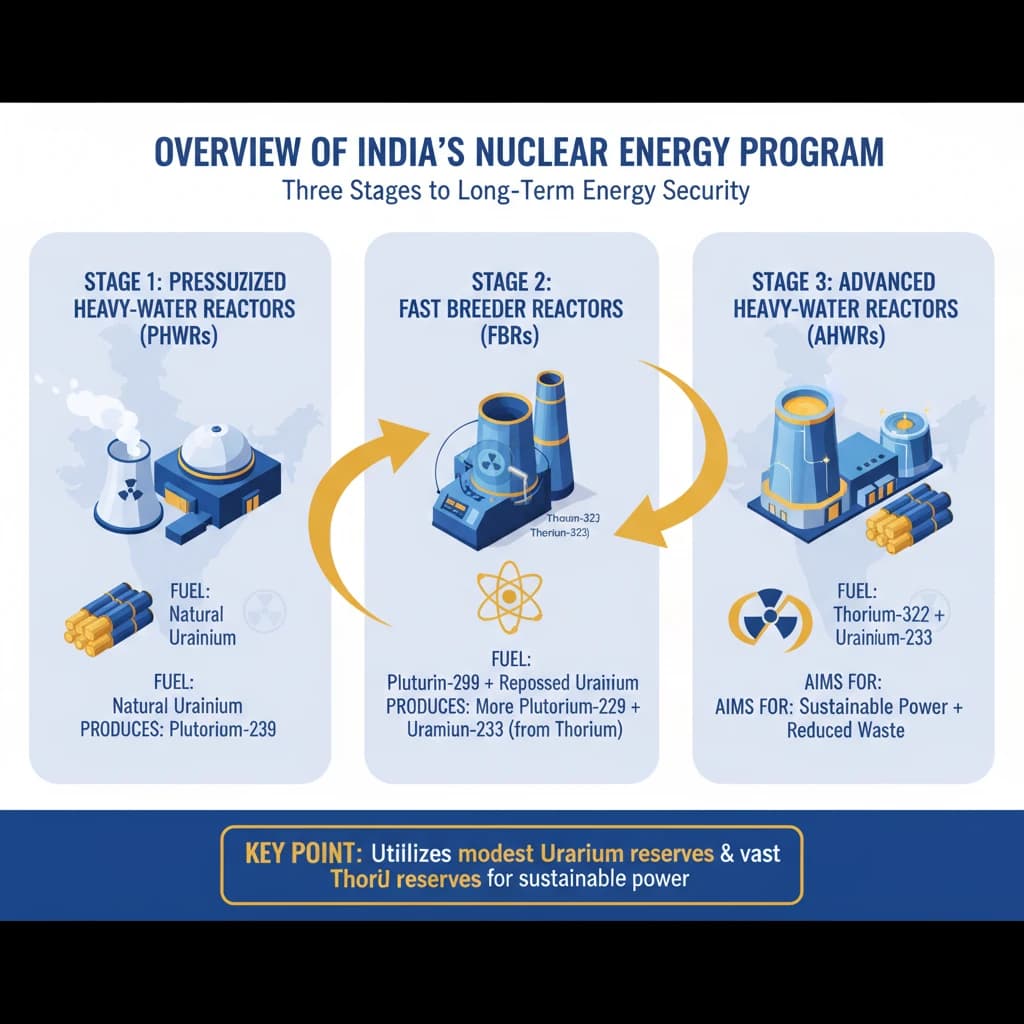
Overview of India's Nuclear Energy Program
India's Nuclear Energy Program is strategically designed in three stages to achieve long-term energy security. This comprehensive approach addresses the nation's specific resource availability and future energy demands.
This multi-stage program aims to optimally utilize India's modest uranium reserves and vast thorium reserves for sustainable power generation.
The First Stage: Pressurised Heavy Water Reactors (PHWRs)
The initial phase focuses on the deployment of Pressurised Heavy Water Reactors (PHWRs). These reactors form the backbone of India's current nuclear power generation capabilities.
- Fuel: Natural Uranium
- Coolant & Moderator: Heavy Water
- Status: Currently operational and under expansion across the country.
PHWRs efficiently use natural uranium as fuel and produce plutonium-239 as a byproduct, which is a crucial fissile material for the subsequent stages of the program.
The Second Stage: Fast Breeder Reactors (FBRs)
The second stage involves the establishment of Fast Breeder Reactors (FBRs). These advanced reactors are designed to 'breed' more fissile material than they consume during operation.
The primary objective of FBRs is to multiply the inventory of fissile material, specifically Plutonium-239 (Pu-239), which is extracted from the spent fuel of PHWRs.
This stage requires sophisticated infrastructure, including reprocessing plants and plutonium fabrication plants, to manage and prepare the nuclear fuel cycle efficiently.
The multiplication of fissile inventory is essential to create a sufficient power base. This base is vital for initiating the large-scale utilization of thorium in the program's third stage.
Progress in FBR technology, such as the Prototype Fast Breeder Reactor (PFBR) at Kalpakkam, is a critical enabler for India's energy independence. Questions on FBRs and their role often appear in UPSC Mains GS-III.
The Third Stage: Thorium-Based Reactors (AHWRs)
The final and most ambitious stage is centered on the Thorium and Uranium-233 (U-233) cycle. India possesses vast reserves of thorium, making this stage crucial for long-term energy security.
Uranium-233 (U-233) is produced by irradiating thorium in existing PHWRs and future FBRs. This U-233 then becomes the fissile fuel for advanced reactors.
- Key Reactor: Advanced Heavy Water Reactor (AHWR)
- Fuel Cycle: Thorium-Uranium-233 Cycle
- Goal: Sustainable, long-term energy generation using indigenous thorium resources.
Commercial utilization of thorium on a significant scale is contingent upon the availability of abundant supplies of either Uranium-233 (U-233) or Plutonium-239 (Pu-239) to initiate and sustain the cycle.
The successful progression of FBRs in the second stage is a prerequisite, making the transition to this thorium-based third phase viable and achievable for India's energy future.
💡 Key Takeaways
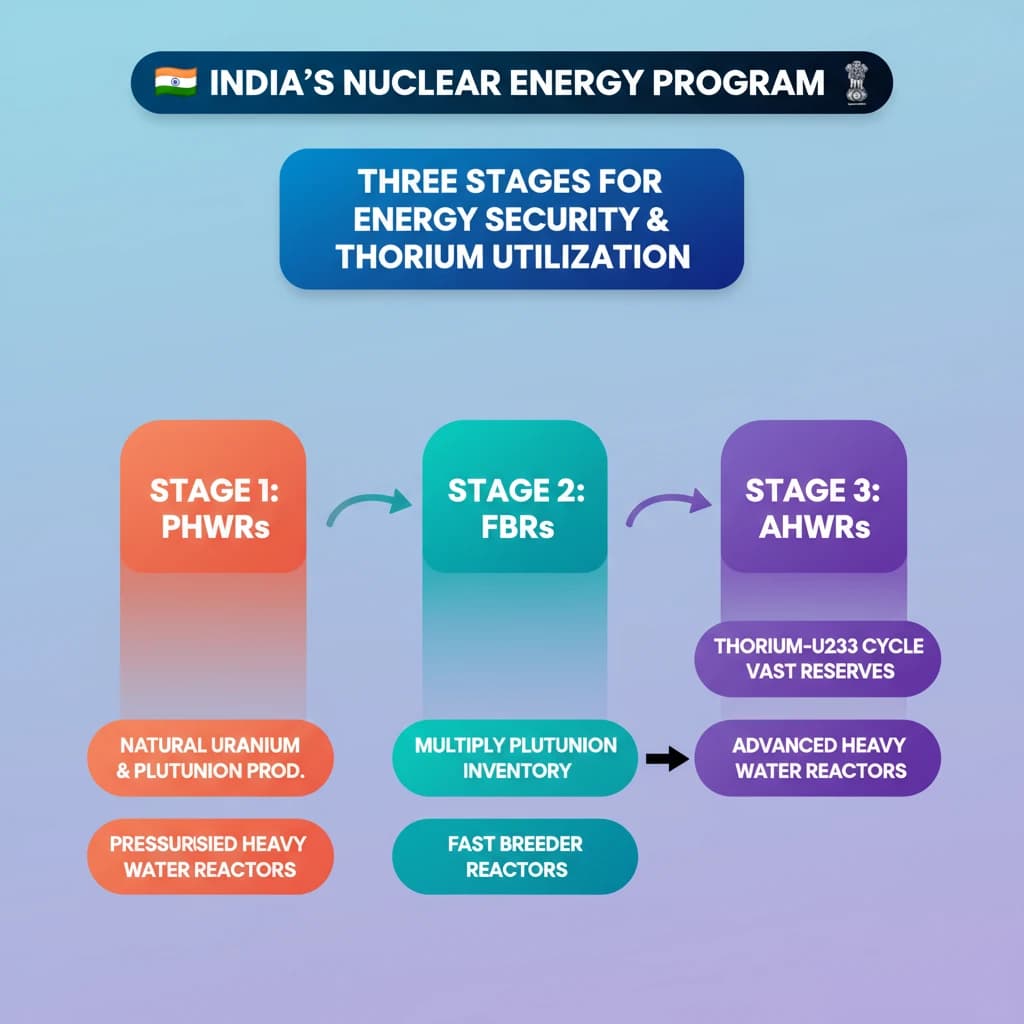
- •India's nuclear program is a three-stage plan for long-term energy security, leveraging indigenous resources.
- •Stage 1 uses Pressurised Heavy Water Reactors (PHWRs) with natural uranium, producing plutonium as a byproduct.
- •Stage 2 employs Fast Breeder Reactors (FBRs) to multiply plutonium inventory, crucial for future thorium utilization.
- •Stage 3 aims for the thorium-Uranium-233 (U-233) cycle via Advanced Heavy Water Reactors (AHWRs), utilizing India's vast thorium reserves.
- •Successful FBR development in Stage 2 is a prerequisite for the commercial viability of the thorium-based Stage 3.
- •The program ensures energy independence, reduces carbon footprint, and showcases India's technological prowess in nuclear science.
🧠 Memory Techniques
95% Verified Content
📚 Reference Sources
•Bhabha Atomic Research Centre (BARC) official website
•Department of Atomic Energy (DAE) annual reports and publications
•Press Information Bureau (PIB) releases related to nuclear energy