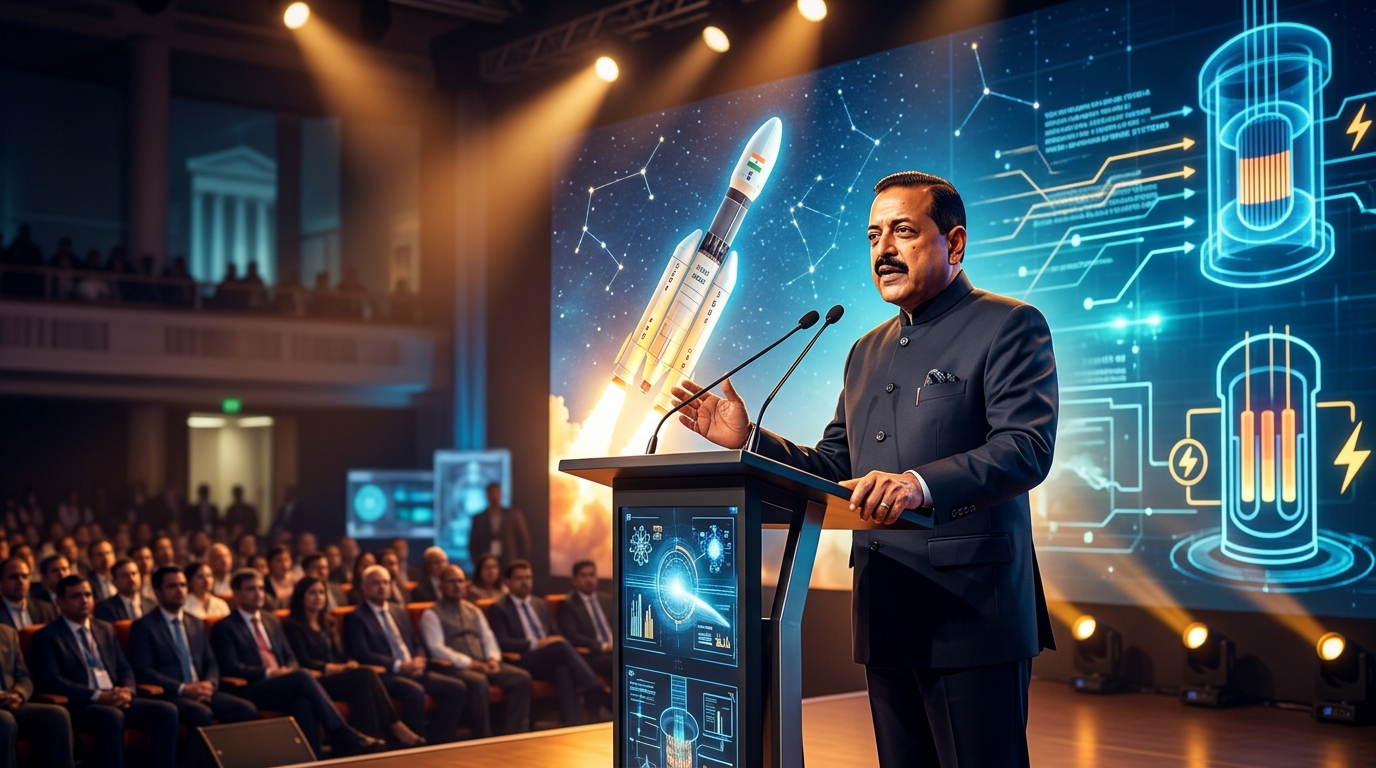
Union Minister Dr. Jitendra Singh Highlights Tech‑Driven Warfare, Space Start‑ups & Nuclear Energy at Unstoppable Bharat 2026 — UPSC Current Affairs | March 15, 2026
Union Minister Dr. Jitendra Singh Highlights Tech‑Driven Warfare, Space Start‑ups & Nuclear Energy at Unstoppable Bharat 2026
Union Minister Dr. Jitendra Singh, speaking at the Unstoppable Bharat 2026 conference, highlighted the shift to technology‑driven warfare, the rapid growth of India's space startup ecosystem, and the strategic role of nuclear energy and AI in future development. He also emphasized government programmes like Vigyan Jyoti and the NEP to nurture scientific talent, underscoring their relevance for national security and economic growth.
Overview : In a fire‑chat at the Unstoppable Bharat 2026 conference, Union Minister of State (Independent Charge) Dr. Jitendra Singh underscored the shift of warfare towards technology, the rapid expansion of the Space Startup Ecosystem , and the role of Nuclear Energy in powering future technologies. Key Developments Warfare is becoming increasingly AI ‑driven; traditional man‑to‑man combat is receding. Recent reforms have opened the space sector to private players, creating a vibrant Space Startup Ecosystem that is expected to boost the national space economy. Government programmes such as Vigyan Jyoti and the flexibility introduced by the National Education Policy are nurturing scientific talent from early stages. Nuclear Energy is earmarked to power AI‑intensive data centres and support clean‑energy goals. Expansion of nuclear medicine is opening new avenues for treating cancer and blood disorders. Important Facts The Minister highlighted that India has “no shortage of scientific talent” and that collaborative efforts among government, industry and academia are essential to translate this talent into strategic capabilities. He emphasized that the Ministry of Science & Technology is driving policies to create an enabling ecosystem for innovation. UPSC Relevance Understanding the shift to technology‑driven warfare aligns with GS II (Defence) and GS III (Science & Technology). The liberalisation of the space sector illustrates public‑private partnership models, a recurring theme in GS III (Economy). Initiatives like Vigyan Jyoti and the NEP are pertinent to GS II (Education) and GS IV (Women & Child Development). The emphasis on Nuclear Energy touches upon energy security, environmental sustainability and health, linking GS III and GS IV. Way Forward For aspirants, it is crucial to monitor: (i) policy updates on private participation in space and defence sectors; (ii) scaling of mentorship schemes like Vigyan Jyoti under the NEP ; and (iii) investments in Nuclear Energy and AI to ensure a resilient, technology‑led national development trajectory.
Login to bookmark articles
Login to mark articles as complete
Overview
Tech‑driven warfare, space startups & nuclear energy earmarked for India’s strategic growth to 2026
Key Facts
Union Minister Dr. Jitendra Singh highlighted AI‑driven warfare and the decline of man‑to‑man combat at the Unstoppable Bharat 2026 conference (March 2026).
Space Activities Bill 2023 and IN‑Space policy 2024 opened the space sector to private players, resulting in over 150 registered space startups by 2025.
Vigyan Jyoti mentorship scheme, aligned with NEP 2020, has reached 1.2 million students, focusing on STEM, AI and space technologies.
India aims to add 6,000 MW of nuclear capacity by 2030, with new reactors at Kudankulam, Jaitapur and upcoming SMRs to power AI‑intensive data centres.
The nuclear medicine market is projected to reach US$2.5 billion by 2028, driven by indigenous production of radioisotopes such as Technetium‑99m.
Ministry of Science & Technology launched an Innovation Hub in 2025, allocating ₹5,000 crore for defence‑dual‑use technology development.
Background & Context
The shift to AI‑enabled warfare, liberalisation of the space sector and expansion of nuclear energy reflect India's strategic push for technology‑led defence and economic growth. These developments intersect with GS III (Science & Technology), GS II (Defence) and GS IV (Environment & Energy), emphasizing public‑private partnerships, talent nurturing and sustainable energy security.
UPSC Syllabus Connections
GS2•Government policies and interventions for developmentEssay•Science, Technology and SocietyGS3•Developments in science and technology and their applicationsPrelims_GS•National Current AffairsEssay•Economy, Development and InequalityPrelims_GS•Science and Technology ApplicationsGS2•Issues relating to Health, Education, Human ResourcesGS3•Infrastructure - Energy, Ports, Roads, Airports, RailwaysGS2•Functions and responsibilities of Union and StatesPrelims_GS•Physics and Chemistry in Everyday Life
Mains Answer Angle
In Mains, candidates can address how AI‑driven warfare, a vibrant space startup ecosystem and nuclear energy together shape India's security, innovation ecosystem and clean‑energy goals (GS III/II/IV). A likely question may ask to evaluate the role of technology in enhancing national security and sustainable development.