Loading page, please wait…
HomeCurrent AffairsEditorialsGovt SchemesLearning ResourcesUPSC SyllabusPricingAboutBest UPSC AIUPSC AI ToolAI for UPSCUPSC ChatGPT

© 2026 Vaidra. All rights reserved.

PrivacyTerms
Vaidra Logo
Vaidra

Top 4 items + smart groups

UPSC GPT
New
Current Affairs
Daily Solutions
Daily Puzzle
Mains Evaluator

Version 2.0.0 • Built with ❤️ for UPSC aspirants

Artemis II Orion Capsule Splashdown; India Nears First Crewed Spaceflight (G1) | GS3 UPSC Current Affairs April 2026
Artemis II Orion Capsule Splashdown; India Nears First Crewed Spaceflight (G1)
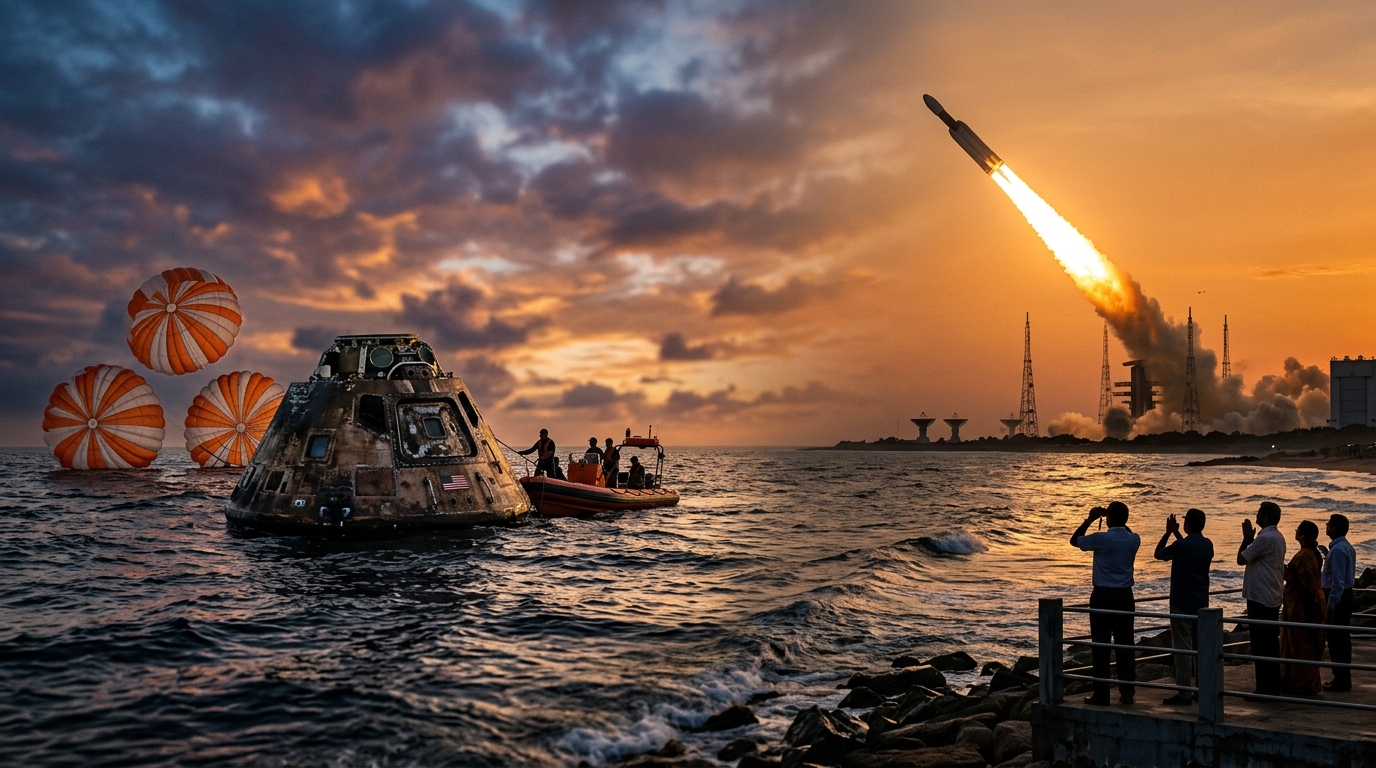
On 10 April 2026 the Orion crew capsule of NASA’s Artemis II mission safely splashed down after a ten‑day lunar fly‑by, marking the farthest human distance from Earth. India’s ISRO is set to announce the launch date for its first uncrewed test flight (G1), moving it closer to becoming the fourth nation to launch a crewed spacecraft.
Overview On 10 April 2026 the Orion crew capsule of the Artemis II mission splashed down in the Pacific Ocean off the coast of San Diego after a ten‑day flight that took four astronauts around the Moon and back. The crew – Reid Wiseman , Victor Glover , Christina Koch (all NASA ) and Jeremy Hansen of the CSA – set a new record for the farthest distance travelled by humans from Earth. Key Developments The mission concluded without anomalies; astronauts reported that all objectives were met as per plan. India’s ISRO announced that the launch date for its first uncrewed test flight, designated G1 , will be disclosed within the week. Successful splash‑down reinforces confidence in the crew capsule design and deep‑space navigation systems. Important Facts The Artemis II crew spent ten days in space, completing a lunar fly‑by that placed them at a maximum distance of roughly 400,000 km from Earth – the farthest any human has travelled. The mission demonstrated critical capabilities such as high‑speed re‑entry, autonomous navigation, and crew health monitoring, all of which are essential for future lunar landing missions (Artemis III) and eventual Mars expeditions. India aims to become the fourth nation to launch a crewed spacecraft, joining the Soviet Union, the United States and China. The upcoming G1 flight will test the launch vehicle, crew module and abort systems before a crewed mission is scheduled, likely in the early 2030s. UPSC Relevance Space missions intersect with several UPSC syllabus areas: GS 3 – Science & Technology (advancements in aerospace engineering, international cooperation, and strategic autonomy), GS 2 – Polity (role of agencies like ISRO and their governance), and GS 4 – Ethics (responsible use of space technology, safety of crew, and environmental considerations of launch activities). Understanding the timeline of crewed missions helps aspirants analyse India’s strategic positioning in the global space race. Way Forward ISRO’s imminent announcement of the G1 flight will set the stage for a crewed launch, likely designated G2 , within the next decade. Continuous monitoring of mission outcomes, technology transfer, and international collaborations (e.g., with NASA’s Artemis programme) will be crucial for building indigenous capabilities and ensuring safety standards. Aspirants should track policy statements, budget allocations, and legislative frameworks governing India’s human spaceflight programme.
  1. Home
  2. Prepare
  3. Current Affairs
  4. Artemis II Orion Capsule Splashdown; India Nears First Crewed Spaceflight (G1)
Login to bookmark articles
Login to mark articles as complete

Overview

gs.gs378% UPSC Relevance

Artemis II splashdown validates deep‑space tech as India readies its first crewed launch (G1).

Key Facts

  1. Artemis II splashdown occurred on 10 April 2026 in the Pacific Ocean off San Diego after a ten‑day lunar fly‑by.
  2. The crew comprised NASA astronauts Reid Wiseman, Victor Glover, Christina Koch and CSA astronaut Jeremy Hansen.
  3. The mission set a human‑distance record of approximately 400,000 km from Earth, the farthest ever travelled by humans.
  4. Key capabilities demonstrated were high‑speed re‑entry, autonomous navigation and continuous crew health monitoring, essential for Artemis III and future Mars missions.
  5. ISRO announced that the launch date for its first uncrewed crew‑module test flight, designated G1, will be disclosed within the week, targeting an early‑2030s crewed launch (G2).
  6. Successful G1 testing aims to make India the fourth nation (after USSR/Russia, USA, China) to launch a crewed spacecraft, enhancing strategic autonomy and international cooperation.

Background & Context

The Artemis II success underscores advancements in deep‑space human flight, a core topic of GS‑3 (Science & Technology). Simultaneously, ISRO’s G1 programme reflects India’s policy drive for strategic autonomy in space (GS‑2) and raises ethical considerations on safety and environmental impact (GS‑4).

Mains Answer Angle

In Mains, candidates can discuss India’s pursuit of a crewed space programme as a facet of strategic autonomy and international collaboration, linking it to GS‑3 and GS‑2. A likely question may ask to evaluate the implications of human spaceflight for India’s scientific, security and diplomatic objectives.

Full Article

<h3>Overview</h3> <p>On <strong>10 April 2026</strong> the <span class="key-term" data-definition="Orion crew capsule — a deep‑space vehicle built by NASA to carry astronauts beyond low‑Earth orbit (GS3: Science & Technology)">Orion</span> crew capsule of the <span class="key-term" data-definition="Artemis II mission — NASA's first crewed lunar fly‑by mission under the Artemis programme, marking a return to crewed deep‑space flights (GS3: Science & Technology)">Artemis II</span> mission splashed down in the Pacific Ocean off the coast of San Diego after a ten‑day flight that took four astronauts around the Moon and back. The crew – <strong>Reid Wiseman</strong>, <strong>Victor Glover</strong>, <strong>Christina Koch</strong> (all <span class="key-term" data-definition="NASA — National Aeronautics and Space Administration, the United States agency responsible for civilian space exploration (GS3: Science & Technology)">NASA</span>) and <strong>Jeremy Hansen</strong> of the <span class="key-term" data-definition="Canadian Space Agency — Canada’s national space agency, involved in international space collaborations (GS3: Science & Technology)">CSA</span> – set a new record for the farthest distance travelled by humans from Earth.</p> <h3>Key Developments</h3> <ul> <li>The mission concluded without anomalies; astronauts reported that all objectives were met as per plan.</li> <li>India’s <span class="key-term" data-definition="ISRO — Indian Space Research Organisation, the apex body for space activities in India (GS3: Science & Technology)">ISRO</span> announced that the launch date for its first uncrewed test flight, designated <span class="key-term" data-definition="G1 — The code name for ISRO’s inaugural uncrewed test of its crewed spacecraft, a precursor to a crewed launch (GS3: Science & Technology)">G1</span>, will be disclosed within the week.</li> <li>Successful splash‑down reinforces confidence in the <span class="key-term" data-definition="crew capsule — a pressurised vehicle that houses astronauts during launch, spaceflight and re‑entry (GS3: Science & Technology)">crew capsule</span> design and deep‑space navigation systems.</li> </ul> <h3>Important Facts</h3> <p>The Artemis II crew spent ten days in space, completing a lunar fly‑by that placed them at a maximum distance of roughly <strong>400,000 km</strong> from Earth – the farthest any human has travelled. The mission demonstrated critical capabilities such as high‑speed re‑entry, autonomous navigation, and crew health monitoring, all of which are essential for future lunar landing missions (Artemis III) and eventual Mars expeditions.</p> <p>India aims to become the fourth nation to launch a crewed spacecraft, joining the Soviet Union, the United States and China. The upcoming <span class="key-term" data-definition="G1 — The code name for ISRO’s inaugural uncrewed test of its crewed spacecraft, a precursor to a crewed launch (GS3: Science & Technology)">G1</span> flight will test the launch vehicle, crew module and abort systems before a crewed mission is scheduled, likely in the early 2030s.</p> <h3>UPSC Relevance</h3> <p>Space missions intersect with several UPSC syllabus areas: <strong>GS 3 – Science & Technology</strong> (advancements in aerospace engineering, international cooperation, and strategic autonomy), <strong>GS 2 – Polity</strong> (role of agencies like <span class="key-term" data-definition="ISRO — Indian Space Research Organisation, the apex body for space activities in India (GS3: Science & Technology)">ISRO</span> and their governance), and <strong>GS 4 – Ethics</strong> (responsible use of space technology, safety of crew, and environmental considerations of launch activities). Understanding the timeline of crewed missions helps aspirants analyse India’s strategic positioning in the global space race.</p> <h3>Way Forward</h3> <p>ISRO’s imminent announcement of the <span class="key-term" data-definition="G1 — The code name for ISRO’s inaugural uncrewed test of its crewed spacecraft, a precursor to a crewed launch (GS3: Science & Technology)">G1</span> flight will set the stage for a crewed launch, likely designated <strong>G2</strong>, within the next decade. Continuous monitoring of mission outcomes, technology transfer, and international collaborations (e.g., with NASA’s Artemis programme) will be crucial for building indigenous capabilities and ensuring safety standards. Aspirants should track policy statements, budget allocations, and legislative frameworks governing India’s human spaceflight programme.</p>
Read Original on hindu

Analysis

Practice Questions

GS1
Easy
Prelims MCQ

Artemis II mission objectives

1 marks
3 keywords
GS2
Medium
Mains Short Answer

India’s ISRO contributions to crewed spaceflight

5 marks
5 keywords
GS3
Hard
Mains Essay

Human spaceflight engineering and governance

20 marks
8 keywords
Related:Daily•Weekly

Loading related articles...

Loading related articles...

Tip: Click articles above to read more from the same date, or use the back button to see all articles.

Quick Reference

Key Insight

Artemis II splashdown validates deep‑space tech as India readies its first crewed launch (G1).

Key Facts

  1. Artemis II splashdown occurred on 10 April 2026 in the Pacific Ocean off San Diego after a ten‑day lunar fly‑by.
  2. The crew comprised NASA astronauts Reid Wiseman, Victor Glover, Christina Koch and CSA astronaut Jeremy Hansen.
  3. The mission set a human‑distance record of approximately 400,000 km from Earth, the farthest ever travelled by humans.
  4. Key capabilities demonstrated were high‑speed re‑entry, autonomous navigation and continuous crew health monitoring, essential for Artemis III and future Mars missions.
  5. ISRO announced that the launch date for its first uncrewed crew‑module test flight, designated G1, will be disclosed within the week, targeting an early‑2030s crewed launch (G2).
  6. Successful G1 testing aims to make India the fourth nation (after USSR/Russia, USA, China) to launch a crewed spacecraft, enhancing strategic autonomy and international cooperation.

Background

The Artemis II success underscores advancements in deep‑space human flight, a core topic of GS‑3 (Science & Technology). Simultaneously, ISRO’s G1 programme reflects India’s policy drive for strategic autonomy in space (GS‑2) and raises ethical considerations on safety and environmental impact (GS‑4).

Mains Angle

In Mains, candidates can discuss India’s pursuit of a crewed space programme as a facet of strategic autonomy and international collaboration, linking it to GS‑3 and GS‑2. A likely question may ask to evaluate the implications of human spaceflight for India’s scientific, security and diplomatic objectives.

Explore:Current Affairs·Editorial Analysis·Govt Schemes·Study Materials·Previous Year Questions·UPSC GPT