Loading page, please wait…
HomeCurrent AffairsEditorialsGovt SchemesLearning ResourcesUPSC SyllabusPricingAboutBest UPSC AIUPSC AI ToolAI for UPSCUPSC ChatGPT

© 2026 Vaidra. All rights reserved.

PrivacyTerms
Vaidra Logo
Vaidra

Top 4 items + smart groups

UPSC GPT
New
Current Affairs
Daily Solutions
Daily Puzzle
Mains Evaluator

Version 2.0.0 • Built with ❤️ for UPSC aspirants

Iranian Drone Strikes Fuel Tanks at Kuwait International Airport – No Casualties, Regional Security Implications — UPSC Current Affairs | April 1, 2026
Iranian Drone Strikes Fuel Tanks at Kuwait International Airport – No Casualties, Regional Security Implications
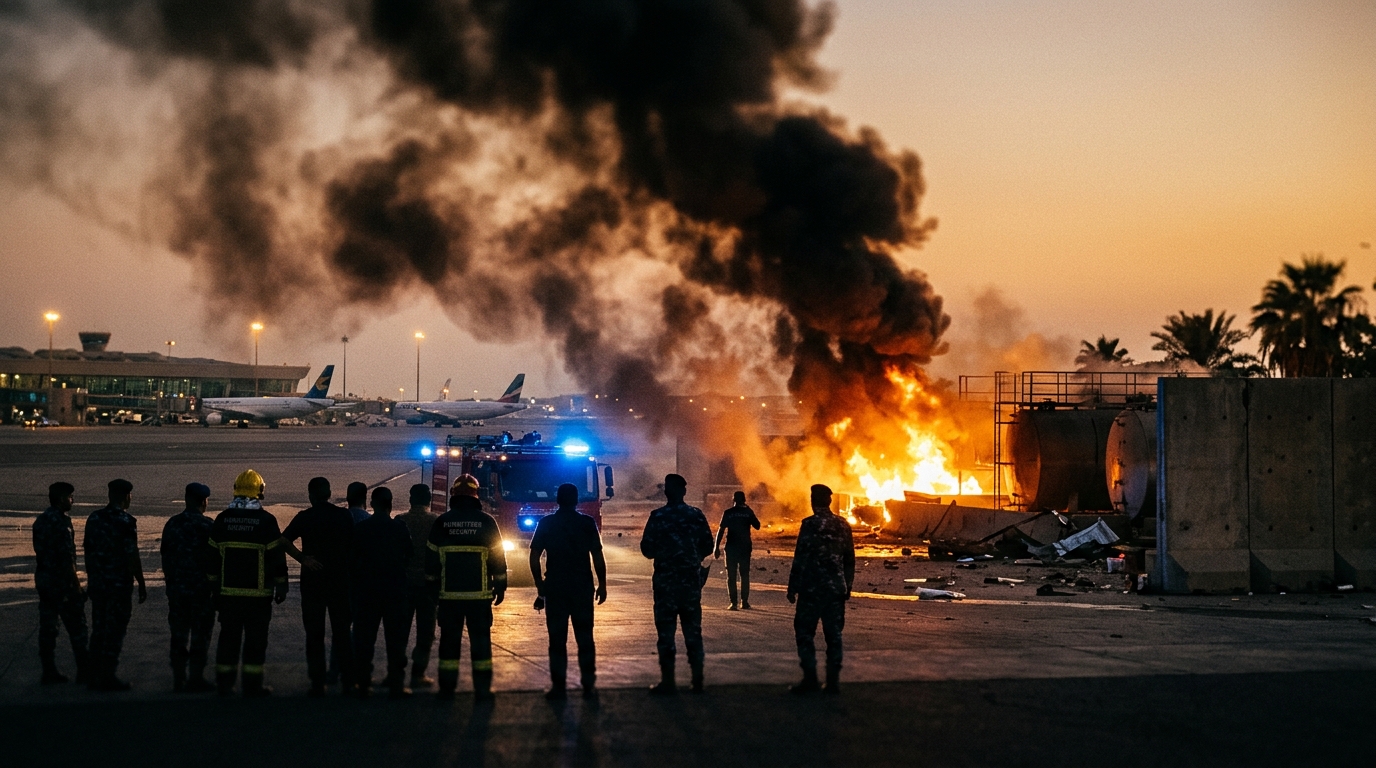
On 1 April 2026, an Iranian drone struck fuel tanks at Kuwait International Airport, causing a large fire but no casualties. The attack, part of the widening U.S.-Israeli‑Iran conflict, highlights the vulnerability of Gulf infrastructure and has direct implications for India’s UPSC syllabus on international relations, security, and energy logistics.
Overview On 1 April 2026 , a Iran drone attack hit the fuel storage complex of Kuwait International Airport . The strike ignited a large fire but, according to the state news agency KUNA , there were no injuries. Key Developments Fuel tanks owned by the Kuwait Aviation Fuelling Company were severely damaged. The incident is part of a series of attacks on the airport and its fuel infrastructure. It occurs against the backdrop of an expanding U.S.-Israeli war on Iran , with Tehran also striking Israel and Gulf Arab states that host Gulf Arab states where U.S. bases are located. Important Facts The civil aviation authority confirmed the damage and reported that fire‑fighting teams contained the blaze within hours. No civilian aircraft were affected, and flight operations resumed after safety checks. UPSC Relevance This event touches upon several GS topics: International Relations (GS2) : The incident illustrates the spill‑over of the Iran‑Israel‑U.S. confrontation into the Gulf, affecting the security calculus of Gulf Cooperation Council (GCC) members. Security & Defence (GS2) : Use of drones for strategic infrastructure attacks signals a shift in warfare tactics. Energy & Infrastructure (GS3) : Damage to aviation fuel storage underscores the vulnerability of critical energy logistics in conflict zones. Media & Information (GS4) : Reliance on state news agency KUNA highlights the role of official communication in crisis management. Way Forward For policymakers, the incident suggests the need to: Strengthen air‑defence and surveillance capabilities around critical infrastructure in the Gulf. Enhance regional cooperation among GCC states to share intelligence on drone threats. Develop contingency plans for rapid fuel supply restoration to minimise disruption to civil aviation. Engage diplomatically to de‑escalate the broader U.S.-Israeli war on Iran and prevent further attacks on civilian assets.
  1. Home
  2. Prepare
  3. Current Affairs
  4. Iranian Drone Strikes Fuel Tanks at Kuwait International Airport – No Casualties, Regional Security Implications
Login to bookmark articles
Login to mark articles as complete

Overview

Iranian drone strike on Kuwait airport fuels regional security concerns over Gulf infrastructure

Key Facts

  1. On 1 April 2026, an Iranian‑manufactured drone hit the fuel storage complex at Kuwait International Airport.
  2. The attack damaged fuel tanks owned by the state‑run Kuwait Aviation Fuelling Company, causing a large fire.
  3. No casualties were reported; fire‑fighting teams contained the blaze within a few hours and flight operations resumed after safety checks.
  4. The incident is part of a series of recent attacks on Kuwait’s airport and fuel infrastructure amid the expanding US‑Israeli‑Iran confrontation.
  5. It highlights the growing use of unmanned aerial vehicles to target critical civilian infrastructure in the Gulf region.
  6. The civil aviation authority confirmed that no civilian aircraft were affected, underscoring the vulnerability of aviation fuel logistics.
  7. The strike prompted calls for enhanced air‑defence and regional intelligence sharing among GCC states.

Background & Context

These attacks occur against the backdrop of heightened Iran‑Israel tensions and the broader US‑Israeli military campaign against Iranian interests, raising concerns under GS2 (International Relations) and GS3 (Energy & Infrastructure). The vulnerability of aviation fuel storage underscores the strategic importance of protecting critical energy logistics and civil aviation infrastructure in the Gulf, a key focus of India’s foreign policy and security considerations.

Mains Answer Angle

GS2 – International Relations & Security; GS3 – Energy & Infrastructure. A possible Mains question could ask candidates to evaluate the impact of drone‑enabled attacks on Gulf security and energy logistics, and suggest policy measures for regional cooperation.

Full Article

Read Original on hindu

Analysis

Practice Questions

Prelims
Easy
Prelims MCQ

Security & Defence

1 marks
4 keywords
GS2
Medium
Mains Short Answer

International Relations; Energy & Infrastructure

5 marks
5 keywords
GS2
Hard
Mains Essay

International Relations; Security & Defence

20 marks
6 keywords
Related:Daily•Weekly

Loading related articles...

Loading related articles...

Tip: Click articles above to read more from the same date, or use the back button to see all articles.

Explore:Current Affairs·Editorial Analysis·Govt Schemes·Study Materials·Previous Year Questions·UPSC GPT