<h3>Overview</h3>
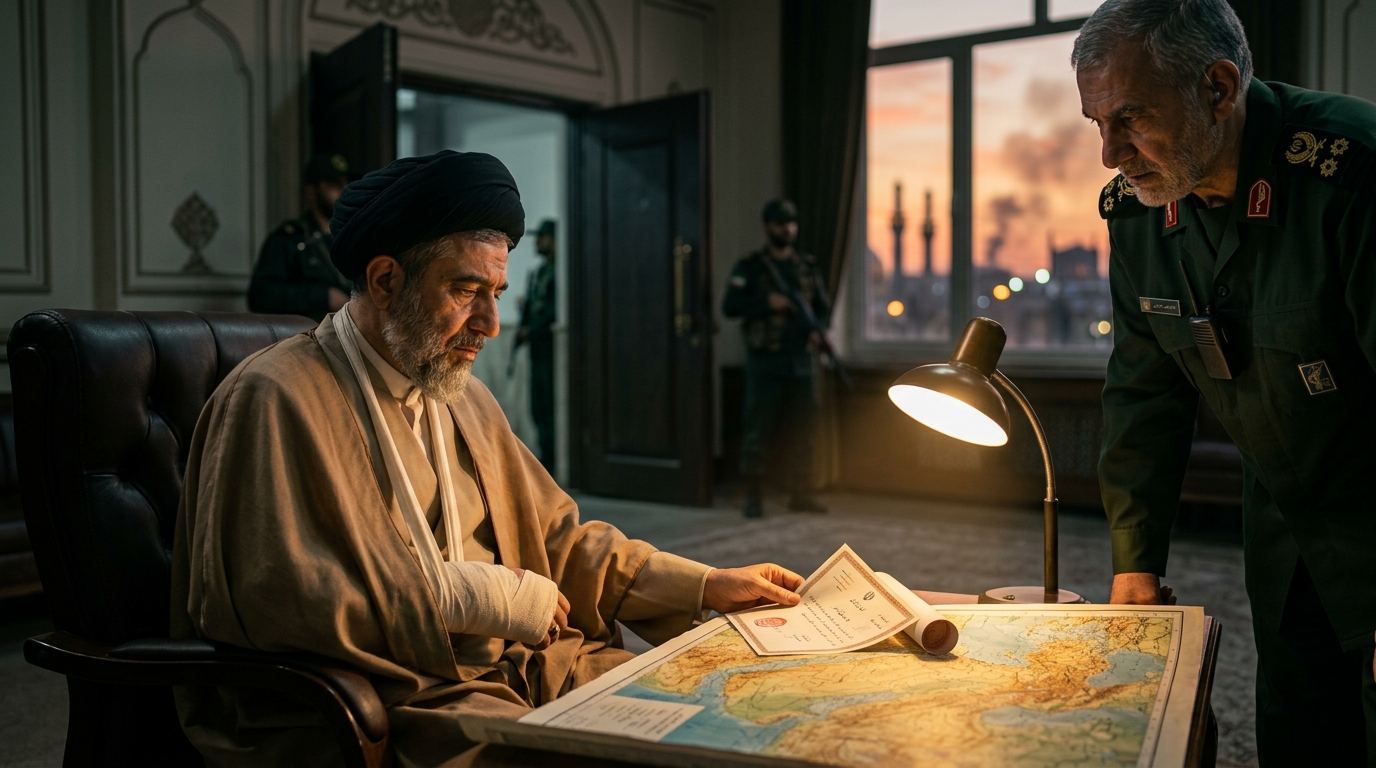
<p>The <strong>New York Times</strong> reported on <strong>23 April 2026</strong> that Iran’s newly appointed <span class="key-term" data-definition="Mojtaba Khamenei — son of the late Ali Khamenei, appointed as Iran’s new Supreme Leader in 2026 (GS2: Polity)">Mojtaba Khamenei</span> sustained serious injuries in a coordinated <span class="key-term" data-definition="U.S.-Israeli airstrike — coordinated military action by the United States and Israel, reflecting strategic cooperation in the Middle East (GS2: Polity, GS3: International Relations)">U.S.-Israeli airstrike</span> that also killed his father, the late <span class="key-term" data-definition="Ali Khamenei — Iran’s former Supreme Leader (1989‑2026), whose death marks a major leadership transition (GS2: Polity)">Ali Khamenei</span>. Despite the physical trauma, the report says the new leader remains "mentally sharp" and has temporarily handed over decision‑making authority to senior officers of the <span class="key-term" data-definition="Revolutionary Guard Corps (IRGC) — Iran’s elite military force that also controls significant economic and political assets; key player in Iran’s foreign and domestic policy (GS2: Polity)">Revolutionary Guards</span>’ <span class="key-term" data-definition="Ideological Army — term used to describe the IRGC’s role in promoting the Islamic Republic’s revolutionary ideology and influencing state decisions (GS2: Polity)">Ideological Army</span>.</p>
<h3>Key Developments</h3>
<ul>
<li>Airstrike on <strong>23 April 2026</strong> targeted the Khamenei family residence, killing <span class="key-term" data-definition="Ali Khamenei — Iran’s former Supreme Leader (1989‑2026), whose death marks a major leadership transition (GS2: Polity)">Ali Khamenei</span> and wounding his son <span class="key-term" data-definition="Mojtaba Khamenei — son of the late Ali Khamenei, appointed as Iran’s new Supreme Leader in 2026 (GS2: Polity)">Mojtaba Khamenei</span>.</li>
<li>The new <span class="key-term" data-definition="Supreme Leader — the highest authority in Iran’s political system, wielding ultimate control over the executive, legislative, and judicial branches (GS2: Polity)">Supreme Leader</span> has, for now, delegated critical decisions to generals of the <span class="key-term" data-definition="Revolutionary Guard Corps (IRGC) — Iran’s elite military force that also controls significant economic and political assets; key player in Iran’s foreign and domestic policy (GS2: Polity)">Revolutionary Guards</span>.</li>
<li>Iranian officials cited by the newspaper remain unnamed, indicating limited official confirmation.</li>
</ul>
<h3>Important Facts</h3>
<ul>
<li>Both the United States and Israel have a history of covert operations in the region; this joint strike underscores their strategic alignment against perceived Iranian threats.</li>
<li>The death of <span class="key-term" data-definition="Ali Khamenei — Iran’s former Supreme Leader (1989‑2026), whose death marks a major leadership transition (GS2: Polity)">Ali Khamenei</span> ends a 37‑year tenure, creating a rare leadership vacuum in the Islamic Republic.</li>
<li>The delegation to the <span class="key-term" data-definition="Ideological Army — term used to describe the IRGC’s role in promoting the Islamic Republic’s revolutionary ideology and influencing state decisions (GS2: Polity)">Ideological Army</span> suggests a shift toward a more militarised decision‑making process.</li>
</ul>
<h3>UPSC Relevance</h3>
<p>Understanding this development is crucial for GS2 (Polity) and GS3 (International Relations). The transition in Iran’s highest office tests the resilience of its theocratic‑political structure, a frequent topic in comparative politics. The involvement of the <span class="key-term" data-definition="Revolutionary Guard Corps (IRGC) — Iran’s elite military force that also controls significant economic and political assets; key player in Iran’s foreign and domestic policy (GS2: Polity)">Revolutionary Guards</span> highlights the intertwining of security institutions with state policy, a pattern observed in many authoritarian regimes. For Indian foreign‑policy aspirants, the incident signals potential recalibration of regional security dynamics, especially concerning India’s energy interests and its strategic partnership with the United States.</p>
<h3>Way Forward</h3>
<p>Analysts anticipate a short‑term consolidation of power within the IRGC, while the new <span class="key-term" data-definition="Supreme Leader — the highest authority in Iran’s political system, wielding ultimate control over the executive, legislative, and judicial branches (GS2: Polity)">Supreme Leader</span> may gradually re‑assert civilian oversight once his health stabilises. Diplomatic channels are likely to remain tense, with the United States and Israel prepared to justify the strike as a counter‑terrorism measure. Indian policymakers should monitor the evolving power balance, assess risks to Indian expatriates and energy projects in the Persian Gulf, and calibrate their own strategic posture accordingly.</p>