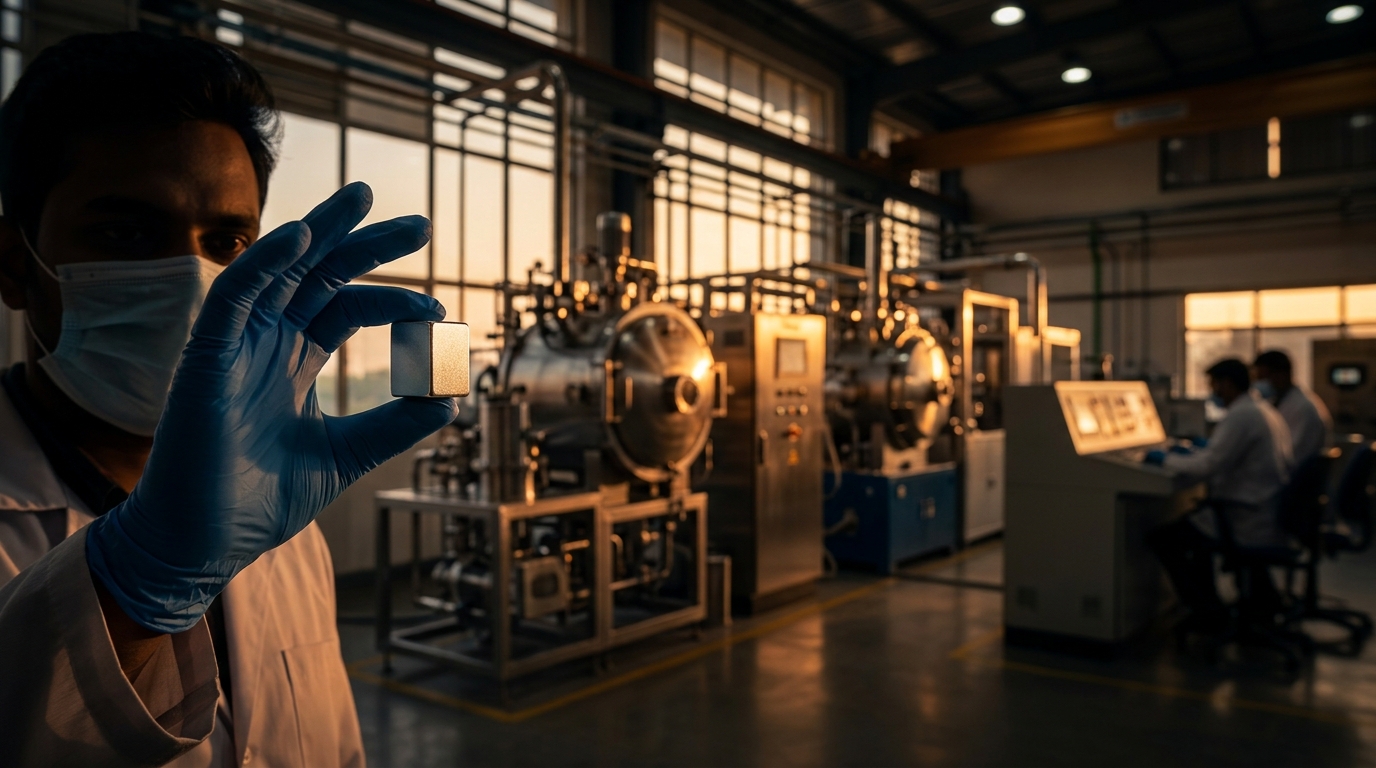
DST Inaugurates Pilot Plant for Nd‑Fe‑B Rare‑Earth Magnets at ARCI, Hyderabad – Boost to Self‑Reliant Manufacturing
The Ministry of Science & Technology inaugurated a pilot plant at the International Advanced Research Centre for Powder Metallurgy and New Materials (ARCI), Hyderabad, to manufacture <span class="key-term" data-definition="Neodymium‑Iron‑Boron – a high‑performance rare‑earth permanent magnet used in electric vehicles, wind turbines and electronics; critical for defence and advanced manufacturing (GS3: Economy)">Nd‑Fe‑B</span> magnets. The facility aims to create an end‑to‑end, self‑reliant ecosystem for rare‑earth magnet production, bolstering India’s clean‑energy and advanced‑manufacturing ambitions under the <span class="key-term" data-definition="Viksit Bharat 2047 – a long‑term vision to make India a developed nation by the centenary of independence in 2047 (GS1: History, GS3: Economy)">Viksit Bharat 2047</span> roadmap.
The Ministry of Science & Technology (DST) inaugurated a pilot plant at the ARCI , Hyderabad, for the production of Nd‑Fe‑B permanent magnets. The plant, opened by Prof. Abhay Karandikar, Secretary, DST , marks a strategic step toward reducing dependence on imported rare‑earth magnets and strengthening India’s position in the global value chain. Key Developments Inauguration attended by senior officials including Prof. Ashutosh Sharma (Former Secretary, DST) and industry leaders. The facility adopts an end‑to‑end approach, covering the process from strip‑cast alloy to sintered magnet. It serves as a test‑bed for technology validation, process optimisation, and scale‑up to commercial production. Collaboration framework invites ANRF , startups, academia and private sector. Links with the MAHA programme to fast‑track critical‑technology development. Important Facts Nd‑Fe‑B magnets are essential for electric vehicles, renewable‑energy systems, electronics and advanced manufacturing . Global rare‑earth magnet supply chains are highly concentrated, creating strategic vulnerabilities for emerging economies. The pilot plant aims to create a self‑reliant ecosystem from mineral extraction to market‑ready products. India’s clean‑energy and EV targets are expected to drive a steep rise in domestic demand for high‑performance magnets. UPSC Relevance The development touches upon several GS topics: GS3 – Economy (strategic materials, supply‑chain security, industrial policy), GS1 – History & Geography (India’s long‑term development vision), and GS3 – Science & Technology (research‑to‑manufacturing pathways, role of autonomous institutions). Understanding the rare‑earth value chain helps answer questions on India’s self‑reliance, technology indigenisation, and the challenges of global supply‑chain geopolitics. Way Forward Scale the pilot to a full‑capacity commercial plant, ensuring cost‑competitiveness with global players. Strengthen public‑private partnerships to foster innovation in alloy design and magnet performance. Integrate the plant’s output with the national Viksit Bharat 2047 agenda for clean mobility and renewable‑energy deployment. Develop a skilled workforce through specialised training programmes aligned with the plant’s technology. Monitor environmental impacts of rare‑earth extraction and promote sustainable processing methods. Overall, the ARCI pilot plant is a cornerstone in India’s quest for strategic autonomy in critical materials, aligning with the broader goals of Atmanirbhar Bharat and the vision of a Viksit Bharat 2047 .
Quick Reference
Key Insight
India launches pilot plant for rare‑earth magnets to secure strategic self‑reliance.
Key Facts
- • Ministry of Science & Technology (DST) inaugurated the Nd‑Fe‑B pilot plant at ARCI, Hyderabad on 10 April 2026.
- • Nd‑Fe‑B magnets are critical for electric vehicles, wind turbines, defence equipment and high‑tech electronics.
- • The plant follows an end‑to‑end process: strip‑cast alloy → sintering → market‑ready magnet.
- • Collaboration framework includes ANRF, startups, academia, private sector and DST’s MAHA programme.
- • Objective: create a self‑reliant ecosystem from rare‑earth processing to finished magnets under Atmanirbhar Bharat.
- • Expected domestic demand to rise sharply as India targets 30 % EV penetration by 2030 and 175 GW renewable capacity by 2030.
- • ARCI is an autonomous DST institution under the Department of Science & Technology, governed by the Science & Technology (DST) Act, 2020.
Background
Rare‑earth magnets are concentrated in a few countries, making supply chains a strategic vulnerability. By establishing a domestic production line, India aligns with its broader industrial policy of strategic material security, clean‑energy transition, and the Atmanirbhar Bharat vision, linking science‑technology research to manufacturing under the GS‑3 syllabus.
UPSC Syllabus
- Essay — Science, Technology and Society
- GS3 — Developments in science and technology and their applications
- Essay — Economy, Development and Inequality
Mains Angle
GS‑3 (Science & Technology) – Discuss how indigenous production of Nd‑Fe‑B magnets can enhance India’s strategic autonomy and support clean‑energy goals. Likely question: ‘Evaluate the role of autonomous research institutions in achieving self‑reliance in critical technologies.’