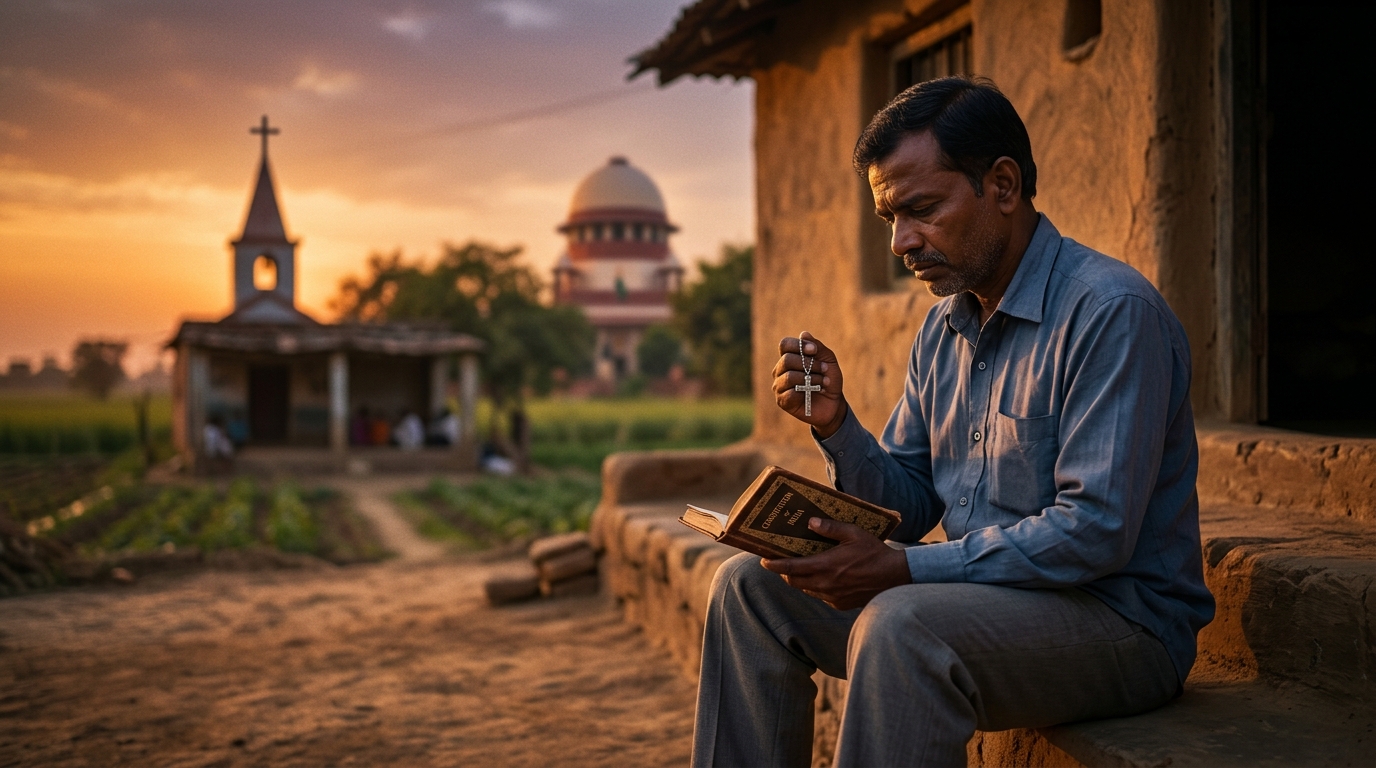
The Supreme Court on 24 March 2026 upheld an Andhra Pradesh High Court order that a person who converts to Christianity cannot claim membership of the Scheduled Caste (SC) community. The judgment clarifies that only followers of Hinduism, Sikhism or Buddhism can retain SC status, as stipulated in Constitution (Scheduled Castes) Order, 1950.
Key Developments
- The Court declared that conversion to any religion other than Hinduism, Sikhism or Buddhism results in immediate loss of SC status, irrespective of birth.
- It affirmed that no statutory benefit, reservation or protection under the Constitution can be claimed by a person who, by operation of Clause 3, is not deemed a member of the SC.
- The judgment arose from a criminal petition where a Christian pastor sought to invoke the SC/ST (Prevention of Atrocities) Act after alleging assault.
- The High Court had earlier held that the caste system is alien to Christianity and barred the pastor from invoking the Act.
Important Facts
- Petitioner: Chinthada Anand, a Christian pastor active for over a decade.
- Case No.: SLP(Crl) No. 9231/2025 (Supreme Court).
- Relevant statutes: Sections 3(1)(r), 3(1)(s), 3(2)(va) of the SC/ST Act; Sections 341, 506, 323, 34 of the Indian Penal Code.
- The petitioner argued that the SC/ST Act was “bad in law” because he had converted; the respondents contended his caste certificate remained valid.
- The Court held that non‑cancellation of a caste certificate does not override the loss of SC status upon conver