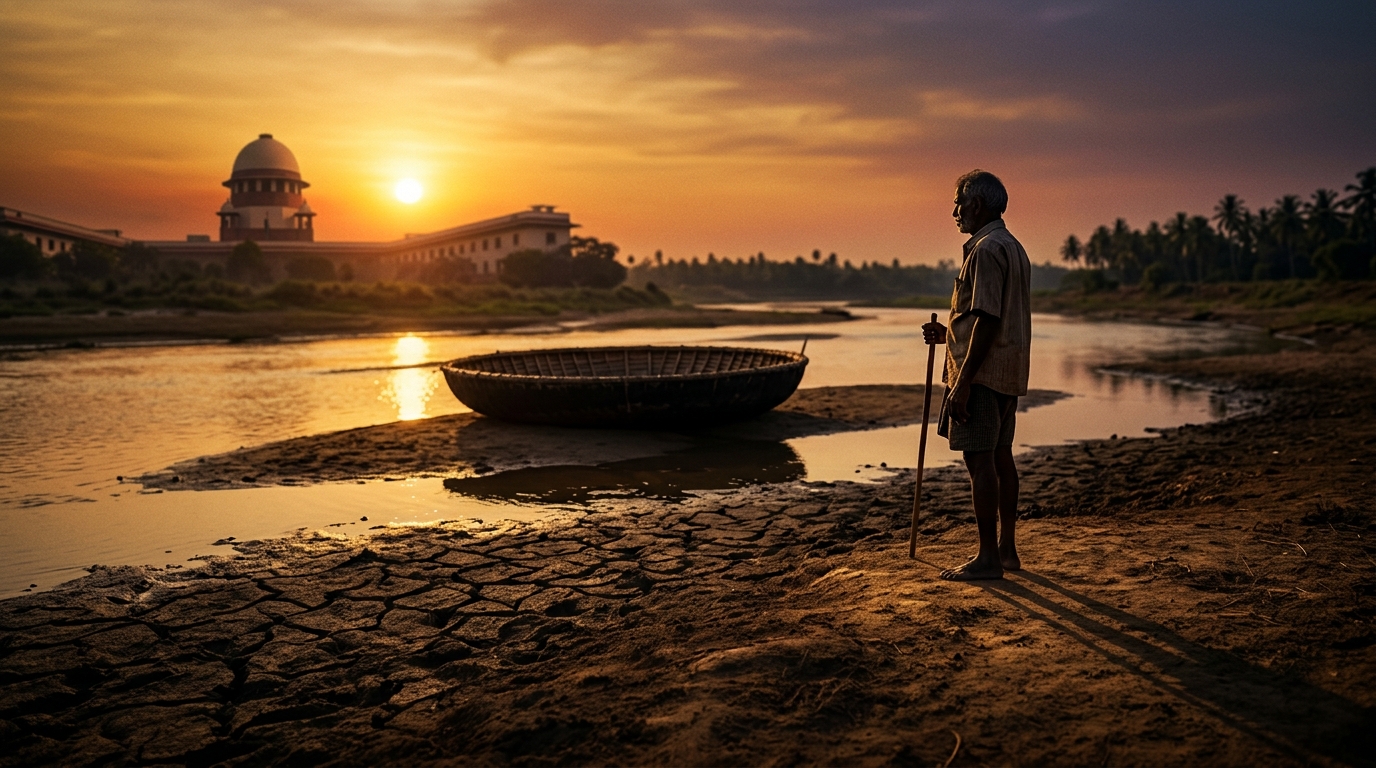
10 min readNew DelhiUpdated: Mar 31, 2026 11:46 AM ISTGiven that the majority of the Indian rivers pass through more than one state, this often leads to disputes between them over water-sharing. (File)Make us preferred source on GoogleWhatsapptwitterFacebookRedditPRINT— Abhinav Rai
Increasing water demand, driven by growing developmental needs, rapidly expanding urban population, environmental degradation, and spatial and seasonal variations, is putting pressure on existing water resources in India.
Since agriculture is the largest water-consuming sector, equitable sharing of river water has emerged as a complex and often emotive issue in states with large farming populations. Given that the majority of the Indian rivers pass through more than one state, this often leads to disputes over water-sharing, especially when an upstream state tries to obstruct or divert the flow by building dams or barrages.
For example, Chief Minister Bhagwant Mann recently asked the Rajasthan government to clear Rs 1.44 lakh crore in “unpaid” water usage since 1960, or stop drawing water from the Gang Canal in Punjab. He also called for a review of a British-era agreement on sharing water.
In another case, the Supreme Court on February 2, 2026, directed the Centre to set up a tribunal to adjudicate the long-pending dispute between Tamil Nadu and Karnataka over sharing the water of the Pennaiyar River. The two states have also been engaged in disputes over water-sharing of the Cauvery River.
Moreover, a 10-member Mahanadi Water Disputes Tribunal had a field assessment during its five-day visit (February 26-March 2). Odisha, which is located downstream of the Mahanadi, has locked horns over water sharing with Chhattisgarh, which is situated on the river’s upstream.
Also Read | How sex and gender distinction has evolved over time
Major inter-state river water sharing disputes
The Centre has thus far constituted nine tribunals under the Inter-State River Water Disputes (ISRWD) Act, 1956, to resolve inter-state disputes over river-water sharing. Two states have also sought the formation of new tribunals – Bihar in relation to the Barakar-Dhadhar sub-basins and Tamil Nadu in relation to the Pennaiyar basin. Story continues below this adName of Tribunal
States concerned
Date of constitutionKrishna Water
Disputes Tribunal (KWDT-I)
Maharashtra, Andhra Pradesh, Karnataka
April 1969Narmada Water
Disputes Tribunal (NWDT)
Rajasthan, Madhya Pradesh, Gujarat and Maharashtra
October 1969Godavari Water Disputes Tribunal (GWDT)
Maharashtra, Andhra Pradesh, Karnataka, Madhya Pradesh & Odisha
April 1969Ravi and Beas Waters Tribunal (RBWT)
Punjab, Haryana and Rajasthan
April 1986Krishna Water Disputes Tribunal (KWDT-II)
Karnataka, Andhra Pradesh and Maharashtra
April 2004Cauvery Water Disputes Tribunal (CWDT)
Kerala, Karnataka, Tamil Nadu and Puducherry
June 1990Vansadhara Water Disputes Tribunal (VWDT)
Andhra Pradesh & Odisha
February 2010Mahadayi Water Disputes Tribunal (MWDT)
Goa, Karnataka and Maharashtra
November 2010Mahanadi Water
Disputes Tribunal
Mahanadi, Odisha, and
Chhattisgarh
March 2018Source: Reply by Minister of state, Ministry of Jal Shakti, to a question in Lok Sabha dated 20.03.2025Story continues below this ad
Decisions of tribunals on Krishna, Godavari, Narmada, Cauvery, and Mahadayi have been published. While the tribunals on Ravi-Beas, Krishna (tribunal-II), and Vansadhara have given their decisions, they have not been published in official Gazettes yet.
The Mahanadi Water Dispute is still in the process of adjudication in a tribunal. As mentioned earlier, the Supreme Court has also directed the centre to constitute a tribunal for the water sharing dispute over the Pennaiyar River.
Must Read | How India’s economy deals with West Asia war
A case of the Cauvery River dispute
The Cauvery dispute is one of the most prominent examples of the complexity surrounding the inter-state river water sharing. The total watershed (land area surrounding a drainage basin, where precipitation collects and drains into a common outlet) of the Cauvery basin is 81,155 sq km, of which about 34,273 sq km lies in Karnataka, 2,866 sq km in Kerala and the remaining 44,016 sq km in Tamil Nadu and Pondicherry.
Disputes over the water of the Cauvery River go back to British India, when agreements were signed in 1892 and 1924 between the Princely State of Mysore and the Madras Presidency. The 1924 agreement, which was valid for 50 years and lapsed in 1974, governed water sharing among basin states – Tamil Nadu and Puducherry got 75 per cent of the surplus water, Karnataka 23 per cent, and Kerala the rest. Story continues below this ad
During the 1970s, Tamil Nadu demanded more water due to increased irrigation needs and approached the Centre in 1986. The Centre constituted the Cauvery Water Disputes Tribunal (CWDT) on June 2, 1990. The tribunal passed an interim order on June 25, 1991, and a final order in 2007, which was published in 2013. The matter also went to the Supreme Court, and after the final verdict, the tribunal was dissolved in 2018.
The Cauvery basin has an estimated 740 thousand million cubic feet (thousand million cubic) of water in a normal year. Following the CWDT’s final award and the February 2018 judgement by the Supreme Court, water allocation for states is as follows:
Karnataka – 284.75 tmc ft
Tamil Nadu – 404.25 tmc ft
Kerala – 30 tmc ft
Puducherry – 7 tmc ft
And the rest has been reserved for ecological sustenance and outflow into the sea.
These developments also draw attention to the legal framework governing inter-state water disputes in India. Story continues below this ad
Don't Miss | Art and Culture with Devdutt Pattanaik | How the British shaped India’s education system
Legal framework governing inter-state disputes
Article 246 of the Constitution provides a framework to distribute legislative powers between the states and the Centre through the Seventh Schedule, which includes the Union List, the State List and the Concurrent List.
Entry 17 of the State List deals with water – covering water supplies, irrigation and canals, drainage and embankments, water storage and water power – subject to the provisions of entry 56 of the Union list.
Entry 56 of the Union List provides that the regulation and development of inter-State rivers and river valleys is declared by Parliament by law. Article 262 further provides Parliament with powers related to the adjudication of inter-state river water disputes related to its use, control, distribution, etc.
In addition, under Article 262, Parliament has enacted the Inter-State River Water Disputes (ISRWD) Act, 1956, for the adjudication of disputes relating to waters of inter-state rivers and river valleys. The act has been amended four times, with the last amendment being in 2002. Story continues below this ad
Under Section 3 of the Act, in the case of river water dispute between two or more states, any state can approach the Centre. If the Centre is of the opinion that the given dispute cannot be settled by negotiations, it can constitute a Water Disputes Tribunal for the adjudication.
Must Read | Why adjusting water governance to climate change has become imperative
Water disputes tribunals: Structure, powers, challenges
The Tribunal consists of a Chairman and two other members, nominated by the Chief Justice of India from among persons who, at the time of such nomination, are judges of the Supreme Court or of a High Court. Furthermore, two or more persons can also be appointed as assessors to advise the Tribunal.
The tribunal’s decision after publication in the official Gazette by the Centre shall be final and binding to the parties, and any courts, including the Supreme Court, do not have any jurisdiction over it. The Centre may formulate a scheme for the implementation of the tribunal’s decision.
In 2019, the Centre brought the Inter-State River Water Disputes (Amendment) Bill, aimed at streamlining and expediting the dispute resolution process. It had provisions for the constitution of a single tribunal with different benches, along with the fixation of strict timelines for adjudication. However, after passing from the Lok Sabha, the bill was pending in the Rajya Sabha and lapsed with the dissolution of the 17th Lok Sabha in 2024.Story continues below this ad
While Article 262 of the Constitution says that the Supreme Court has no jurisdiction on the inter-state water disputes being dealt by tribunals, Article 131 gives the apex court mandate to adjudicate matters of inter-state as well as centre-state disputes.
Similarly, Article 136 (Special Leave Petition) empowers the Supreme Court to hear appeals against the verdict or awards given by all Tribunals and Commissions under its appellate jurisdiction except for the armed forces tribunals.
Rethinking water management
The Constitution provides states the right to ‘use’ the river water. However, the responsibility of regulating inter-state rivers lies with the Centre. Post-independence, state boundaries were redrawn based on linguistic considerations and not on the geographical realities and ecological dynamics.
Moreover, India’s per capita annual water availability was 5200 m3 in 1951, which reduced to 2309m3 in 1991 and 1902 m3 in 2001. At present, most parts of the country have water availability below 1700 m3, an international norm for ‘water-stressed’ regions. This emphasises the need for a framework to ensure equitable distribution of available water resources. Story continues below this ad
An integrated basin approach based on geographical realities that takes a holistic view of water-land-food would be a step in the right direction. An integrated approach based on the interdisciplinary knowledge base will also help understand the multifaceted, socio-economic and ecological role played by water resources for agriculture, urban development, navigation, ecosystems, and others.
The river interlinking projects usually took a narrow view of the river’s eco-hydrology by categorising it in ‘surplus’ and ‘deficit’ river basins. At a time when many countries are decommissioning dams and other such structures to restore natural hydrological flow regimes of the rivers, India needs to balance its developmental needs with ecological integrity and the health of its river systems.
Post read questions
How do geographical factors such as river basin distribution and upstream-downstream dynamics contribute to inter-state water disputes in India?
Examine how increasing water demand, environmental degradation, and climate variability are intensifying inter-state river water disputes in India.
Evaluate the role and performance of water disputes tribunals in India. Illustrate with examples.
Tribunal awards alone are insufficient to resolve inter-state water disputes. Illustrate using examples such as Cauvery, Mahanadi, or others.
Discuss the constitutional and legal framework governing inter-state river water disputes in India. How effective has it been in resolving conflicts?
(Abhinav Rai is a Doctoral candidate at the Department of Geography, Delhi School of Economics, University of Delhi.)
Share your thoughts and ideas on UPSC Special articles with [email protected].
Click Here to read the UPSC Essentials magazine for February 2026. Subscribe to our UPSC newsletter and stay updated with the news cues from the past week.
Stay updated with the latest UPSC articles by joining our Telegram channel – IndianExpress UPSC Hub, and follow us on Instagram and X.Expand © IE Online Media Services Pvt LtdTags:Current Affairsgovernment jobsSarkari NaukriUPSCUPSC Civil ServicesUPSC Civil Services ExamUPSC EssentialsUPSC Specials
Loading page, please wait…