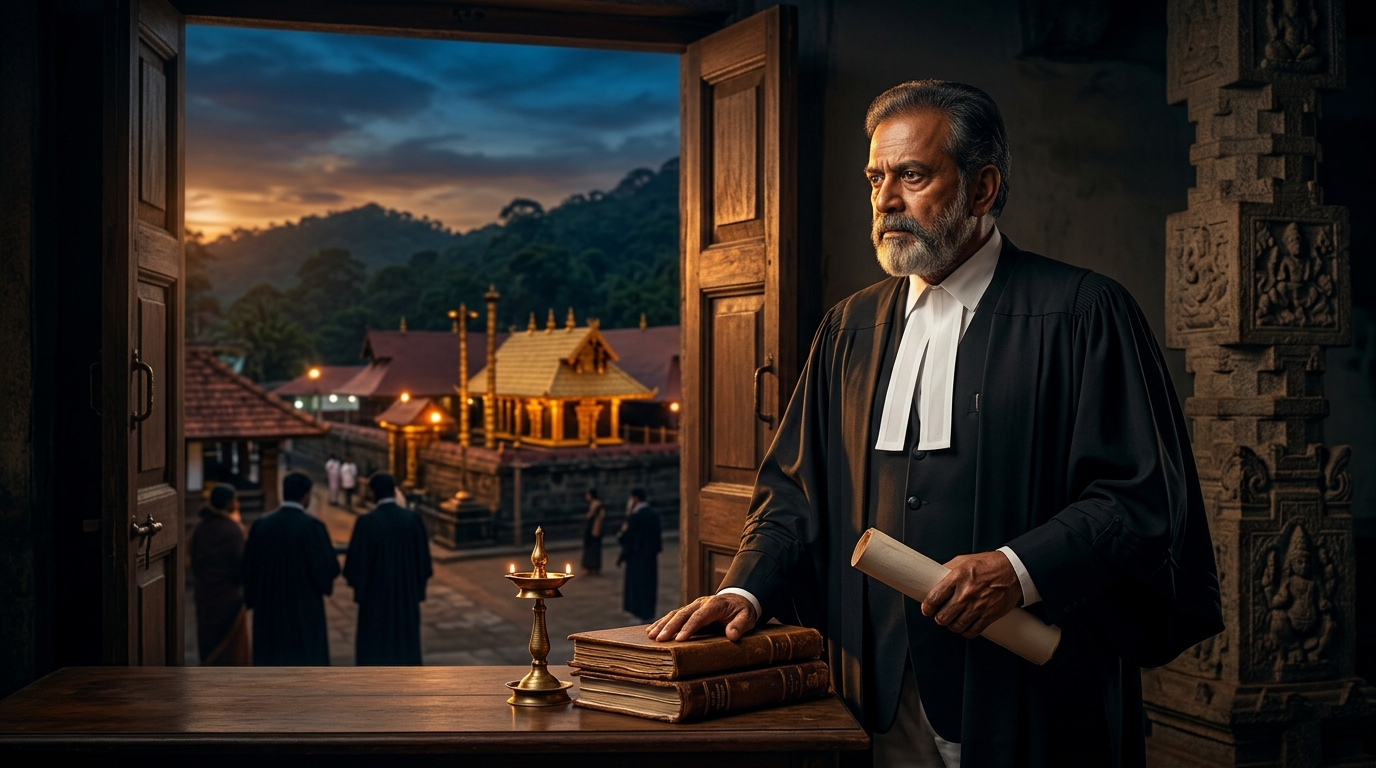
<p><strong>Senior Advocate <span class="key-term" data-definition="MR Venkatesh — Senior counsel appearing for Atman Trust before the Supreme Court, representing the view that menstrual restrictions are a religious discipline, not discrimination (GS2: Polity)">MR Venkatesh</span></strong> argued before the nine‑judge <span class="key-term" data-definition="Constitution Bench — A bench of the Supreme Court consisting of at least five judges to hear matters of constitutional importance (GS2: Polity)">Constitution Bench</span> that women voluntarily abstaining from temples during menstruation is a matter of belief and discipline, not gender bias.</p>
<h3>Key Developments</h3>
<ul>
<li>Venkatesh highlighted that across South India, women observe a self‑imposed restriction from entering temples and puja rooms during their monthly cycle, describing it as a “non‑written rule”.</li>
<li>He cited <span class="key-term" data-definition="B.R. Ambedkar — Chairman of the Drafting Committee of the Indian Constitution, who distinguished between untouchability and temporary ritual impurity (GS1: History, GS2: Polity)">Dr. B.R. Ambedkar</span>'s speeches to argue that the Constitution treats temporary defilement differently from the social evil of untouchability.</li>
<li>Reference was made to <span class="key-term" data-definition="Travancore‑Cochin Temple Entry Rules — Historical regulations governing temple entry, including Rule 6 that bars persons with birth‑ or death‑related pollution (GS2: Polity)">Rule 6 of the Travancore‑Cochin Temple Entry Rules</span>, emphasizing that such rules stem from a denomination’s right to manage its own affairs.</li>
<li>Venkatesh warned that a broad interpretation of <span class="key-term" data-definition="Article 25(2) — Constitutional provision permitting the State to regulate any particular religious practice or denomination for public order, health, morality, etc. (GS2: Polity)">Article 25(2)</span> could erode religious autonomy, turning non‑denominational temples into mere public spaces.</li>
<li>He distinguished between the right of entry under <span class="key-term" data-definition="Article 25(2)(b) — Clause allowing temples to be opened to all Hindus, ensuring non‑discriminatory access (GS2: Polity)">Article 25(2)(b)</span> and the management rights protected by <span class="key-term" data-definition="Article 26(b) — Clause safeguarding a religious denomination’s right to manage its own affairs without State interference (GS2: Polity)">Article 26(b)</span>, using the Supreme Court’s own functioning as an analogy.</li>
<li>He argued that “section of Hindus” in <span class="key-term" data-definition="Article 25(2)(b) — (see above) (GS2: Polity)">Article 25(2)(b)</span> should be read broadly to include all pilgrims, noting that caste distinctions dissolve during the Sabarimala yatra.</li>
<li>The concept of <span class="key-term" data-definition="Sampradaya — A religious lineage or tradition that forms a juridical pers