Overview
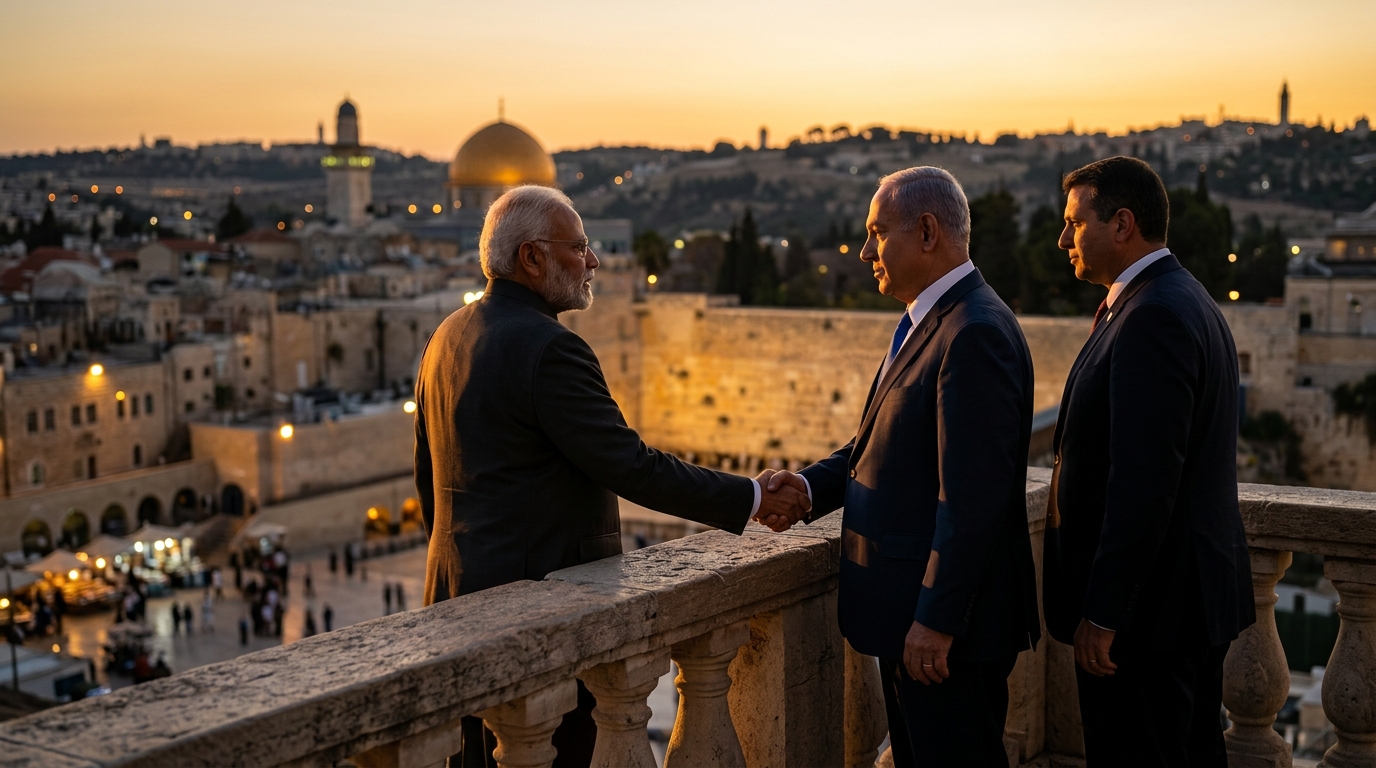
On a 24‑hour trip to Narendra Modi, India upgraded its bilateral ties with Israel to a Special Strategic Partnership. The visit, however, drew criticism for its limited reference to the Palestinian issue, raising questions about India’s traditional balancing act in West Asia.
Key Developments
- Special Strategic Partnership signed, encompassing over 15 MoUs in AI, agriculture, culture and education.
- Agreement to facilitate employment of 50,000 Indian workers in Israel over the next five years.
- Joint declaration to strengthen the I2U2 framework and launch the India‑Middle East‑Europe Economic Corridor (IMEC).
- In his Knesset address, Benjamin Netanyahu praised the deepening India‑Israel relationship, a tone stronger than during the 2017 visit.
- Modi’s speech referenced the U.S.-led Gaza Peace Initiative and the two‑state solution, but omitted explicit condemnation of the high civilian toll in Gaza.
Important Facts
The visit came at a time when Israel faces international censure over its West Bank settlement plans and the humanitarian crisis in Gaza, with more than 72,000 deaths reported from Israeli strikes. The timing also coincided with heightened U.S.–Iran tensions, raising the risk of India being perceived as taking sides.
Israel is heading toward national elections later in 2024, which many view as a referendum on Netanyahu’s governance, corruption allegations, and security record. India’s engagement is likely to be viewed through the lens of these domestic dynamics.
Exam Relevance
For GS 2 (Polity) and GS 3 (Economy), the upgrade to a Special Strategic Partnership illustrates how India leverages strategic diplomacy to secure technology transfer, trade, and labour mobility. The I2U2 and IMEC initiatives are case studies of multilateral economic corridors that can be examined under “regional cooperation” and “connectivity” themes. The nuanced stance on the Israel‑Palestine conflict touches upon GS 4 (Ethics) and GS 2 (International Relations), highlighting the challenge of balancing moral considerations with strategic interests.
Way Forward
- India should articulate a clearer position on the two‑state solution to maintain its credibility as a neutral player in the Middle‑East peace process.
- Monitoring the implementation of the 15+ MoUs will be crucial to assess tangible benefits in AI, agriculture and education.
- Engagement with other West Asian nations (UAE, Saudi Arabia, Qatar) must continue to preserve the long‑standing “calibrated regional balance” that underpins India’s energy security and diaspora interests.
- Parliamentary oversight of the labour‑migration agreement can ensure protection of Indian workers abroad.
Overall, the Jerusalem visit underscores India’s intent to deepen strategic ties with Israel while navigating the delicate geopolitics of West Asia.