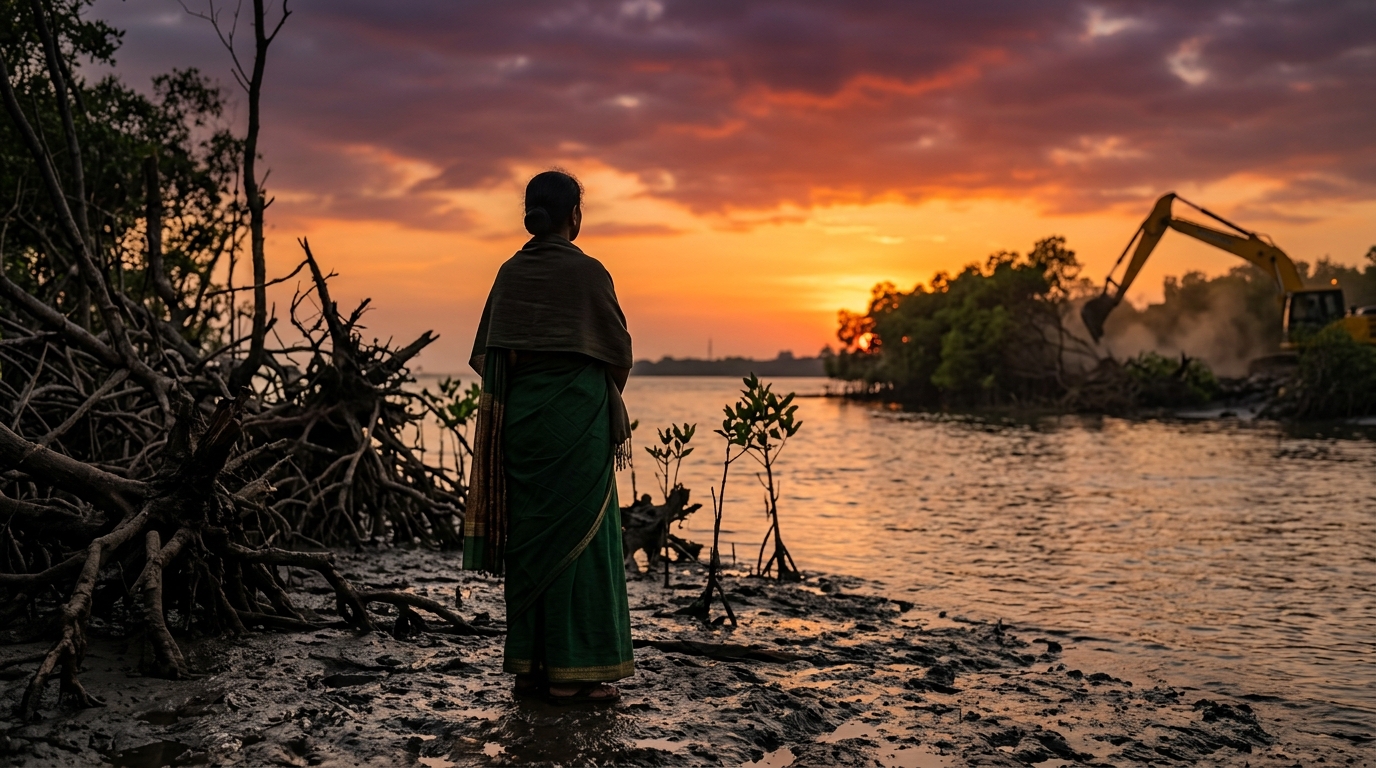
The Supreme Court declined to interfere with a Bombay High Court's permission to the BMC to fell more than 45,000 mangrove trees for the proposed Versova‑Bhayandar coastal road.
Key Developments
- On 12 December 2025, the High Court allowed the removal of 45,675 mangrove trees covering 103.65 hectares, subject to a ten‑year reporting condition.
- The Supreme Court bench (CJI Surya Kant, Justices Joymalya Bagchi and Vipul Pancholi) heard a petition by the environmental NGO Vanashakti and refused to stay the order.
- The Court emphasized the "significant and beneficial impact" of de‑congesting the western highway and noted that the High Court had imposed safeguards.
- The BMC committed to compensatory afforestation in Chandrapur district equal to the area of mangroves removed.
- Annual status reports on restoration and afforestation must be filed with the High Court for the next ten years.
Important Facts
- Mangroves to be relocated: 36,675 trees.
- Mangroves to be permanently removed: 9,000 trees (directly in the road alignment).
- Carbon sequestration value: Mangroves absorb CO₂ more than five times that of typical forests, aiding climate mitigation.
- Legal arguments: Petitioners cited satellite images from October 2025 showing prior afforestation; the Solicitor General Tushar Mehta defended the project, citing reduced travel time and lower emissions.
- Procedural note: Justice Bagchi directed that any challenge to the number of trees must be made at the Environmental Clearance (Stage 1) stage.
Exam Relevance
This case touches upon several GS topics: the role of the judiciary in balancing development and environmental protection (GS2), urban infrastructure planning and its climate impact (GS3), and the legal mechanisms for forest conservation such as compensatory afforestation and Environmental Clearance. Understanding the procedural safeguards and the weight given to expert assessments helps answer questions on sustainable development and environmental jurisprudence.
Way Forward
- Strict monitoring of the BMC’s annual reports to ensure actual restoration matches the pledged area.
- Encourage use of alternative alignments or engineering solutions that could further reduce mangrove loss.
- Strengthen the role of independent environmental experts in the EC process to pre‑empt litigation.
- Promote community‑based monitoring of mangrove health, linking local livelihoods with conservation outcomes.